What Solar Panels Cost in Saugerties, New York
Two houses on the same Saugerties street can land far apart on price, and almost none of the gap is the panels. It is the roof, the service, the trench and the utility on your bill.
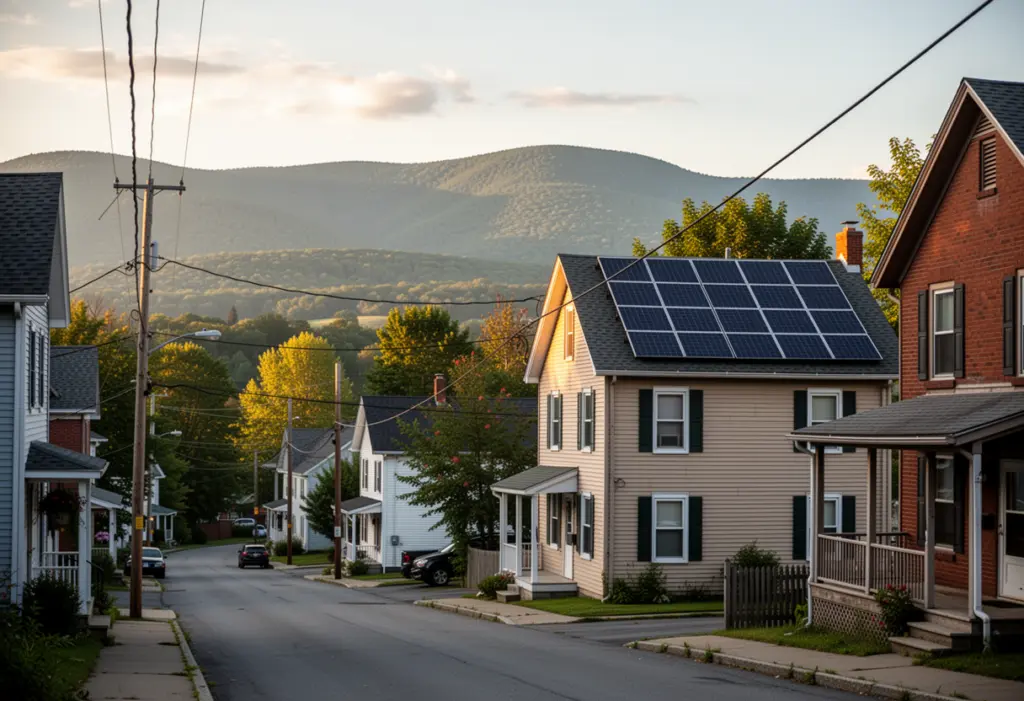
The honest starting answer about solar cost in Saugerties is that two houses on the same street can land far apart, and almost none of the gap is the modules. Panels are a commodity. What varies is the roof, the electrical service, the distance from the array back to the meter, and which utility is printed on the bill.
Where Saugerties addresses sit
Most of the town is Central Hudson territory. The village and much of the surrounding town carry the 12477 ZIP code, with Glasco at 12432 and Mount Marion at 12456. Central Hudson customers pay a residential Customer Benefit Contribution of $1.67 per kW-month of DC size for 2026, so an 11 kW system is charged 11 × $1.67 = $18.37 a month, roughly $220 over a year, regardless of what it generates. It is levied on systems interconnected on or after 1 January 2022 and on no earlier ones.
That charge is why an oversized array is a poorer deal here than in most of the state. Building credits you never consume costs you the capital and then bills you monthly for the capacity anyway. Size to consumption; and if a heat pump or an electric vehicle is coming, size to that load rather than to a round number someone likes the sound of.
Site conditions that show up in a Saugerties quote
- The Catskill front to the west. Parcels on the western side of town lose late-afternoon sun to rising ground well before sunset. That belongs in the production model, so ask whether the model used on-site measurement or satellite imagery.
- Esopus Creek and the low ground beside it. A ground mount on a parcel that takes water is an engineering question before it is a price question. Ask how the array is anchored, how the trench is routed, and what happens to the conduit when the water comes up.
- Trench distance. Ground mounts are priced partly by the run back to the service. An array beside the barn, a couple of hundred feet out, costs more than the same array beside the house, and that difference is usually larger than the gap between two panel brands.
- Village housing stock. Nineteenth century houses near the centre often still carry 100 amp service and older roof framing. A structural letter and a service upgrade are both ordinary here, and both belong in the proposal in writing.
Permits: village or town
A Village of Saugerties address is permitted by the village; the rest of the town is permitted by the Town of Saugerties. Ask which office applies to yours, whether the New York State Unified Solar Permit is used there for systems of 25 kW DC and under, and how long the queue runs at the moment. Permitting time is not a cost line by itself, but it decides when the array starts offsetting your bill.
What comes off the price in 2026
Nothing federal, for a homeowner buying a system outright. Section 25D ended for expenditures made after 31 December 2025, with the expenditure treated as made when the original installation is completed, so a purchase this year earns no federal credit — no phase-down, and no carryover of something that was never earned. The business-side credit survives for the company that owns a leased or PPA system, which is why third-party offers can still price in an incentive that never appears on your own return.
What remains is the state side. The IT-255 credit pays 25% of qualifying cost up to a ceiling of five thousand dollars at your principal residence. The sales tax exemption covers residential equipment. RPTL 487 exempts the added assessed value for fifteen years where the village or town, Ulster County and your school district have each declined to opt out, and it applies only where the system is constructed before 1 January 2030. NY-Sun and its income-qualified Affordable Solar incentive, both applied by the contractor, are not on that list: as of September 2026 NYSERDA has no open NY-Sun block for homes in any utility territory, the Affordable Solar blocks included; check NYSERDA’s NY-Sun dashboard for a new one.
Every one of these moves over time. Check on the day you sign whether NYSERDA has opened a new NY-Sun block for homes, ask the assessor about the opt-out position rather than trusting what a neighbour was told, and read the utility name on your own bill.
Frequently Asked Questions
What determines what solar costs in Saugerties?
Roof condition and covering, the electrical service, shading from the Catskill front to the west, and for a ground mount the trench distance back to the meter. The modules themselves are close to a commodity and rarely explain a gap between two quotes.
Is Saugerties in Central Hudson territory?
Most of the town is served by Central Hudson, whose 2026 residential capacity charge is $1.67 per kW-month of DC size. Boundaries in the Hudson Valley do not follow town lines cleanly, so confirm the utility name printed on your own bill.
Is a ground mount more expensive than a roof array?
Usually, because racking, foundations and a trench back to the service replace roof mounting. Against that it avoids the reroofing sequence and lets the array face the sun rather than whichever way the house happens to point.
Does a bigger system always save more money?
No. The Customer Benefit Contribution is charged on DC size regardless of output, so an 11 kW array on Central Hudson pays $18.37 a month whether the credits are used or not. Size to consumption, including any heat pump or EV you plan to add.
This article is general information, not tax, legal or financial advice. Incentive amounts, eligibility rules and deadlines change and depend on your utility, your tax situation and your property. Confirm current terms with NYSERDA, your utility and a qualified tax professional before making a decision.
NY Solar Incentives
Independent New York solar research. We summarise NYSERDA, NY-Sun and federal programme rules from published sources and state plainly when a figure is an estimate. We are not a government agency and do not sell equipment.
Run the arithmetic on your own system
Check the dated program table and your arrangement before counting an incentive. Standard residential NY-Sun blocks are closed; Long Island Affordable Solar has a conditional income-verification route. The NY credit depends on qualified costs and tax liability, while the NYC abatement reduces future property-tax bills. The estimator keeps those timings separate.