Solar Panel Cost in Hyde Park, NY
In Hyde Park the roof covering is usually the biggest single cost variable, and the utility charge underneath it is the highest in New York.
On this page 8 sections
- 01The roof covering is the biggest single cost variable
- 02100 amp service, and the line item that follows
- 03Historic character
- 04Trees and the river slope
- 05Central Hudson charges the most in New York
- 06What the state credit does and does not cover
- 072026: the exemption that scales with an expensive installation
- 08Frequently Asked Questions
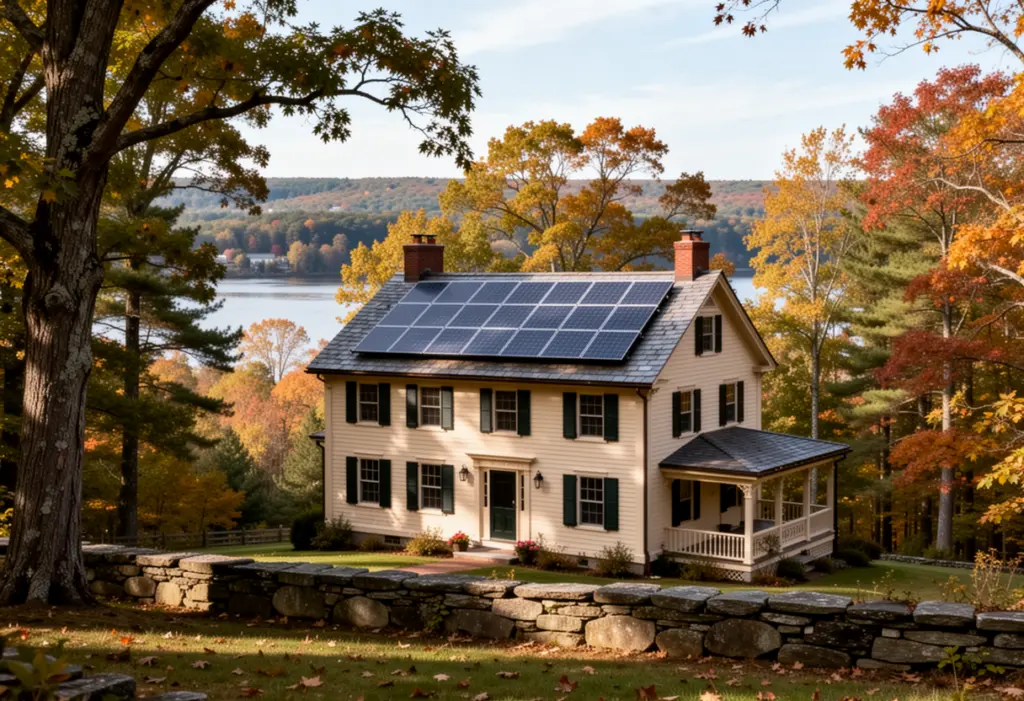
Hyde Park is a town on the east bank of the Hudson in Dutchess County, taking in the hamlets of Hyde Park, Staatsburg and East Park. ZIP codes 12538 and 12580. There are no incorporated villages, so the Town of Hyde Park issues permits across it — one authority rather than the two or three that complicate neighbouring places. What is not simple here is the housing.
The roof covering is the biggest single cost variable
Hyde Park has a lot of genuinely old housing, and what is on the roof changes the price of an installation more than almost anything else on the quote.
- Standing-seam metal is the best case. Racking clamps to the seams with no penetrations at all, the work is quick, and the roof commonly outlasts the panels.
- Slate is the expensive case. It needs a mounting approach not every installer is equipped for, and the labour is slower and more skilled. Ask what they have done on slate specifically and for photographs of it, and be sceptical of a quote that prices slate as though it were asphalt.
- Asphalt with under roughly ten years of life left means re-roof first. Removing and reinstalling an array later costs considerably more than mounting on a bare roof, so this is an avoidable cost rather than a hidden one.
Older framing also draws a structural engineer’s letter more often than modern engineered trusses. Budget it rather than discovering it after contract.
100 amp service, and the line item that follows
Find out what your service is rated at before you read another number. A 100 amp board is normal in housing of this age, and where the busbar is already full, adding a solar breaker means an upgrade or a line-side tap. It is a legitimate cost rather than padding, but it should be visible before you sign, and where two quotes for the same system differ substantially this is one of the first places to look.
Historic character
The Route 9 corridor and the older river-side properties carry significant historic character. Where a property is individually listed or sits in a designated district, review may apply as a step ahead of the building permit — establish whether yours is affected before signing rather than after.
Where it applies, design for approval: a rear or secondary roof plane not visible from the public way, all-black modules with black frames, flush mounting following the roof plane, and concealed conduit. Ask when the reviewing board meets, because a monthly cycle turns a missed deadline into four weeks.
Trees and the river slope
Mature canopy is the norm on the older properties here, and the ground falls away toward the river on the western side of the town. Both raise the horizon and cut the low winter sun, and December is when it costs the most, because that is when the net metering credit bank is being drawn down.
Have the shading measured on the property rather than from imagery, and ask for December and January to be reported separately from the annual total. If tree removal is proposed, treat it as your decision and price it separately rather than letting it sit as an assumption inside a production figure.
Central Hudson charges the most in New York
One line on the electricity bill outlives the installation itself. Anything interconnected on or after 1 January 2022 pays a Customer Benefit Contribution each month, scaled to the DC size of the array, and of the seven utilities NYSERDA publishes rates for, Central Hudson charges the most — $1.67 a kilowatt in 2026:
- A 7.5 kW system: $12.53 a month, about $150 a year.
- A 10.5 kW system: $17.54 a month, about $210 a year.
It is charged on capacity regardless of production, which is a direct argument against an oversized array — the extra kilowatts bill every month whether they are needed or not. The rate is recalculated annually rather than fixed at interconnection, so nobody can honestly quote you a 20-year total for it, and since territory boundaries in the valley do not follow municipal lines, the utility name on your own bill is the one to work from.
Exports run under Phase One net metering, credited at the full retail rate, with that structure held for 20 years from interconnection — the arrangement most residential rooftop customers here are on.
What the state credit does and does not cover
New York’s credit is 25% of qualified expenditure capped at $5,000, claimed on Form IT-255 for a principal residence in New York. Two limits decide what you actually receive:
- The $5,000 cap binds on a large system, so on an expensive slate installation the credit covers a smaller share of the total than a proposal quoting 25% might suggest.
- It is limited by your actual New York State tax liability. It is not refundable, but unused credit carries forward up to five years. Check your own position with an accountant before a proposal is built around the headline figure.
Long third-party arrangements count towards it too: ten years or more on either a lease or a power purchase agreement, with the same floor applying to both.
2026: the exemption that scales with an expensive installation
The 30% federal residential credit is gone. The termination bites on expenditures made after 31 December 2025, and section 25D dates an expenditure to the day the original installation was completed. A 2026 proposal still carrying a federal line is materially wrong, and on an expensive roof that error is a large absolute number.
With the credit capped and the federal line at zero, the incentive that still grows with the size of the bill is the sales tax exemption. New York exempts residential solar energy system equipment from state sales tax, and localities may separately elect to exempt their local share, so the total relief differs by county and city — which means the right question is not whether the exemption exists but how much of it applies at your address, and whether the quote in front of you adds any sales tax to the job at all. On an expensive slate installation that difference is worth asking about in dollars rather than in principle.
Two other things carry unusual weight on an expensive job here. The five-year carryforward on the state credit matters more when the credit is at its $5,000 ceiling and your annual liability is smaller than that, because the balance is not lost. And RPTL 487, the 15-year exemption on the added assessed value, is worth more where the system adds more value — available where the Town of Hyde Park, Dutchess County and your school district have each separately not opted out, for systems constructed before 1 January 2030.
No longer there: NY-Sun, once applied by your contractor as a price reduction, and its Affordable Solar incentive. NYSERDA’s last standard Upstate residential block for Central Hudson and Orange & Rockland customers (Block 13, $0.15/W) closed on 4 August 2025; the last for NYSEG, RG&E and National Grid customers (Block 14, $0.15/W) closed on 17 December 2025 and the Upstate Affordable Solar block on 9 March 2026, and as of September 2026 NYSERDA has no open NY-Sun block for homes in any utility territory; check NYSERDA’s NY-Sun dashboard for a new one. And where the roof is slate, shaded or simply not worth the money, community solar needs no roof and no up-front cost, and its subscribers pay no Customer Benefit Contribution at all. Programmes are revised, so verify the current position with NYSERDA before committing.
Frequently Asked Questions
Does a slate roof make solar more expensive in Hyde Park?
Yes. Slate needs a mounting approach not every installer is equipped for and the labour is slower and more skilled. Ask what they have done on slate specifically and for photographs, and be sceptical of a quote that prices it like asphalt.
Who issues my solar permit in Hyde Park?
The Town of Hyde Park, across the whole town including Staatsburg and East Park. There are no incorporated villages here, so there is no second authority layered on top as there is in several neighbouring places.
How much is the monthly utility charge on a Hyde Park system?
Central Hudson's Customer Benefit Contribution for 2026 is $1.67 per kW-month of DC size, the highest in New York — about $150 a year on a 7.5 kW system and $210 on 10.5 kW, billed on capacity regardless of production.
Will the state credit cover 25% of an expensive installation?
Not on a large one. It is 25% of qualified expenditure but capped at $5,000, so on an expensive roof the cap binds and the credit covers a smaller share. It is also limited by your actual New York State tax liability, though unused credit carries forward up to five years.
This article is general information, not tax, legal or financial advice. Incentive amounts, eligibility rules and deadlines change and depend on your utility, your tax situation and your property. Confirm current terms with NYSERDA, your utility and a qualified tax professional before making a decision.
NY Solar Incentives
Independent New York solar research. We summarise NYSERDA, NY-Sun and federal programme rules from published sources and state plainly when a figure is an estimate. We are not a government agency and do not sell equipment.
Run the arithmetic on your own system
Check the dated program table and your arrangement before counting an incentive. Standard residential NY-Sun blocks are closed; Long Island Affordable Solar has a conditional income-verification route. The NY credit depends on qualified costs and tax liability, while the NYC abatement reduces future property-tax bills. The estimator keeps those timings separate.