Solar Incentives in Newburgh, NY: What Is Left in 2026
In Newburgh the income-eligible NY-Sun adder is closed to homes for now, and in a two-family house the meter decides who the system is actually for.
On this page 7 sections
- 01Affordable Solar and NY-Sun: closed to homes for now
- 02Why the state credit may be worth less than the headline
- 03The meter question in a two-family house
- 04Very old housing: three checks before any incentive matters
- 05City or town, and the utility on your bill
- 06The one that is gone
- 07Frequently Asked Questions
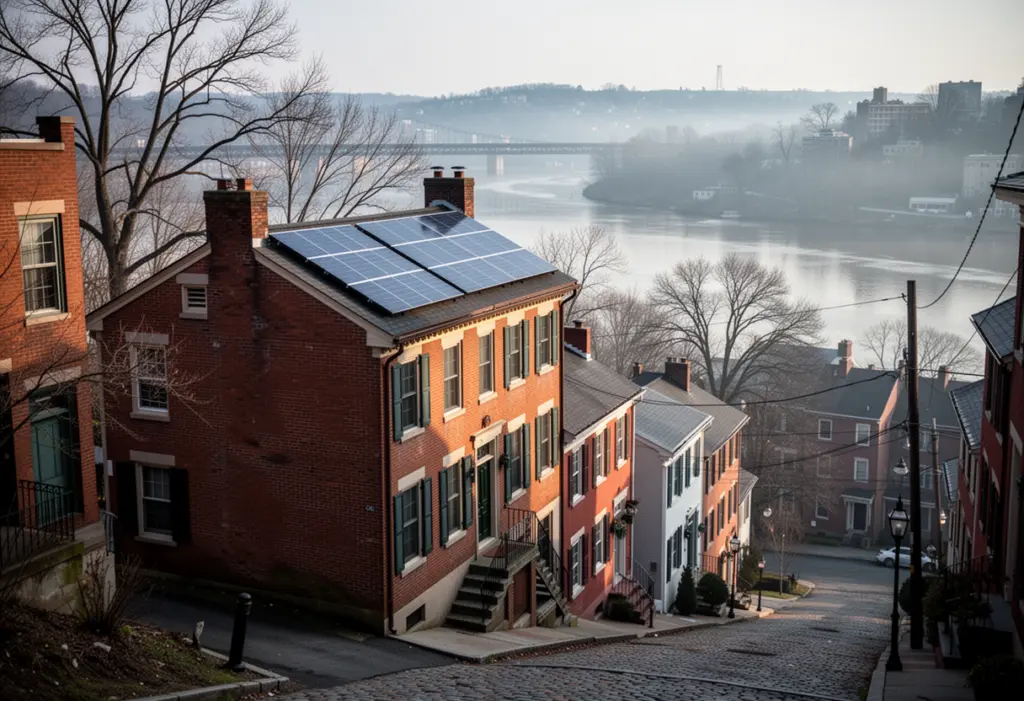
Newburgh is a city in Orange County on the west bank of the Hudson, with a separate Town of Newburgh around it. ZIP code 12550. Its older neighbourhoods carry a great deal of nineteenth-century housing, and the per-watt incentive an older proposal may open with is not available to homes at present.
Affordable Solar and NY-Sun: closed to homes for now
NYSERDA’s Affordable Solar incentive increased the NY-Sun incentive for households at or below 80% of area median income. It was applied by the contractor as a reduction in the price rather than claimed on a tax form months later, so it lowered what had to be financed on the day the work was done. As of September 2026 NYSERDA has no open NY-Sun block for homes in any utility territory, standard or Affordable Solar; check NYSERDA’s NY-Sun dashboard for a new one. Until one opens, ask any installer whose proposal still shows an Affordable Solar or NY-Sun deduction to name the open block it relies on, in writing.
NY-Sun itself is structured as megawatt blocks whose per-watt value steps down as each region’s capacity fills, so if NYSERDA opens a new residential block, ask what it is worth at your address on the day you are quoted rather than accepting a number carried over from an older proposal. NYSERDA also runs financing through Energy Finance Solutions, including an On-Bill Recovery Loan repaid through the utility bill and a Smart Energy Loan, both worth pricing against whatever finance the contractor offers instead of assuming they are equivalent.
Why the state credit may be worth less than the headline
New York’s 25% credit capped at $5,000 on Form IT-255 is real and still live, but two conditions weigh more here than elsewhere. It requires your principal residence in New York State, so a rental property you own does not qualify. And it is limited by your actual New York State tax liability, which on a modest income means the full amount may not be usable in the year of installation. It is not refundable, though unused credit carries forward for up to five years, so the balance is deferred rather than lost. Check your own position with an accountant before a proposal is built around the whole $5,000. The credit does reach leases and power purchase agreements, but only where the agreement runs ten years or more, and that minimum applies to the lease as much as to the PPA.
The meter question in a two-family house
Newburgh has a substantial rented and two-family stock, and there the meter decides everything. An array offsets only the meter it is wired behind: connected to the owner’s meter it offsets hallway lighting, the boiler and the common areas, not the tenant’s apartment, even where the panels sit directly above it. Before a design is drawn, establish how many meters the building has, which one the array will serve, and whose bill that meter is. If the answer does not match who you are trying to help, the system is solving a different problem from the one you meant. For tenants, and for owners whose tenants hold the meters, community solar reaches the person actually paying: no roof, no up-front cost, and no Customer Benefit Contribution, because those projects sit in front of the meter.
Very old housing: three checks before any incentive matters
How much life is left in the roof? Ten years of remaining shingle life is the usual threshold, and below it the roof comes first, because an array that has to be lifted and reset is labour billed twice. What is the roof framed in, and who says it will carry the load? Nineteenth-century wood frame draws a structural engineer’s letter far more often than newer construction, and that is a budget line rather than a surprise. And what is the electrical service? 100 amp panels are common in housing of this age, so ask whether the busbar has room and get the answer into the quote. Much of the East End carries substantial historic character, and where architectural review applies it comes ahead of the building permit — design for approval with a rear or secondary roof plane out of view from the public way, all-black modules in black frames, flush mounting and concealed conduit, and ask when the board sits, because boards frequently meet monthly.
City or town, and the utility on your bill
The City of Newburgh and the Town of Newburgh are separate authorities with separate building departments, and they are separate for RPTL 487 too. Inside the city you check the city, Orange County and the Newburgh Enlarged City School District; there is no village layer inside a city. The exemption runs fifteen years on the added value and requires construction before 1 January 2030.
Orange County is split between two utilities, and the Customer Benefit Contribution — a monthly charge on DC system size for anyone interconnecting on or after 1 January 2022 — differs sharply between them. Central Hudson’s 2026 residential rate is $1.67 per kW-month, the highest in New York, and Orange & Rockland’s is $1.00. A 4 kW system costs $6.68 a month on Central Hudson against $4.00 on Orange & Rockland, about $80 a year against $48. An 8 kW system costs $13.36 against $8.00, roughly $160 against $96. Read the name off your own bill and check that the proposal used it. The charge is billed on capacity regardless of production and recalculated annually. Phase One net metering credits exports at the full retail rate and holds for twenty years from interconnection.
The one that is gone
Section 25D, the 30% federal residential credit, was terminated for expenditures made after 31 December 2025, and the statute treats an expenditure as made when the original installation is completed rather than when the system is switched on. A homeowner buying in 2026 therefore claims nothing federally, and a proposal carrying a 30% federal line is describing a rule that has expired. What survives is the business-side credit belonging to whoever owns a leased or PPA system, which is why third-party offers can still be priced around an incentive you never see. Everything above can change, so check where each programme stands before you sign.
Frequently Asked Questions
What is the first incentive to ask about in Newburgh?
The New York State credit, and how much of it your own tax bill can absorb: it is 25% of qualified expenditure capped at $5,000 on Form IT-255, not refundable, with unused credit carrying forward for up to five years. Affordable Solar, the NYSERDA incentive for households at or below 80% of area median income, is not available at present. As of September 2026 NYSERDA has no open NY-Sun block for homes in any utility territory; check NYSERDA’s NY-Sun dashboard for a new one.
Can I claim the state credit on a rental property I own in Newburgh?
No. Form IT-255 requires the equipment to be installed and used at your principal residence in New York State. A rental, a second home or a seasonal property does not qualify, and the credit is limited by your actual state tax liability, though unused credit carries forward for up to five years.
Who does solar help in a two-family house?
Whoever holds the meter the array is connected behind. An owner-side system offsets hallways, boiler and common areas rather than a tenant's apartment. Establish how many meters the building has and which one the array will serve before any design is drawn.
What is the monthly utility charge on a Newburgh system?
It depends which utility serves you. The 2026 Customer Benefit Contribution is $1.67 per kW-month on Central Hudson and $1.00 on Orange and Rockland, so an 8 kW system costs about $160 a year on one and $96 on the other. Confirm from your own bill.
This article is general information, not tax, legal or financial advice. Incentive amounts, eligibility rules and deadlines change and depend on your utility, your tax situation and your property. Confirm current terms with NYSERDA, your utility and a qualified tax professional before making a decision.
NY Solar Incentives
Independent New York solar research. We summarise NYSERDA, NY-Sun and federal programme rules from published sources and state plainly when a figure is an estimate. We are not a government agency and do not sell equipment.
Run the arithmetic on your own system
Check the dated program table and your arrangement before counting an incentive. Standard residential NY-Sun blocks are closed; Long Island Affordable Solar has a conditional income-verification route. The NY credit depends on qualified costs and tax liability, while the NYC abatement reduces future property-tax bills. The estimator keeps those timings separate.