NYSEG Solar Rebate: What Actually Exists in 2026
In NYSEG territory the reduction arrives through your contractor and the credit arrives on your tax return. Nothing arrives from the utility.
On this page 8 sections
- 01Where the reduction actually comes from
- 02The one you claim yourself
- 03The line that should not be on a 2026 quote
- 04What NYSEG does charge you
- 05If your bill does not say NYSEG
- 06Questions that make a rebate claim checkable
- 07What is live in 2026, and how to check it yourself
- 08Frequently Asked Questions
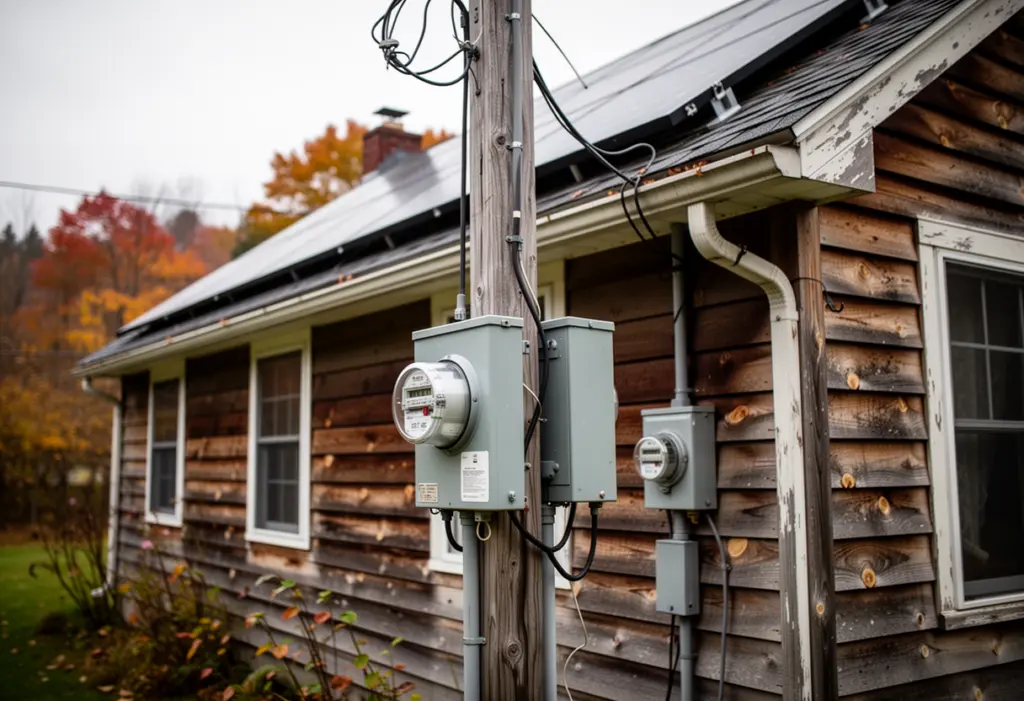
The short answer is that there is no cheque. In NYSEG territory the money that reduces a solar price comes from a New York State tax credit you file yourself; the state programme a contractor applies before you ever see a number, NY-Sun, has no open block for homes as of September 2026. If a proposal carries a line called a NYSEG rebate, ask for the programme name and the body that administers it in writing. That single question separates a real incentive from a sales line.
Where the reduction actually comes from
NY-Sun is the state programme, administered by NYSERDA and paid through your installer as a reduction on the contract price when a block is open. You do not apply for it and you never handle the money. Its size depends on system size and on your region, and it is structured in megawatt blocks: each region holds capacity blocks, and the per-watt amount steps down as each block fills. It is designed to shrink as the market matures, and it has. As of September 2026 NYSERDA has no open NY-Sun block for homes in any utility territory; check NYSERDA’s NY-Sun dashboard for a new one. A figure a neighbour quoted last year is not a figure you can rely on now.
Ask for two numbers rather than one. The contract price before any incentive, and the incentive as its own line. A quote that shows only the net figure hides whether the reduction reached you or was absorbed into the price ahead of it.
The Affordable Solar incentive, for households below 80% of area median income, is closed as well: its Upstate track, which covers NYSEG territory, ran from 18 December 2025 to 9 March 2026. It was contractor-applied too, which in practice meant the customer had to raise it, so if a new block opens, ask directly whether your household was screened for it and get the answer on paper.
The one you claim yourself
New York’s solar energy system equipment credit is 25% of qualified expenditures, capped at $5,000, claimed on Form IT-255. The cap is the part worth doing arithmetic on: 25% of $20,000 is exactly $5,000, so every dollar of system price above roughly that point earns nothing further from this credit. It is not refundable, unused amounts carry forward for up to five years, and it is limited by your actual New York State tax liability in the first place.
It requires the equipment to be installed and used at your principal residence in New York. A camp on a Finger Lake, a second home or a rental property does not qualify. It does reach leases and power purchase agreements, but only where the agreement runs ten years or more — and that ten-year minimum applies to the lease as well as the PPA. A seven-year lease does not qualify however it is described to you.
The line that should not be on a 2026 quote
The 30% federal residential credit is gone. Section 25D was terminated for expenditures made after 31 December 2025, and an expenditure is treated as made when the original installation is completed rather than when the system is placed in service. A 2026 buyer claims nothing federally: no phase-down, no transition, no carryover of a credit never earned. A proposal still showing a 30% federal line is materially wrong, and every number downstream of it is wrong with it.
Two wrinkles are worth carrying. For new construction the test moves — an expenditure connected with constructing a structure is treated as made when your original use of that structure begins, so panels fitted in December 2025 on a house first occupied in 2026 do not qualify. And business and farm projects sit under a different provision entirely, which is a question for your accountant rather than for a residential sales sheet.
What NYSEG does charge you
The Customer Benefit Contribution is billed on the DC size of your array rather than on what it produces. NYSEG’s 2026 residential rate is $1.19 per kW-month. A 7.4 kW system therefore pays 7.4 x $1.19, which is $8.81 a month or about $106 a year, in a January when the array makes almost nothing exactly as in a bright June. It applies to systems interconnected on or after 1 January 2022, and the rates are recalculated annually rather than locked in at interconnection.
One oddity, if you also run a small business on a separate account: NYSEG’s 2026 small commercial rate of $1.14 sits below its residential rate of $1.19. NYSEG is one of only three New York utilities where the small commercial figure is the lower of the two.
If your bill does not say NYSEG
Several villages in and around NYSEG country run their own electric utilities — Bath in Steuben County, Groton in Tompkins, Marathon in Cortland, Watkins Glen in Schuyler, Penn Yan in Yates, Sherburne and Greene in Chenango, Wellsville in Allegany. A municipal electric customer sits outside Public Service Commission jurisdiction altogether: no PSC net metering, no Customer Benefit Contribution, no state interconnection process. Terms are set by that utility and have to be asked for directly. Check the utility name printed on your own bill before assuming any of this reaches you.
Questions that make a rebate claim checkable
- What is the price before incentives, and what is each incentive as a separate line?
- Which body administers each one — NYSERDA, New York State Tax and Finance, or the utility?
- Does the proposal show a NY-Sun or Affordable Solar line, and which open block on NYSERDA’s dashboard is it quoted from?
- What DC size will be declared on the interconnection application, since that is what the monthly capacity charge is billed on?
- Is any financing dealer fee built into the system price, and what would the cash price be?
What is live in 2026, and how to check it yourself
For a NYSEG-area homeowner the live list is the state sales tax exemption on residential solar equipment, the IT-255 credit on your own return, and the RPTL 487 property tax exemption on the added value, which runs 15 years, requires the system to be constructed before 1 January 2030, and applies only where your municipality, your county and your school district have each declined to opt out. Those are three separate checks and any one of them can have been made. NY-Sun and its Affordable Solar incentive are not on the list: as of September 2026 NYSERDA has no open NY-Sun block for homes in any utility territory; check NYSERDA’s NY-Sun dashboard for a new one. Programme terms move, blocks open and close, and the capacity charge is reset every year, so confirm the current position with NYSERDA and with the New York State Department of Taxation and Finance before you sign rather than from any sales document.
Frequently Asked Questions
Does NYSEG pay a solar rebate?
The incentives on a NYSEG-area solar quote are state programmes rather than utility ones. NY-Sun is administered by NYSERDA and applied by your contractor as a price reduction when a block is open, but as of September 2026 NYSERDA has no open NY-Sun block for homes in any utility territory. The 25% state credit is claimed by you on Form IT-255. If a proposal names a utility rebate, ask for the programme name and the administering body in writing.
How much is the NYSEG capacity charge on solar?
NYSEG's 2026 residential Customer Benefit Contribution is $1.19 per kW-month of DC system size. A 7.4 kW array pays about $8.81 a month, roughly $106 a year, and it is charged on capacity regardless of production.
Can I still claim the 30% federal credit in 2026?
No. Section 25D was terminated for expenditures made after 31 December 2025, and an expenditure is treated as made when the original installation is completed. Any 2026 quote showing a 30% federal line is wrong.
What if my village runs its own electric utility?
Then none of the Public Service Commission framework applies to you — no PSC net metering, no Customer Benefit Contribution and no state interconnection process. Bath, Groton, Marathon, Watkins Glen, Penn Yan, Sherburne, Greene and Wellsville all run municipal electric departments. Ask your utility directly for its own terms.
This article is general information, not tax, legal or financial advice. Incentive amounts, eligibility rules and deadlines change and depend on your utility, your tax situation and your property. Confirm current terms with NYSERDA, your utility and a qualified tax professional before making a decision.
NY Solar Incentives
Independent New York solar research. We summarise NYSERDA, NY-Sun and federal programme rules from published sources and state plainly when a figure is an estimate. We are not a government agency and do not sell equipment.
Run the arithmetic on your own system
Check the dated program table and your arrangement before counting an incentive. Standard residential NY-Sun blocks are closed; Long Island Affordable Solar has a conditional income-verification route. The NY credit depends on qualified costs and tax liability, while the NYC abatement reduces future property-tax bills. The estimator keeps those timings separate.