Solar Panel Cost in Greece, New York
Greece is Rochester's largest suburb, on the Lake Ontario shore, in RG&E territory — which carries the state's second-highest solar charge.
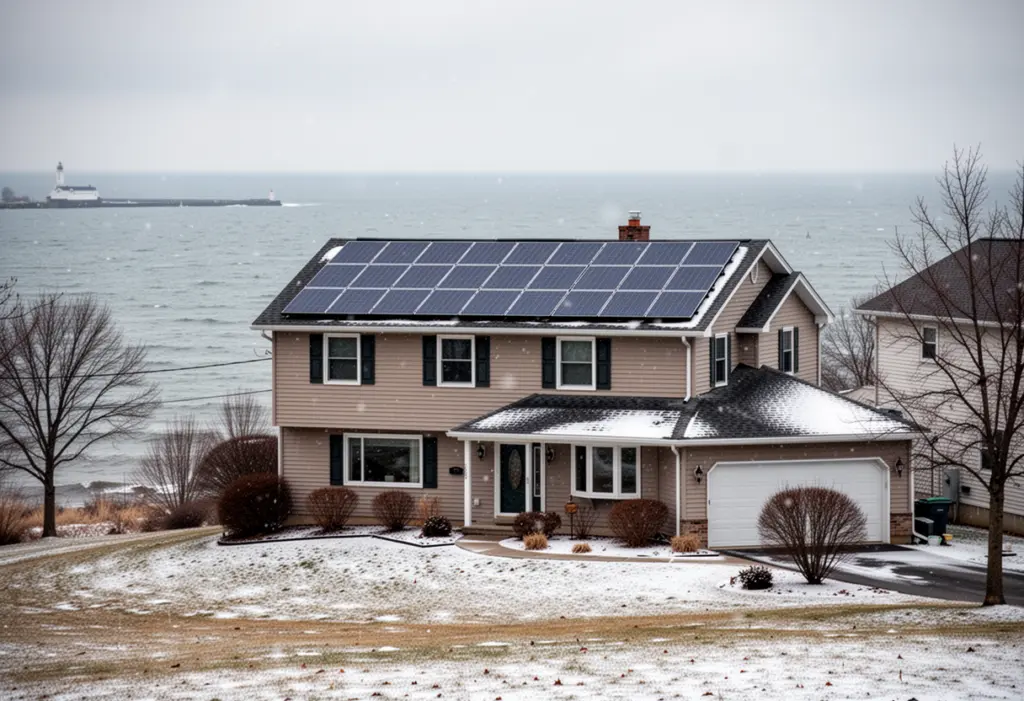
Greece is Rochester’s largest suburb, running along the Lake Ontario shore west of the city. ZIP codes here begin 146 and 144. It is post-war suburban housing in RG&E territory, and both of those set the terms.
The RG&E charge is the local number to know
RG&E’s 2026 residential Customer Benefit Contribution — a monthly charge on the DC size of your system for anyone interconnecting on or after 1 January 2022 — is $1.31 per kW-month, the second highest in New York State after Central Hudson.
- A 6 kW system: $7.86 a month, about $94 a year.
- An 8 kW system: $10.48 a month, about $126 a year.
- A 10 kW system: $13.10 a month, about $157 a year.
It is billed on capacity regardless of production and recalculated annually rather than fixed at interconnection. It will not be in the sales proposal; put it in your own arithmetic.
Post-war roofs
Greece grew after the war, which means a lot of ranches, split-levels and colonials of similar vintage. Two consequences: many roofs are now at or past the age where replacement comes first, and usable roof area rather than consumption frequently caps the array.
Under roughly ten years of shingle life left means re-roof before installing — removing and reinstalling an array later costs considerably more than mounting on a bare roof. And ask your installer directly what is limiting the system size.
Rochester’s grey winter
Monroe County is one of the cloudier parts of the state, and the November-to-February trough is deep. What makes solar work anyway is net metering: the March-to-September surplus banks as a credit and pays the winter bills.
So sizing has to be honest. A system that does not run a genuine annual surplus in summer will exhaust its credit balance in January, which is the month it is most needed. Ask what annual kWh the design assumed and check it against your own twelve months of RG&E usage.
Lake-shore snow and wind
Proximity to Lake Ontario means real lake-effect snow and real exposure. Ask what snow load and what wind load the racking is specified for, whether snow guards are needed where the array discharges, and what snow-cover assumption is in the production estimate.
2026 incentives
The 30% federal residential credit is gone — section 25D was terminated for expenditures made after 31 December 2025, with an expenditure treated as made when the original installation is completed. Any quote showing a 30% federal line is overstating your net cost by thousands.
Still available: New York’s 25% credit capped at $5,000 on Form IT-255, non-refundable but carried forward five years and reaching leases and PPAs of ten years or more as well as purchases; the state sales tax exemption; and RPTL 487’s 15-year property tax exemption, claimed on form RP-487 filed with your assessor by the taxable status date, where the town, Monroe County and your school district have not opted out. NY-Sun and its Affordable Solar track are not: as of September 2026 NYSERDA has no open NY-Sun block for homes in any utility territory; check NYSERDA’s NY-Sun dashboard for a new one.
Comparing quotes
- DC size in kW and estimated annual kWh on every quote.
- The snow and wind loads the racking is specified for.
- What is limiting the array — roof area or budget.
- Your monthly CBC at $1.31 per kW, which the proposal will not include.
- Confirmation that no federal credit appears in the net-cost figure.
Frequently Asked Questions
What does RG&E charge a Greece NY solar customer?
The Customer Benefit Contribution at $1.31 per kW-month of DC system size for 2026, the second highest in New York — about $94 a year on a 6 kW system, $126 on 8 kW and $157 on 10 kW.
Is Rochester's grey winter a problem for solar in Greece?
It makes honest sizing essential. Net metering banks the March-to-September surplus to pay the winter bills, so a system that does not run a genuine annual surplus in summer will exhaust its credit balance in January.
Does the Lake Ontario shore change the engineering?
Yes, on two counts. Lake-effect snow and shore exposure mean racking must be specified for both a snow load and a wind load. Ask for both figures rather than one.
Why is my Greece NY system smaller than expected?
Post-war ranches and split-levels frequently limit the array by usable roof area rather than by consumption, and fire-access clearances take proportionally more of a small roof. Ask your installer directly what is capping it.
This article is general information, not tax, legal or financial advice. Incentive amounts, eligibility rules and deadlines change and depend on your utility, your tax situation and your property. Confirm current terms with NYSERDA, your utility and a qualified tax professional before making a decision.
NY Solar Incentives
Independent New York solar research. We summarise NYSERDA, NY-Sun and federal programme rules from published sources and state plainly when a figure is an estimate. We are not a government agency and do not sell equipment.
Run the arithmetic on your own system
Check the dated program table and your arrangement before counting an incentive. Standard residential NY-Sun blocks are closed; Long Island Affordable Solar has a conditional income-verification route. The NY credit depends on qualified costs and tax liability, while the NYC abatement reduces future property-tax bills. The estimator keeps those timings separate.