Solar Panel Installation in Webster, NY
Webster has newer housing than most of Monroe County, which helps — but RG&E carries the state's second-highest solar charge.
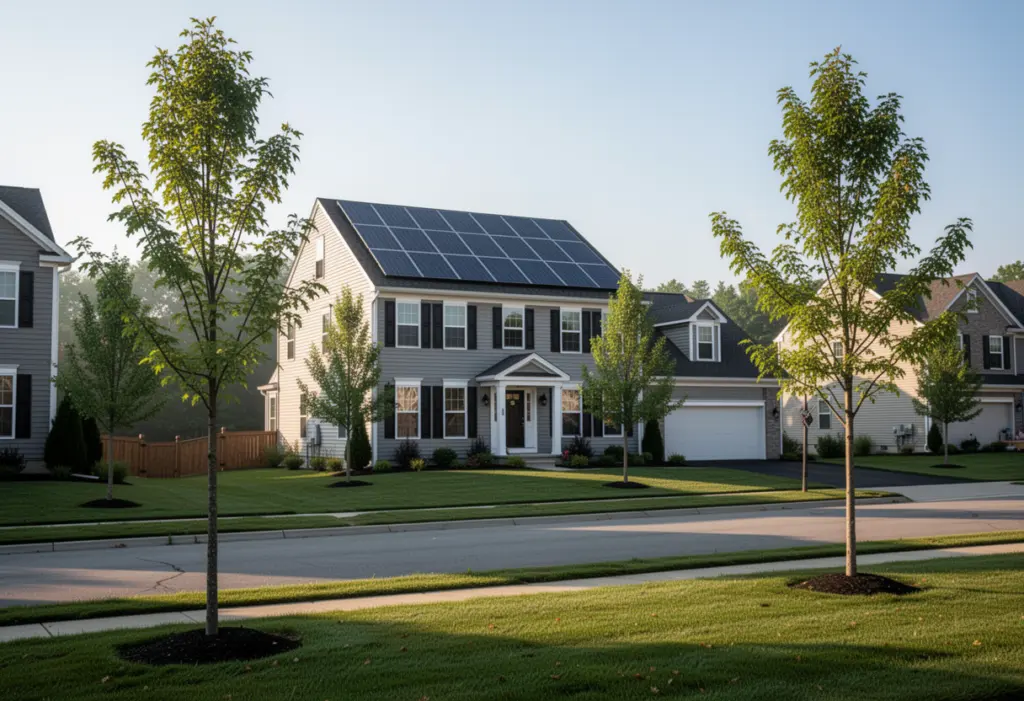
Webster sits on the Lake Ontario shore east of Rochester, one of Monroe County’s faster-growing towns. ZIP codes here begin 145 and 146. Its newer housing stock is a genuine advantage, and its utility is a genuine cost.
Newer housing helps in four ways
- Roofs have life left, so the constraint that decides most Monroe County projects bites less here.
- Simpler roof planes mean more usable area and less lost to fire-access clearances.
- Structural questions are rarer than on pre-war stock.
- 200-amp services handle solar plus an EV charger plus a heat pump without an upgrade.
The trade is that newer subdivisions were landscaped, and those trees are now substantial. An on-site shading assessment still matters, and in this grey climate the December figure matters more than the annual one.
The RG&E charge
RG&E’s 2026 residential Customer Benefit Contribution is $1.31 per kW-month of DC system size, the second highest in New York. An 8 kW system pays about $10.48 a month, roughly $126 a year; a 12 kW system about $189.
Billed on capacity regardless of production, recalculated annually, and absent from sales proposals. Because newer larger houses here take larger systems, it is worth calculating on the actual proposed size rather than a generic example.
The sequence
- Twelve months of RG&E usage, an on-site shading assessment, roof condition and structure.
- Interconnection application to RG&E, before installation.
- Town of Webster building permit — Monroe County’s towns each run their own, with their own turnarounds.
- Installation, then electrical inspection.
- Certificate to RG&E, meter exchange, permission to operate. The system may not run before PTO.
If a project goes quiet after installation, ask for the inspection certificate and the date it was submitted to RG&E.
Lake-shore snow and wind
The Ontario shore takes real lake-effect snow and real exposure. Ask what snow load and wind load the racking is specified for, whether snow guards are needed where the array discharges, and what snow-cover assumption is in the production estimate.
Sizing in a grey climate
Monroe County’s November-to-February trough is deep. Net metering banks the summer surplus to cover it, so the system must run a genuine annual surplus in the strong months or the credit balance runs out in January. Ask what annual kWh the design assumed and check it against your own usage.
2026 incentives
The 30% federal residential credit has ended — section 25D was terminated for expenditures made after 31 December 2025, with an expenditure treated as made when the original installation is completed.
Still available: New York’s 25% credit capped at $5,000 on Form IT-255 — note the cap, because on the larger systems newer Webster houses take it covers a smaller share of the total; the state sales tax exemption; and RPTL 487’s 15-year property tax exemption where the town, Monroe County and your school district have not opted out. The RPTL 487 exemption is not automatic: file form RP-487 with your assessor by the taxable status date (March 1 in most towns; January 2 in Nassau towns; May 1 or June 1 in Westchester towns; set by charter in cities; usually January 1 in villages), and the system must be built before January 1, 2030 (RP-487 instructions).
NY-Sun is not on that list. The last standard Upstate residential block (Block 14, $0.15/W, NYSEG, RG&E and National Grid territories) closed on 17 December 2025, and as of September 2026 NYSERDA has no open NY-Sun block for homes in any utility territory. Check NYSERDA’s NY-Sun dashboard for a new one.
Five questions worth asking here
- What snow load AND what wind load is the racking specified for?
- What annual kWh does the design assume, and does it hold against my own twelve months?
- What DC size is proposed, and therefore my monthly CBC at $1.31 per kW?
- Was the shading assessment done on site, and what does it say about December?
- Does the net-cost figure contain any federal credit? It should not.
On a newer Webster house the third question matters more than most people expect, because larger houses take larger systems and the charge is billed on size rather than on what the array produces.
Frequently Asked Questions
Is Webster a good market for rooftop solar?
Its newer housing helps considerably — roofs have life left, planes are simpler, structural questions are rarer and 200-amp services handle solar plus an EV charger. The offsetting factor is RG&E's charge, the second highest in the state.
What does RG&E charge a Webster solar customer?
The Customer Benefit Contribution at $1.31 per kW-month of DC system size for 2026 — about $126 a year on an 8 kW system and $189 on 12 kW. Worth calculating on your actual proposed size, since newer houses here take larger systems.
Is the New York solar credit worth less on a larger system?
Proportionally, yes. It is 25% of qualified expenditure but capped at $5,000 regardless of system size, so on the larger arrays newer Webster houses take it covers a smaller share of the total.
Does the lake shore affect the installation?
Yes. Lake-effect snow and shore exposure mean racking must be specified for both a snow load and a wind load, and the production estimate needs a snow-cover assumption. Ask for all three figures.
This article is general information, not tax, legal or financial advice. Incentive amounts, eligibility rules and deadlines change and depend on your utility, your tax situation and your property. Confirm current terms with NYSERDA, your utility and a qualified tax professional before making a decision.
NY Solar Incentives
Independent New York solar research. We summarise NYSERDA, NY-Sun and federal programme rules from published sources and state plainly when a figure is an estimate. We are not a government agency and do not sell equipment.
Run the arithmetic on your own system
Check the dated program table and your arrangement before counting an incentive. Standard residential NY-Sun blocks are closed; Long Island Affordable Solar has a conditional income-verification route. The NY credit depends on qualified costs and tax liability, while the NYC abatement reduces future property-tax bills. The estimator keeps those timings separate.