Solar on a Barn or Outbuilding in New York
The best roof on a New York property is frequently not the house. Here is what to check before putting an array on the barn.
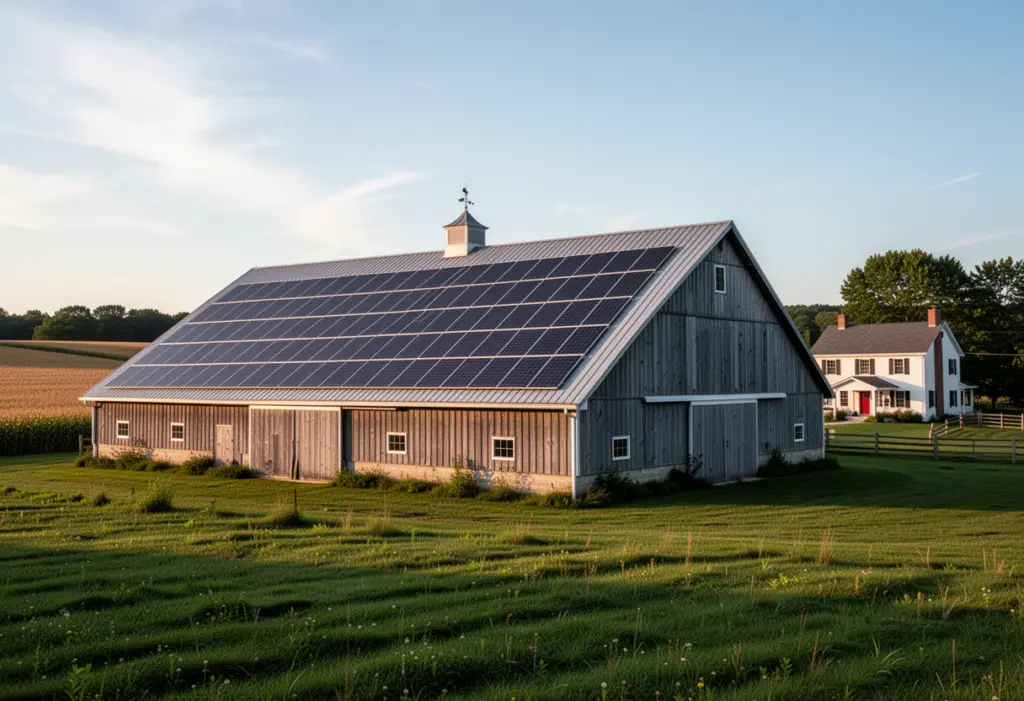
On a great many New York properties the best solar roof is not the house. A barn, a detached garage, a shop or a machine shed is frequently larger, simpler, better oriented and less shaded — and it is the option installers propose least often, because they arrive thinking about the house.
Why an outbuilding is often better
- Larger, simpler roof planes. No dormers, hips or valleys, so more usable area and far less lost to fire-access clearances.
- Better orientation, sometimes. Barns are frequently sited on the long axis of a field rather than to match the house, and that can put a long roof plane closer to south.
- Less shading. Outbuildings usually sit clear of the mature trees planted around a house.
- Metal roofing. Common on barns, and a standing seam metal roof is the best solar surface there is — racking clamps to the seams with no penetrations at all, and it sheds snow better than asphalt.
- Nobody minds how it looks. In a historic district or an HOA, an array on a rear outbuilding is far more likely to be approved than one on the principal elevation.
The three things to check
1. Structure. This is the real question. Barns and older outbuildings were not always built to carry a permanent additional load on top of a New York snow load, and some were built to no particular standard at all. A structural assessment is not optional here, and on an old timber barn it may be the thing that decides the answer.
Ask specifically: has someone competent looked at the frame, and what did they conclude in writing?
2. The run back to the house. An array on an outbuilding has to get its output to wherever the meter is, which means a trench and a conduit run if the building is detached — a real cost that scales with distance, and one that is easy to leave out of a headline price. Ask for it itemised separately.
If the outbuilding has its own service and its own meter, that is a different situation again, and it leads directly to the third question.
3. Which meter does it feed? The system offsets whichever meter it is connected behind. On a farm with several service points, an array on the barn feeding the barn’s meter does nothing for the house’s bill. Establish before design which meter the system serves and what that meter’s annual consumption actually is.
Roof condition still applies
The rule that governs house roofs governs barn roofs: if the covering has under roughly ten years of life left, deal with it first. Removing and reinstalling an array is expensive, and it is no cheaper on a barn.
Where the roof is standing seam metal in good condition, that constraint largely disappears — metal roofs commonly outlast the panels.
Permits and setbacks
An outbuilding array still needs a building permit and an electrical inspection, and the municipality applies the same fire-access requirements. If the building is agricultural there may be different provisions, and if the property is in a historic district or inside the Adirondack Park there may be review — ask which authority covers the specific building rather than the property generally.
The rest is unchanged
Net metering, the Customer Benefit Contribution on the DC size of the system, the interconnection application and permission to operate all work exactly as they would for a house array. And the incentive position is the same: the 30% federal residential credit ended for expenditures made after 31 December 2025, while New York’s 25% credit capped at $5,000 on Form IT-255 remains for equipment installed and used at your principal residence.
If the outbuilding serves a farm business rather than the residence, the tax treatment is the business one — and that is a question for your accountant, not for a sales proposal.
Frequently Asked Questions
Is a barn roof better than a house roof for solar?
Frequently. Larger simpler planes mean more usable area and less lost to fire-access clearances, outbuildings usually sit clear of mature trees, and standing seam metal roofing lets racking clamp on with no penetrations at all.
What is the main risk with solar on an old barn?
Structure. Barns and older outbuildings were not always built to carry a permanent additional load on top of a New York snow load, and some were built to no particular standard. A structural assessment is essential and may decide the answer.
What hidden cost does a detached building add?
The trench and conduit run back to wherever the meter is. It scales with distance and is easy to leave out of a headline price, so ask for it itemised separately.
Will an array on my barn reduce the house's electricity bill?
Only if it is connected behind the meter that serves the house. On a property with several service points, an array feeding the barn's own meter does nothing for the house's bill — settle which meter it serves before design.
This article is general information, not tax, legal or financial advice. Incentive amounts, eligibility rules and deadlines change and depend on your utility, your tax situation and your property. Confirm current terms with NYSERDA, your utility and a qualified tax professional before making a decision.
NY Solar Incentives
Independent New York solar research. We summarise NYSERDA, NY-Sun and federal programme rules from published sources and state plainly when a figure is an estimate. We are not a government agency and do not sell equipment.
Run the arithmetic on your own system
Check the dated program table and your arrangement before counting an incentive. Standard residential NY-Sun blocks are closed; Long Island Affordable Solar has a conditional income-verification route. The NY credit depends on qualified costs and tax liability, while the NYC abatement reduces future property-tax bills. The estimator keeps those timings separate.