My Solar Production Dropped: What to Check
Most reported production drops are seasonal and normal. Here is how to tell in ten minutes which kind you have before you call anyone.
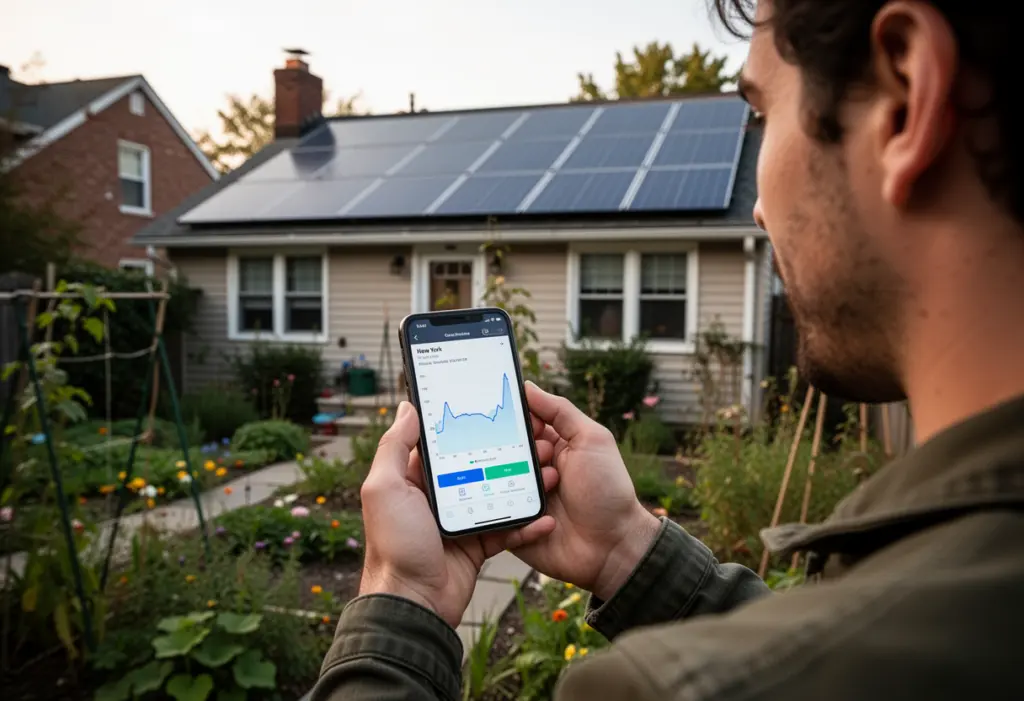
Production has fallen and you want to know whether something is broken. Work through this in order — it costs nothing, and it distinguishes the common explanations from the ones that need a service call.
1. Compare like with like
New York production varies enormously through the year. Comparing October with July tells you the season changed, not that the system failed. So compare this month against the same month last year, or against the design estimate for that month.
If you do not have a full year of history yet, compare against the monthly figures in your original proposal. A system in its first year has no baseline of its own and it is the single most common reason for a false alarm.
A run of dull days does the same thing. Two grey weeks in a New York November are not a fault.
2. Look at the roof
Free, immediate, and the answer more often than anything else:
- Snow or ice. Zero output in January with the array under snow is a covered array, not a broken one. Leave it — panels shed faster than the roof around them.
- Leaves and debris, particularly where an array meets a valley or a dormer.
- Something new casting shade. Trees grow. An extension, a new dormer, a neighbour’s addition or a satellite dish will do it too. If output fell gradually over years, this is very likely the cause.
- Bird or squirrel activity under the array — nesting material can block airflow and chewing can damage wiring.
- Soiling, if you are near a dirt road, farmland or heavy pollen. Uncommon in New York, where rainfall usually keeps panels clean enough.
3. Read the monitoring properly
What the app shows determines what kind of problem you have.
Panel-level monitoring — with microinverters or optimizers — is the useful case. Look at the panel view on a clear day around midday:
- One panel low or dead — a module or its microinverter/optimizer. A single panel is a small share of output, so this is a warranty claim rather than an emergency.
- A group low in a pattern that moves with the sun — shading, not hardware.
- A contiguous group dead — likely a wiring or connector fault between them.
- Everything low but proportionate — weather, soiling, or a whole-system issue.
System-level monitoring only — a plain string inverter — cannot distinguish these, which is itself useful information: it means diagnosis needs someone on site.
4. Look at the inverter
It is the component that fails first, by a wide margin, and it usually says so. Check the display or status light for a fault code, and look the code up in the manual or the manufacturer’s site before calling anyone — knowing the code turns a vague call into a specific one.
A completely dark inverter is a different matter: check whether its AC disconnect or breaker has tripped. If a breaker has tripped, do not simply reset it repeatedly — a breaker that keeps tripping is reporting something.
5. Check nothing changed indoors
Occasionally “production dropped” is actually “the bill went up”, and the array is fine. A new electric vehicle, a heat pump, a hot tub, a tenant, or a family member working from home all raise consumption without touching generation. Look at the production figure itself rather than the bill.
When to call, and whom
- Inverter fault code, or a dead inverter — your installer, with the code.
- One dead panel — your installer. It is a warranty claim; note the date you first saw it.
- A contiguous group dead — your installer. Wiring faults do not fix themselves.
- Gradual decline over years with no fault — usually shading from growth. An arborist may be the right call rather than a solar company.
- Nothing at all since a storm — check the inverter and its breaker first, then call.
What to have ready when you call
- The exact fault code, if there is one.
- A screenshot of the panel-level view on a clear day.
- The month-on-month comparison you did in step 1.
- Your installation date and the workmanship warranty term.
That turns a service visit into a repair visit, which is usually the difference between one appointment and two.
Frequently Asked Questions
Why has my solar production dropped?
Most reported drops are seasonal. Compare this month against the same month last year or against your proposal's monthly estimate rather than against the previous month, then check the roof for snow, debris and new shading before assuming a fault.
How do I tell if one solar panel has failed?
With panel-level monitoring, look at the panel view on a clear day around midday. One panel low or dead points to that module or its microinverter or optimizer. A group that dims in a pattern moving with the sun is shading, not hardware.
What usually breaks first on a solar system?
The inverter, by a wide margin, and it normally reports a fault code. Look the code up before calling, because it turns a vague service call into a specific repair visit.
My output fell gradually over several years. What is that?
Usually shading from growth — trees get taller, and an obstruction that was irrelevant at installation blocks the low winter sun years later. An arborist may be the right call rather than a solar company.
This article is general information, not tax, legal or financial advice. Incentive amounts, eligibility rules and deadlines change and depend on your utility, your tax situation and your property. Confirm current terms with NYSERDA, your utility and a qualified tax professional before making a decision.
NY Solar Incentives
Independent New York solar research. We summarise NYSERDA, NY-Sun and federal programme rules from published sources and state plainly when a figure is an estimate. We are not a government agency and do not sell equipment.
Run the arithmetic on your own system
Check the dated program table and your arrangement before counting an incentive. Standard residential NY-Sun blocks are closed; Long Island Affordable Solar has a conditional income-verification route. The NY credit depends on qualified costs and tax liability, while the NYC abatement reduces future property-tax bills. The estimator keeps those timings separate.