Fire Access Pathways for Rooftop Solar in New York
Your roof cannot be fully covered in panels, and the reason is that firefighters have to get onto it. Here is what that costs you in capacity.
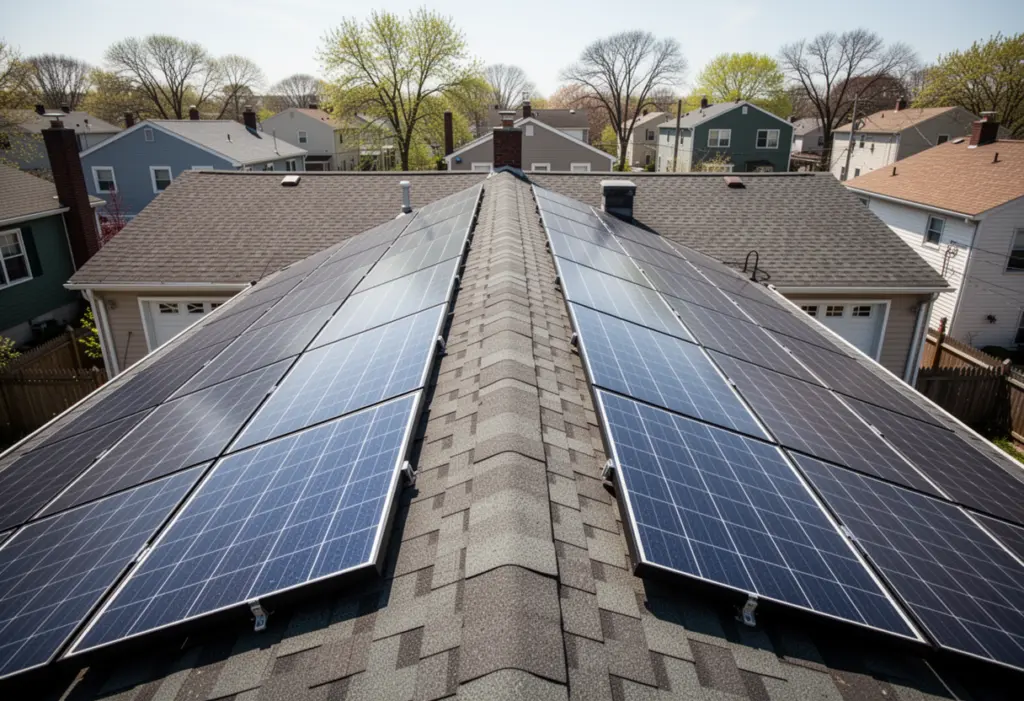
Homeowners frequently ask why the array does not cover the whole roof. Part of the answer is production and part is structure, but a large part is a fire-safety requirement that most people have never heard of until a layout drawing arrives.
Why the requirement exists
Firefighters work on roofs. They walk them, and in a fire they cut ventilation holes to release heat and smoke, which is what makes the interior survivable for anyone inside and for the crews going in.
A roof entirely covered in glass and aluminium cannot be walked or cut. So codes require clear pathways and clear areas so a roof remains usable in an emergency.
Once you know that, it stops feeling like bureaucracy. It is the reason someone can get onto your roof at three in the morning.
What is generally required
The principles are consistent even though the detail varies:
- A clear pathway at or near the ridge, so crews can move along the top of the roof and cut there.
- Clear pathways from the eave to the ridge, so the roof can be crossed rather than only skirted.
- Setbacks at hips and valleys on more complicated roofs.
- Clearance around roof access points, hatches and skylights.
New York’s code framework derives from the model fire code, and there are exceptions and alternatives — some depend on roof geometry, some on building size, some on other fire protection present. Your local authority applies it, and interpretations differ between building departments and fire officials in a way that surprises installers working across county lines.
This page describes the principle so you can read a layout drawing. It is not the specification for your address — that comes from the authority issuing your permit.
What it costs you
Capacity. On a small or complicated roof it can be a significant fraction of what looked available.
The effect is uneven, and it is worth knowing which side you are on:
- A large simple gable roof loses a modest share. The pathways come out of area you had plenty of.
- A small or cut-up roof — dormers, hips, valleys, a Cape or a split-level of the sort that dominates Nassau County and the older upstate cities — can lose a great deal, because the required clearances overlap with the only usable planes.
This is one of the main reasons a system ends up smaller than a homeowner’s consumption would justify, and it is rarely explained. If your quote came back smaller than expected, ask specifically how much area went to fire pathways.
Rapid shutdown is a separate requirement
Often mentioned in the same breath and not the same thing. Rapid shutdown brings the voltage at module level down quickly so crews are not working around live DC conductors. It is satisfied inherently by microinverters and by module-level optimizers, and needs additional equipment with a plain string inverter.
Pathways are about physical access. Rapid shutdown is about electrical safety. Both apply.
What to ask
- Ask to see the layout drawing with the pathways and setbacks marked. Any competent installer has produced one for the permit.
- Ask how much capacity went to clearances, in kW. It should be a specific number.
- Ask which authority is applying the code and whether they have required anything unusual recently. Local interpretation is real.
- Ask how rapid shutdown is achieved and whether that equipment is in the quoted price.
- If the roof is complicated, ask whether a different plane or a ground mount gets more usable area.
Do not try to design around it
An array laid out to maximise panels at the expense of required clearances will fail inspection, and correcting it after installation means removing and remounting panels. The clearances are not negotiable at the inspection stage, so they have to be right at the design stage.
An installer who has drawn them properly is one who has done this in your municipality before.
Frequently Asked Questions
Why can't solar panels cover my whole roof?
Fire codes require clear pathways and setbacks so firefighters can walk the roof and cut ventilation holes in a fire. A roof completely covered in glass and aluminium cannot be worked on, so part of it must stay clear.
How much capacity do fire pathways cost?
It varies enormously by roof shape. A large simple gable roof loses a modest share; a small or cut-up roof with dormers, hips and valleys can lose a great deal because the clearances overlap the only usable planes. Ask your installer for the figure in kW.
Are fire access requirements the same across New York?
The principles are consistent, but the detail and its interpretation vary between building departments and fire officials, and there are exceptions based on roof geometry, building size and other fire protection present. Your permitting authority applies it.
Is rapid shutdown the same as fire access pathways?
No. Pathways are about physical access to the roof; rapid shutdown is about bringing module-level voltage down quickly so crews are not working around live DC conductors. Both apply, and rapid shutdown is satisfied inherently by microinverters and optimizers.
This article is general information, not tax, legal or financial advice. Incentive amounts, eligibility rules and deadlines change and depend on your utility, your tax situation and your property. Confirm current terms with NYSERDA, your utility and a qualified tax professional before making a decision.
NY Solar Incentives
Independent New York solar research. We summarise NYSERDA, NY-Sun and federal programme rules from published sources and state plainly when a figure is an estimate. We are not a government agency and do not sell equipment.
Run the arithmetic on your own system
Check the dated program table and your arrangement before counting an incentive. Standard residential NY-Sun blocks are closed; Long Island Affordable Solar has a conditional income-verification route. The NY credit depends on qualified costs and tax liability, while the NYC abatement reduces future property-tax bills. The estimator keeps those timings separate.