Solar for a Master-Metered Building in New York
Where the owner buys all the electricity, solar and the person paying for it are finally aligned. That makes master-metered buildings the strongest multifamily case.
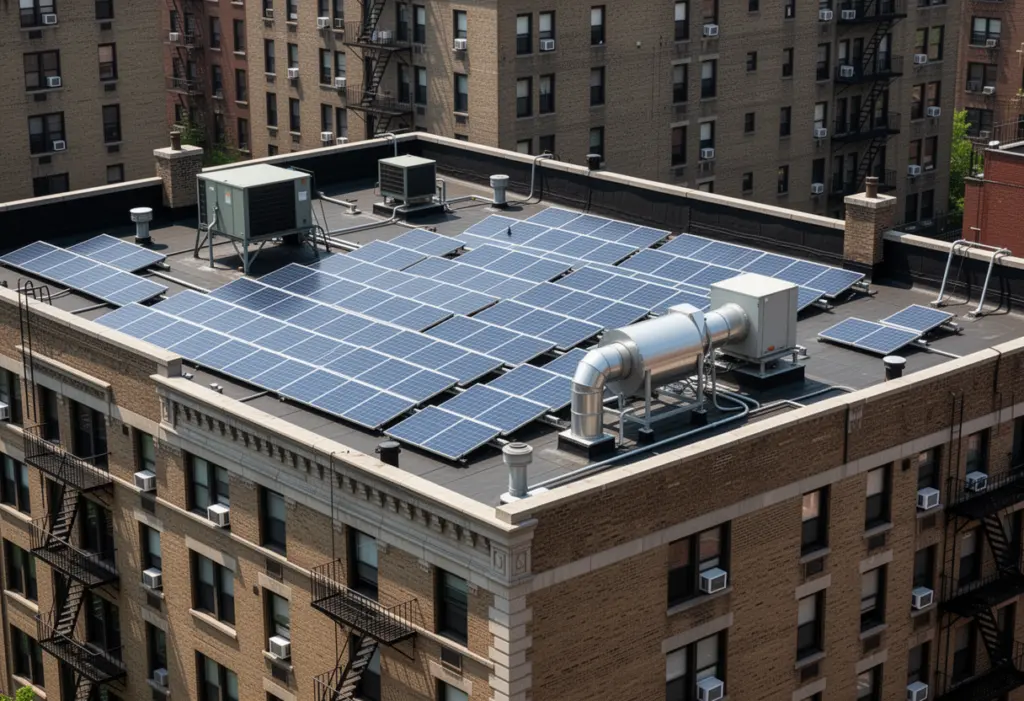
Most multifamily solar proposals in New York founder on the same problem: the roof belongs to the owner and the electricity bill belongs to the tenants, so whoever pays for the array is not the person who benefits from it. A master-metered building removes that problem entirely, which makes it the strongest multifamily case there is.
What master-metered means
The building has one electricity account. The owner buys all the electricity and recovers it through rent rather than through separate tenant bills. There are no individual apartment meters, or they exist only as sub-meters for allocation.
The consequence for solar: the array offsets the account the owner actually pays, and it can be sized against the whole building’s consumption rather than a small house-meter load.
Why that changes the arithmetic
In a submetered or individually metered building, an owner-side system offsets the house meter — hallway lighting, the boiler, elevators, laundry, the compactor. Real, but usually a modest fraction of what the building consumes.
In a master-metered building the load is everything: apartments included. That means:
- The roof is far more likely to be the binding constraint than the load, which is the healthy direction for a solar project.
- Consumption is high enough for a system large enough to be worth the fixed project costs — permits, engineering, interconnection, staging.
- The economics are a straightforward operating-cost calculation rather than a question about who benefits.
What to establish first
- Twelve months of the building’s actual usage and demand data, not bill totals. For a commercial-scale account the shape of the load is the analysis, and whether the account carries a demand charge changes everything about what solar is worth.
- Whether the account has a demand charge. If it does, the account is exempt from the Customer Benefit Contribution — and separately, whether solar reduces demand depends entirely on when your peak occurs. Ask any proposal to separate the energy saving from the demand saving.
- The roof’s remaining life. A flat roof with under a decade left means sequencing the roof first. Removing and reinstalling an array is far more expensive than installing on a bare membrane.
- The mounting method and the roof warranty. Ballasted systems, common on flat New York roofs, may avoid penetrations entirely. Confirm what the warranty permits before anything is fixed down.
- What the roof is already carrying — cooling equipment, tanks, bulkheads, and any structural headroom that leaves.
Net metering or the Value Stack
For a building-scale system this is a genuine decision rather than a formality. Net metering credits exports at the full retail rate; the Value Stack values them by time and location. Which suits depends on the load shape and the system size, and it is worth asking a proposal to model both rather than assume one.
One exception: mass-market LIPA projects on Long Island cannot opt into the Value Stack at all.
The tax position is not the residential one
New York’s 25% credit on Form IT-255 is for an individual’s principal residence. A building owner’s system is a business asset, and the applicable treatment — including the business-side investment tax credit and depreciation, neither of which followed the residential credit into repeal at the end of 2025 — is a question for the owner’s accountant with the owner’s own figures.
Depreciation in particular is frequently worth as much as any credit on an asset of this size, and it is the part an installer’s proposal is least likely to model correctly.
Where it goes wrong
Two failure modes, both avoidable:
- A proposal built on bill totals rather than interval data. On a commercial account that is not an analysis, it is an estimate wearing one.
- Sequencing the roof after the array. It is the most expensive ordering mistake available in multifamily solar, and it is entirely predictable from a roof report.
Frequently Asked Questions
Why is a master-metered building better for solar?
Because the owner buys all the electricity, so the array offsets the account the owner actually pays and can be sized against the whole building's consumption rather than a small house meter. Solar and the person paying for it are finally aligned.
Do master-metered buildings pay the Customer Benefit Contribution?
Commercial accounts that already carry a demand charge are exempt from it. Whether your account carries one is worth establishing early, because it also changes what solar is worth — demand savings depend entirely on when your peak occurs.
Should a building system take net metering or the Value Stack?
For a building-scale system it is a genuine decision. Net metering credits exports at the full retail rate while the Value Stack values them by time and location, so ask for both to be modelled against your load shape. Mass-market LIPA projects cannot opt into the Value Stack at all.
Can a building owner claim the New York residential solar credit?
No. Form IT-255 is for an individual's principal residence. A building owner's system is a business asset, and the treatment — including the business investment tax credit and depreciation, neither of which was repealed with the residential credit — belongs with the owner's accountant.
This article is general information, not tax, legal or financial advice. Incentive amounts, eligibility rules and deadlines change and depend on your utility, your tax situation and your property. Confirm current terms with NYSERDA, your utility and a qualified tax professional before making a decision.
NY Solar Incentives
Independent New York solar research. We summarise NYSERDA, NY-Sun and federal programme rules from published sources and state plainly when a figure is an estimate. We are not a government agency and do not sell equipment.
Run the arithmetic on your own system
Check the dated program table and your arrangement before counting an incentive. Standard residential NY-Sun blocks are closed; Long Island Affordable Solar has a conditional income-verification route. The NY credit depends on qualified costs and tax liability, while the NYC abatement reduces future property-tax bills. The estimator keeps those timings separate.