Farm Solar in New York: Incentives and Land Leases
Farm solar means two very different things — offsetting your own load, or leasing ground to a developer. The economics and the risks are not the same.
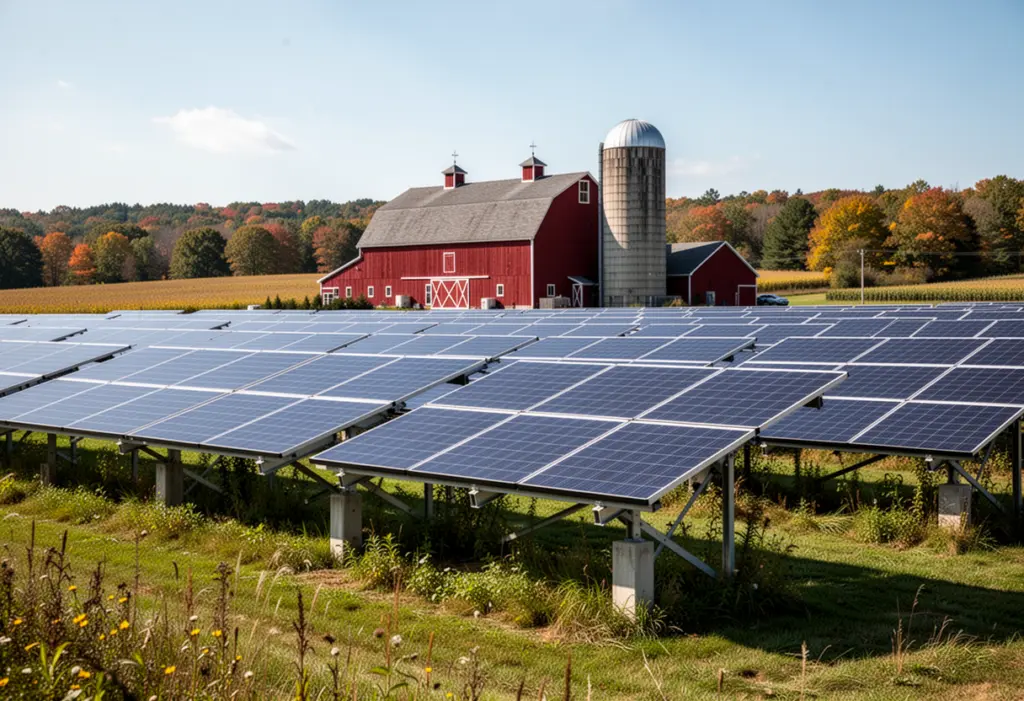
“Farm solar” in New York describes two entirely different decisions that get discussed as though they were one. Separating them is the first useful thing to do.
Decision one: install solar to offset the farm’s own electricity — the milking parlour, the irrigation pumps, the cold storage, the grain dryer, the shop.
Decision two: lease ground to a developer who builds a commercial array on it and pays you rent.
They have different economics, different risks and different paperwork, and an offer that blurs them is worth reading twice.
Powering the farm itself
A farm is a business, and that matters more in 2026 than it used to. The residential federal credit under section 25D ended for expenditures made after 31 December 2025; the business-side investment tax credit is a separate provision that did not follow it. A farm’s project sits on the business side. What that is worth in your circumstances is an accountant’s question, not a website’s — but it is a live question, which the homeowner equivalent no longer is.
Depreciation is the other business-side advantage a household never gets, and on a capital-intensive asset it is substantial.
Things specific to agricultural load:
- Load shape is seasonal and often extreme. An irrigation pump running in July or a dryer running for three weeks in autumn produces a load profile that a residential-style analysis will get wrong. Get interval data from the utility.
- Ground mounts are usually available, which removes the roof constraint entirely and allows optimal orientation. That is a genuine advantage over a rooftop project.
- Demand charges, if your account carries them, may dominate the arithmetic. Ask any proposal to separate energy savings from demand savings.
- Multiple meters. Many farms have several service points. A system behind one meter offsets that meter. New York’s remote net metering and Value Stack arrangements exist partly to address this, and it is worth asking specifically how the proposal handles a multi-meter operation.
- The Unified Solar Permit stops at 25 kW. Most genuine farm systems exceed that and follow the municipality’s ordinary process.
Leasing land to a developer
This is a real income opportunity and a long commitment. New York’s build-out of mid-scale solar has made land offers common across the Southern Tier, the Mohawk Valley, the Finger Lakes and western New York.
What to look at, in order of how often it causes regret:
- Term and renewals. These agreements run for decades with extension options. Read what the extensions do and who controls them.
- Decommissioning security. What happens at the end, who removes the equipment, and what financial security backs that obligation. A promise is not security; a bond or escrow is.
- Which acres, and access. The array’s footprint, the access road, the interconnection route and any easement. These affect the farming operation on the land you keep.
- Drainage and tile. Construction across tiled ground can affect fields well outside the leased area.
- Escalation. A rent that does not escalate is worth materially less over thirty years than one that does.
- The option period. Many offers begin as an option, sometimes lightly paid, that ties up the land while the developer pursues interconnection. Understand what you are agreeing to and for how long.
- Agricultural district and assessment consequences. Converting land use can affect agricultural assessment. This is exactly the sort of thing to check before signing rather than after.
Take your own advice — an attorney and an accountant who act for you, not the developer’s paperwork. The sums involved over a thirty-year term justify it comfortably.
Property tax
RPTL 487 provides a 15-year exemption on the added value of a solar system, and it applies to commercial and agricultural property as well as residential — but municipalities may opt out, and for larger arrays a payment-in-lieu-of-taxes agreement with the municipality is common. The RPTL 487 exemption is not automatic: file form RP-487 with your assessor by the taxable status date (March 1 in most towns; January 2 in Nassau towns; May 1 or June 1 in Westchester towns; set by charter in cities; usually January 1 in villages), and the system must be built before January 1, 2030 (RP-487 instructions). If you are leasing land, who bears that liability is a term of the lease and should be explicit.
Where to start
For powering the farm: twelve months of interval data, a clear statement of which meters matter, and a proposal that separates energy from demand.
For a land lease: your own attorney, before you sign the option.
For either: NY-Sun’s non-residential incentives are administered through NYSERDA and paid via the contractor, and Cornell Cooperative Extension is a genuinely neutral starting point for New York agricultural questions in a market where most of the available advice is being given by someone selling something.
Frequently Asked Questions
Can a New York farm still get a federal solar tax credit?
A farm project sits on the business side of the tax code, and the business investment tax credit is a separate provision from the residential credit that ended after 2025. It is a live question in 2026, but the specifics belong with your accountant.
How much does a solar land lease pay in New York?
Rent varies with location, acreage, interconnection value and the developer, so no honest single figure exists. What matters as much as the rate is escalation, term length, decommissioning security and which acres are affected.
What should a farmer check before signing a solar land lease?
Term and renewal control, decommissioning security backed by a bond or escrow rather than a promise, the footprint and access route, effects on drainage and tile, rent escalation, the option period, and consequences for agricultural assessment. Use your own attorney.
Does farm solar affect agricultural property assessment?
It can, and it depends on how the land use changes. RPTL 487's exemption may apply where the municipality has not opted out, and for larger arrays a payment-in-lieu-of-taxes agreement is common. Check before signing.
This article is general information, not tax, legal or financial advice. Incentive amounts, eligibility rules and deadlines change and depend on your utility, your tax situation and your property. Confirm current terms with NYSERDA, your utility and a qualified tax professional before making a decision.
NY Solar Incentives
Independent New York solar research. We summarise NYSERDA, NY-Sun and federal programme rules from published sources and state plainly when a figure is an estimate. We are not a government agency and do not sell equipment.
Run the arithmetic on your own system
Check the dated program table and your arrangement before counting an incentive. Standard residential NY-Sun blocks are closed; Long Island Affordable Solar has a conditional income-verification route. The NY credit depends on qualified costs and tax liability, while the NYC abatement reduces future property-tax bills. The estimator keeps those timings separate.