Lease vs Buy: Solar in New York Compared
The tax argument for buying rested on a federal credit that ended at the close of 2025. What remains is a straightforward comparison of ownership, escalators, risk and resale.
On this page 9 sections
- 01What you are actually choosing between
- 02The federal picture inverted at the end of 2025
- 03What each New York solar program pays, and to whom
- 04Escalators are the main long-run difference
- 05Who carries the risk if the system underperforms
- 06Selling the house is where the two paths diverge most
- 07How the two compare on the points that matter
- 08What tends to decide it in practice
- 09Frequently asked questions
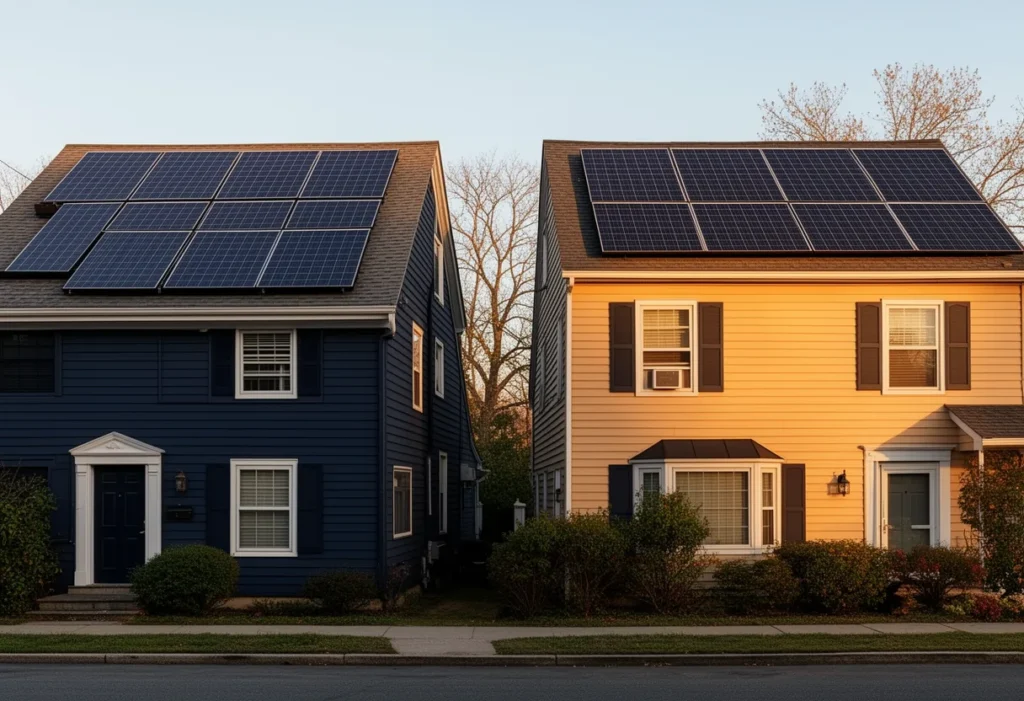
The real choice in front of most New York households is not solar or no solar. It is whether to own the equipment on the roof or to buy a service from the company that owns it.
That decision used to be dominated by tax, and it still is, but the arithmetic has flipped. The federal residential credit ended at the close of 2025, while the business-side credit available to a third-party owner did not. Every New York solar program that remains for homes — the state credit, the New York City abatement, the sales-tax exemption and the RPTL 487 property-tax exemption — now sits on top of that changed picture, and NY-Sun has no open block for homes as of September 2026. The RPTL 487 exemption is not automatic: file form RP-487 with your assessor by the taxable status date (March 1 in most towns; January 2 in Nassau towns; May 1 or June 1 in Westchester towns; set by charter in cities; usually January 1 in villages), and the system must be built before January 1, 2030 (RP-487 instructions).
What you are actually choosing between
Buying means acquiring an asset, with cash or with borrowed money, and taking on everything that comes with owning hardware: warranty administration, repairs outside warranty, roof coordination, and eventual replacement of the inverter.
Leasing means paying a fixed monthly amount for the use of equipment owned by someone else. A power purchase agreement is a close cousin in which the payment is tied to production rather than fixed, and that variant is covered separately in power purchase agreements for New York homeowners.
The distinction that carries through everything below is legal ownership. Incentives, repair duties, contract length and what happens at closing all follow from it.
The federal picture inverted at the end of 2025
The residential clean energy credit under Internal Revenue Code section 25D was terminated by the One Big Beautiful Bill Act, signed 4 July 2025, for expenditures made after 31 December 2025. An expenditure counts as made when the original installation is completed, so a system finished in December 2025 but switched on in January 2026 still falls under the old rules. A homeowner buying a system today receives nothing for it on their own federal return, with no phase-down and no transition provision.
A system whose installation was completed in 2025 was governed by the old rules, and unused credit from that year can generally be carried forward on the taxpayer’s own returns. That is a genuinely different situation and should not be read across to a purchase made now.
The business-side credit is separate legislation with its own rules and its own timetable, and it belongs to the company that owns a leased or PPA system. That is why some third-party offers can still price in a federal incentive: the incentive is real, but the homeowner never claims it and never sees it as a line on a tax return. In pure tax terms this now tilts toward third-party ownership and toward community solar, which is the opposite of the position most published guidance still describes.
Reject any purchase quote that still shows a 30% federal credit
Proposal software across the industry has been slow to update. If a purchase quote for a system being installed now includes a federal tax credit line, the payback figure beneath it is wrong, and it is wrong by a large margin. Ask for the proposal to be reissued without it before comparing anything.
What each New York solar program pays, and to whom
NY-Sun paid a per-watt incentive through the installer, not to the household, and stepped down as each regional megawatt block filled. It reduced the contract price on an owned system and the provider’s cost on a third-party-owned one. As of September 2026 NYSERDA has no open NY-Sun block for homes in any utility territory, so neither a purchase nor a lease on a home gets it now; check NYSERDA’s NY-Sun dashboard for a new one.
The New York State Solar Energy System Equipment Credit is claimed on Form IT-255. It is a percentage of qualified expenditure up to a statutory cap. Unusually, and unlike the former federal credit, New York’s rules can treat amounts paid under a qualifying written lease or power purchase agreement as qualified expenditure where the agreement runs for at least a minimum term. That makes the state credit a live question for lessees as well as buyers, and it is worth reading how the state equipment credit is calculated before assuming either way.
In New York City, the property tax abatement is filed with the Department of Buildings and applied against property tax liability in four annual instalments. Whether and how a third-party-owned system reaches that abatement is a filing question rather than an assumption, and it is set out further in the NYC solar property tax abatement. Statewide, Real Property Tax Law section 487 exempts the added assessed value of a qualifying system for a set period, subject to a municipality’s right to opt out.
Escalators are the main long-run difference
A purchase fixes the cost at the outset. Once a loan is paid off, the running cost of an owned system is maintenance and eventual component replacement, and nothing else.
Most leases and PPAs include an annual escalator, a fixed percentage by which the payment rises each year. A modest-sounding escalator compounds over a twenty-year term, and whether it stays below the utility’s own rate trajectory is unknowable at signing. Any proposal that presents that comparison as settled is presenting an assumption as a fact.
Some contracts are offered with no escalator at a higher starting rate. That version is easier to evaluate because only one number has to be judged rather than two.
Who carries the risk if the system underperforms
On an owned system, underproduction is the owner’s problem, mitigated by whatever the equipment and workmanship warranties actually say. Warranty terms differ sharply between manufacturers and installers, and the labour portion is often the shortest part.
On a lease or PPA, the provider owns the hardware and normally carries monitoring and repair duties, which is a genuine transfer of risk. The value of that transfer depends entirely on the provider still existing and still responding in year twelve, and on what the contract commits them to do rather than what the salesperson describes.
Production guarantees, where offered, are the mechanism that turns underperformance into a remedy. Read what the remedy is: a cash adjustment against a shortfall is not the same as a promise to fix anything.
Selling the house is where the two paths diverge most
An owned, paid-off system conveys with the property. An owned system with a loan behind it requires the lender’s filing to be released or the balance paid at closing, which is a scheduling task rather than a negotiation.
A leased or PPA system requires the contract to be assigned to the buyer, and the buyer usually has to meet the provider’s own credit requirements. If they will not or cannot take it on, the alternatives are prepaying the remaining term or paying for removal, and both are priced by the provider.
None of this makes a lease unsellable. It makes it a longer item in attorney review, which is why it belongs in the decision rather than being discovered later.
Model year 15 and year 20, not year one
Ask each provider for the full payment schedule across the entire term, in dollars, not as a percentage escalator. Then set it beside the total cost of an owned system including a mid-life inverter replacement. Comparing first-year figures flatters whichever option has the lower opening payment and tells you almost nothing.
How the two compare on the points that matter
| Question | Cash purchase | Loan purchase | Lease or PPA |
|---|---|---|---|
| Who owns the equipment | The homeowner | The homeowner, subject to the lender’s security interest | The provider |
| Who can claim the state credit on Form IT-255 | The homeowner | The homeowner | Possibly the homeowner, if the agreement meets the minimum term in the IT-255 rules |
| Federal residential credit (section 25D) | Ended for systems with installation completed after 31 December 2025 | Ended for systems with installation completed after 31 December 2025 | Never claimable by the homeowner |
| Business-side federal credit | Not available | Not available | Available to the owning company, under its own rules |
| Who repairs a failed inverter | The homeowner, within warranty terms | The homeowner, within warranty terms | The provider, as the contract requires |
| What happens at sale | Conveys with the house | Filing released or balance paid at closing | Contract assigned to the buyer, prepaid or bought out |
What tends to decide it in practice
Households with the capital and enough state tax liability to absorb the IT-255 credit generally still find ownership the cleaner arrangement, because it ends. The payments stop and the equipment stays.
Households without that capital face a narrower question than they used to. With the federal residential credit gone, a loan purchase no longer carries a second-year windfall to lean on, and the case for it rests on the state and local incentives alone. The detail of that is in how solar loans in New York work.
Households that expect to move within a few years, or that have limited state tax liability, are the ones for whom a third-party arrangement is most defensible on its own terms rather than as a fallback.
Frequently asked questions
Is buying still better than leasing in New York?
Not automatically, and less clearly than before. The federal residential credit that carried much of the case for buying ended for expenditures made after 31 December 2025, while the business-side credit available to a lease or PPA provider did not. Buying still ends in an owned asset with no ongoing payment, which is its main advantage; the tax advantage that used to sit alongside it is gone.
Can a leaseholder claim the New York State solar credit?
Possibly. New York’s rules can treat amounts paid under a written lease or power purchase agreement as qualified expenditure where the agreement runs for at least a minimum term, which is different from how the former federal credit worked. The precise conditions and the cap are set out in the Form IT-255 instructions and should be checked against your specific contract with a tax preparer rather than assumed.
Does a lease raise or lower my property tax in New York?
Real Property Tax Law section 487 exempts the increase in assessed value attributable to a qualifying solar system for a set number of years, but municipalities are allowed to opt out of it. Whether your town or city has opted out is a local question that the assessor’s office can answer directly. Confirm it before treating the exemption as part of the comparison.
What happens to a solar lease if the provider goes out of business?
The contract is an asset and is normally sold or transferred to another company, which then inherits the obligations written into it. That is precisely why the contract text matters more than the sales relationship: your protection is whatever the document commits the owner to do, not the servicing standard of the original firm. Read the assignment clause and the maintenance obligations before signing.
Verify the current numbers
Incentive levels, credit percentages and statutory caps change, and NY-Sun block pricing moves as blocks fill. Confirm current incentive levels with NYSERDA, the state credit position with the New York State Department of Taxation and Finance, and any New York City abatement question with the Department of Buildings and the Department of Finance. This site is independent and is not affiliated with any of them.
NY Solar Incentives
Independent New York solar research. We summarise NYSERDA, NY-Sun and federal programme rules from published sources and state plainly when a figure is an estimate. We are not a government agency and do not sell equipment.
Run the arithmetic on your own system
Check the dated program table and your arrangement before counting an incentive. Standard residential NY-Sun blocks are closed; Long Island Affordable Solar has a conditional income-verification route. The NY credit depends on qualified costs and tax liability, while the NYC abatement reduces future property-tax bills. The estimator keeps those timings separate.