Line Set Maximum Length: Heat Pump Limits in New York
A heat pump's refrigerant line set has a published ceiling on total run and on vertical separation. Both constrain where the outdoor unit can sit.
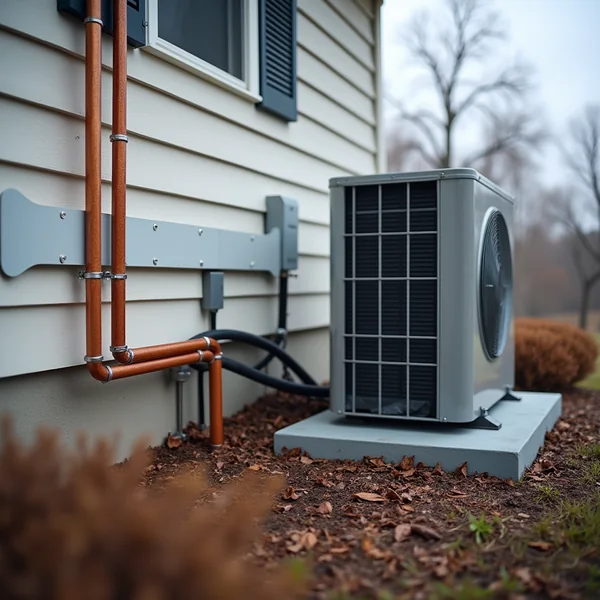
Why the refrigerant run between the outdoor unit and the indoor coil has a published ceiling, and how that ceiling quietly decides where a New York heat pump can go.
The outdoor unit has to go somewhere. In a New York house that somewhere is usually decided by setbacks, a co-op board, a neighbour’s window, snow drift, or simply which wall has room — and then the installer works out whether the refrigerant piping can actually reach it. That piping is the line set: two insulated copper tubes, one liquid and one suction, joining the outdoor unit to the indoor coil or wall head.
Every piece of equipment publishes a ceiling on how far that piping may run. Exceed it and the system does not fail dramatically; it under-performs quietly, in ways that look like a bad thermostat or an undersized unit. Knowing the ceiling before the proposal is signed is what keeps that quiet under-performance from being discovered a winter later.
Line Set Maximum Length: What Actually Limits a Refrigerant Run
There is no single industry number. The limit belongs to the specific model, appears in its engineering or installation manual, and is stated as a set of related figures rather than one. Reading only the headline figure is the common mistake.
Four figures, not one
- Maximum total length. The full run measured along the pipe, not the straight-line distance across the yard. Vertical drops, the loop behind the air handler and the service coil at the outdoor unit all count.
- Maximum height difference. The vertical separation between indoor and outdoor units. This is frequently a smaller number than people expect, and it is often stated twice — one figure when the outdoor unit is above the indoor unit, a different one when it is below.
- Equivalent length. Elbows and bends behave like extra straight pipe because they add resistance. A run with many turns can be well under the stated maximum on a tape measure and over it in the calculation that matters.
- Minimum length. Yes, minimum. Very short runs can distribute compressor oil and refrigerant poorly, and several manufacturers publish a floor. Coiling the excess neatly is the standard answer, not cutting to fit.
Why a maximum exists at all
Three separate physical problems set the ceiling, and they bite at different points.
Oil return
Compressor lubricating oil circulates with the refrigerant and has to find its way home. On long runs, and especially on tall vertical risers at low compressor speed, oil can be left sitting in the pipe instead of returning. Manufacturers address this with velocity requirements, and sometimes with oil traps at specified intervals on a riser. An inverter-driven heat pump spends most of a mild New York shoulder season running slowly, which is exactly the condition in which oil return is weakest — so this is not an edge case here.
Pressure drop and lost capacity
Refrigerant loses pressure to friction over distance. The engineering manual carries a correction table: a capacity multiplier that falls as the line lengthens. A system at the far end of its permitted run can deliver noticeably less heating and cooling than its nameplate implies. That correction has to be applied before the equipment is matched to the load, not discovered afterwards. It is one of the quiet ways a system that looked correctly sized on paper turns out not to be, which is worth reading alongside how heat pump sizing is done in New York.
Refrigerant charge
Equipment ships pre-charged for a stated line length. Beyond that length, refrigerant must be added at a published rate per additional foot, and the addition should be weighed in with a scale rather than guessed from gauge pressures. Undercharge and the system starves at low outdoor temperatures, precisely when a New York homeowner notices. Overcharge and you get high head pressure, poor efficiency and a shorter compressor life. Either way the symptom shows up months later and rarely gets traced back to the pipe run.
What to look up, and what going over costs
| Figure | What it constrains | Where it lives | Consequence of exceeding it |
|---|---|---|---|
| Maximum total length | How far the outdoor unit can sit from the coil | Installation or engineering manual for the exact model pairing | Capacity loss, oil return risk, warranty exposure |
| Maximum height difference | Basement-to-attic and roof-mount arrangements | Same manual, usually two values by direction | Oil stranded in the riser; compressor wear |
| Equivalent length | Runs with many bends and offsets | Fitting allowance table | Real resistance higher than measured length suggests |
| Pre-charge length | How much refrigerant the unit arrives with | Data plate and manual | Undercharge on a long run if nobody adds any |
| Charge per additional foot | Correct commissioning | Manual, stated per unit length | Low-temperature capacity loss or high head pressure |
| Minimum length | Very short runs to a nearby wall | Manual, often overlooked | Poor oil distribution; coil excess instead of cutting short |
Where New York houses hit the limit
The constraint bites in patterns that repeat across the state.
- City row houses and brownstones. The outdoor unit lands in a rear yard or on the roof while the heads serve upper floors. That is a vertical separation problem before it is a length problem, and the vertical figure is the tighter of the two.
- Long Island and suburban Westchester. Side-yard setbacks and noise ordinances push the condenser to the rear of the lot, adding horizontal run to reach a mechanical room that sits at the front of the house.
- Older Hudson Valley and upstate houses. A basement air handler with the outdoor unit raised on a stand to clear snow adds height at both ends, and balloon-framed walls rarely offer the straight chase the drawing assumed.
- Multi-zone retrofits. One outdoor unit feeding several heads has a maximum for each branch and a maximum for the combined run of all of them. The second figure is the one people miss.
Routing and insulation, which the limit assumes are right
Published maximums presume competent installation. Both tubes are insulated separately along their whole length, including inside walls, because a bare liquid line in an unconditioned attic gives away heat and a bare suction line sweats and drips onto whatever is below it. Outdoors the insulation needs a covering that survives sunlight; bare foam degrades in a couple of New York summers and then the line is effectively uninsulated. Bends must be formed, not crushed, since a kinked tube adds resistance that no table accounts for, and penetrations through masonry want a sleeve and a proper seal rather than expanding foam alone.
How to check this before you sign
- Get the measured run on the proposal. Total developed length and the height difference, written down — not “it will be fine.”
- Ask for the capacity multiplier at that length from the engineering data for the exact indoor and outdoor pairing, and confirm the corrected capacity still meets the calculated load on a design day.
- Ask how the additional charge will be measured. The answer should involve a scale and the manual’s rate per foot.
- Ask whether the riser needs traps if any part of the run is a substantial vertical climb.
- Treat the limit as a design input, not an obstacle. Moving the outdoor unit, relocating the air handler, or splitting a multi-zone system into two smaller outdoor units are all normal answers, and all cheaper than a system that never quite performs.
Line set length is one of several constraints that quietly decide the order of a whole-house project, alongside panel capacity and where the meter sits. If a heat pump, a battery or an EV charger are all on the list, it helps to see how the sequence of a New York electrification project fits together, and how heat pumps and solar panels work together here, before any single piece of equipment is ordered.
Frequently Asked Questions
What is a line set on a heat pump?
It is the pair of copper refrigerant tubes joining the outdoor unit to the indoor coil or wall head: a small-diameter liquid line and a larger suction line, each insulated separately. On a ductless system it usually travels in a protective channel down the exterior wall along with the control wiring and the condensate drain.
How do I find the maximum line length for my equipment?
Look it up in the installation or engineering manual for the exact indoor and outdoor unit pairing, not for the brand generally. The manual will give a maximum total length, a maximum height difference between the units, an allowance for bends, the pre-charged length, and the refrigerant to add per additional foot beyond it.
Does a longer line set reduce heating capacity?
Yes. Refrigerant loses pressure to friction over distance, and manufacturers publish a correction factor that lowers rated capacity as the run lengthens. The correction should be applied to the equipment selection before ordering, so that the system still meets the calculated design load rather than only meeting it on paper.
What is the maximum height difference between indoor and outdoor units?
It is model-specific and often given as two separate figures, one for the outdoor unit above the indoor unit and one for below. It is usually a tighter constraint than total length, which is why a basement air handler serving a rooftop condenser, or a top-floor head fed from a rear yard, is the arrangement that most often runs out of room.
Can a line set be too short?
It can. Several manufacturers publish a minimum length, because very short runs can distribute compressor oil and refrigerant unevenly. When the physical distance is shorter than the minimum, the correct response is to coil the surplus tubing neatly in a horizontal loop, not to cut the line set down to the distance.
Do I need extra refrigerant if the run is long?
If the run exceeds the length the unit was pre-charged for, yes, at the rate the manual specifies per additional foot. It should be weighed in with a scale rather than estimated from gauge readings. Skipping this leaves the system undercharged, and the symptom typically appears as weak heating on the coldest days rather than as an obvious fault.
Can an existing air conditioner line set be reused for a heat pump?
Sometimes, but it is a decision to make deliberately rather than by default. The tube diameters have to match what the new equipment specifies, the run has to fall within the new limits, the insulation has to be intact along its whole length, and the pipe has to be cleaned of oil left by the previous refrigerant. If any of those are in doubt, replacing the line set is the safer path.
NY Solar Incentives
Independent New York solar research. We summarise NYSERDA, NY-Sun and federal programme rules from published sources and state plainly when a figure is an estimate. We are not a government agency and do not sell equipment.
Run the arithmetic on your own system
Check the dated program table and your arrangement before counting an incentive. Standard residential NY-Sun blocks are closed; Long Island Affordable Solar has a conditional income-verification route. The NY credit depends on qualified costs and tax liability, while the NYC abatement reduces future property-tax bills. The estimator keeps those timings separate.