Heat Pumps and Solar Panels Together in New York
A cold climate heat pump and a rooftop array belong on the same house. What decides whether the pairing goes smoothly is your electrical service and the order you do the two projects in.
On this page 8 sections
- 01Buy the load calculation before you buy anything else
- 02Order of operations
- 03Backup heat is the part that surprises people
- 04What the two systems do not share
- 05The charge that follows capacity, not output
- 06If your power comes from a village or city utility
- 07Incentives as they stand in 2026
- 08Frequently Asked Questions
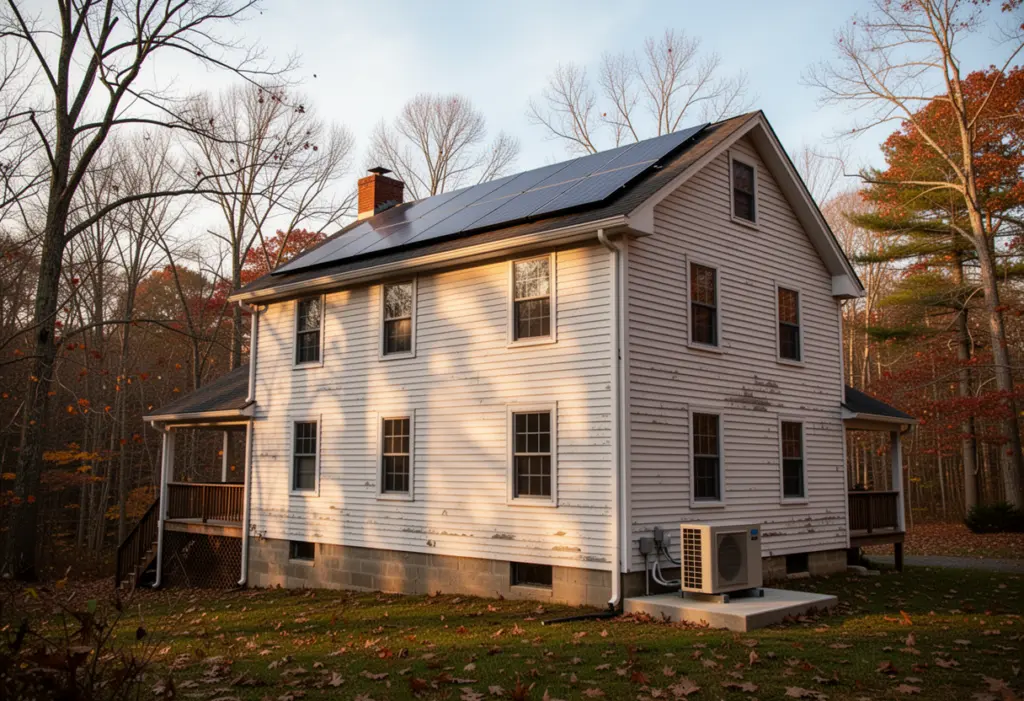
Yes, a cold climate heat pump and a rooftop array belong on the same New York house, and the combination is now ordinary. What decides whether it goes smoothly is not the panels. It is your electrical service, the order you tackle the two projects in, and whether anybody modelled the heating load before a solar designer modelled the roof.
Buy the load calculation before you buy anything else
A heat pump is a large new circuit. So is a solar inverter, and so is an EV charger if one is on the horizon. Plenty of New York housing stock still runs on a 100 amp service, and three additions of that size do not all fit behind it. An electrician can produce a load calculation in an afternoon, and it is the single most useful thing to pay for before signing either contract, because a service upgrade can easily exceed the gap between two competing solar bids.
Ask for the result in writing. Ask separately whether the main panel has physical breaker positions free, because space and amperage are two different limits and a load calculation only answers one of them.
Order of operations
If both projects will happen within a year or two, run them in whatever order the money allows, but design for the finished house from the beginning. In practice that means the heating contractor hands you an expected annual kilowatt-hour figure for the heat pump, the solar designer works from that figure rather than from your old bills, and the inverter and service panel are chosen with the second project already drawn rather than bolted on afterwards.
Correcting this later is not a small edit. Expanding an array means a fresh interconnection application with your utility, a fresh permit, and a crew mobilised a second time for work that could have been done once.
Backup heat is the part that surprises people
Many heat pump installations carry electric resistance backup for the coldest hours, and resistance heat draws far more power than the heat pump it is propping up. If the controls hand over readily, or the changeover temperature is set conservatively by a technician who does not want callbacks, your February consumption will not resemble anybody’s estimate.
Three questions cover it. What form does the backup take. At what outdoor temperature does it engage. Can the changeover point be adjusted after a winter of real data. Ask as well for the manufacturer’s capacity figures at low outdoor temperatures rather than the headline rating, because a cold climate unit publishes output at several temperatures and only the low ones describe a New York January.
What the two systems do not share
They feel like one project and they are two.
- Separate incentive tracks. Solar support and heat pump support are administered by different programmes, and heat pump money often flows through your electric or gas utility rather than through the solar contractor. A solar proposal that folds a heat pump rebate into its savings column is quoting something it does not control.
- Separate approvals. The solar work goes through utility interconnection and an electrical inspection. The mechanical work does not touch that process at all.
- Separate warranties. Nobody warrants the combination. If the winter bill disappoints, each contractor can reasonably point at the other, which is the argument for keeping both scopes and both assumptions in writing.
The charge that follows capacity, not output
Sizing an array around a heat pump makes it larger, and in New York a larger array carries a larger fixed monthly charge. The Customer Benefit Contribution is billed per kilowatt of DC system size every month on systems interconnected on or after 1 January 2022, whether or not the sun appeared. At the 2026 NYSEG residential rate of $1.19 per kW-month an 11 kW array pays $13.09 a month, roughly $157 a year, in January exactly as in July. The same array under Orange & Rockland pays $11.00 a month at that utility’s 2026 rate of $1.00.
None of that argues against sizing for the heat pump. It argues against padding beyond the load, because capacity you never consume still bills you every month. The rates are recalculated annually and are not locked in at interconnection, so treat them as a moving line in your arithmetic rather than a fixed one.
If your power comes from a village or city utility
A municipal electric customer sits outside the Public Service Commission framework entirely: no state net metering rules, no Customer Benefit Contribution, and an interconnection process written locally. That changes the heat pump case as much as the solar case, because it changes how surplus generation is credited against winter consumption. Read the utility name printed on your own bill before assuming any of this applies to you.
Incentives as they stand in 2026
Start with what is not on offer. NY-Sun, NYSERDA’s per-watt incentive, is applied by the contractor as a reduction in the contract price rather than paid to you, and its Affordable Solar blocks for income-qualified households worked the same way. As of September 2026 NYSERDA has no open NY-Sun block for homes in any utility territory, Affordable Solar included; check NYSERDA’s NY-Sun dashboard for a new one. A 2026 bid that nets a NY-Sun amount off the price is worth challenging until the installer shows you the open block.
New York does still offer the 25% state credit capped at $5,000 on Form IT-255 for equipment at your principal residence, and the residential sales tax exemption on the equipment itself. The 30% federal residential credit is gone: section 25D was terminated for expenditures made after 31 December 2025, and an expenditure counts as made when the original installation is completed. A 2026 proposal still carrying a 30% federal line is materially wrong and worth challenging. Programmes move, so read the NYSERDA and Department of Taxation and Finance pages on the day you sign rather than trusting a printed brochure.
Frequently Asked Questions
Should I install the heat pump or the solar panels first?
Either order works, but design for the finished house from the start. Get an expected annual kilowatt-hour figure for the heat pump first and hand it to the solar designer, because expanding an array later means a second interconnection application and a second permit.
Will my electrical service handle a heat pump and solar together?
Often not on a 100 amp service. Pay an electrician for a load calculation before either contract is signed, and ask separately whether the main panel has free breaker positions, since space and amperage are different limits.
Do heat pump and solar incentives come from the same place?
No. They are separate programmes, and heat pump support frequently comes through your electric or gas utility rather than the solar contractor. Treat any rebate a solar proposal claims on the heating side as unconfirmed until the utility confirms it.
Does sizing an array for a heat pump raise a fixed monthly charge?
Yes. The Customer Benefit Contribution is billed per kilowatt of DC capacity regardless of output. At the 2026 NYSEG residential rate of 1.19 dollars per kW-month an 11 kW array pays 13.09 dollars a month, about 157 dollars a year, in winter as well as summer.
This article is general information, not tax, legal or financial advice. Incentive amounts, eligibility rules and deadlines change and depend on your utility, your tax situation and your property. Confirm current terms with NYSERDA, your utility and a qualified tax professional before making a decision.
NY Solar Incentives
Independent New York solar research. We summarise NYSERDA, NY-Sun and federal programme rules from published sources and state plainly when a figure is an estimate. We are not a government agency and do not sell equipment.
Run the arithmetic on your own system
Check the dated program table and your arrangement before counting an incentive. Standard residential NY-Sun blocks are closed; Long Island Affordable Solar has a conditional income-verification route. The NY credit depends on qualified costs and tax liability, while the NYC abatement reduces future property-tax bills. The estimator keeps those timings separate.