Charging on a Regular Outlet: What It Really Gives You
A household socket returns a predictable amount of range overnight. Run the arithmetic against your own driving before assuming you need a 240-volt circuit.
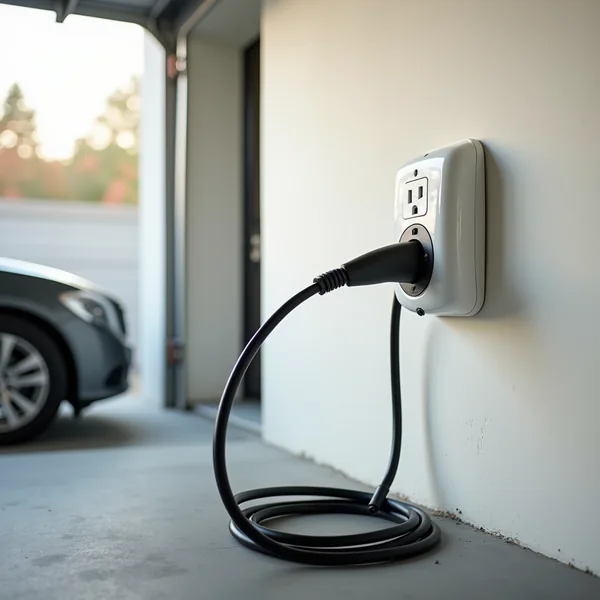
The arithmetic that tells you whether the cord supplied with the car is enough, and what to check on the circuit before you rely on it nightly.
Most electric cars are supplied with a portable cord that plugs into an ordinary wall socket, and where one is not in the trunk it can be bought outright. Nothing else is required — no permit, no electrician, no installation. That fact gets buried under advice to install a 240-volt circuit before the car arrives, and for a large share of New York drivers the advice is premature.
The honest version is arithmetic, not opinion. A household socket delivers a known amount of energy per hour, a car consumes a known amount per mile, and the two numbers decide whether the cord in the boot is sufficient or whether it is a stopgap. Here is how to run that calculation for your own driving, and what to check on the circuit before you rely on it every night.
What charging on a regular outlet actually delivers
The energy budget of a household socket
A standard American receptacle supplies nominally 120 volts. The branch circuit behind it is protected at 15 or 20 amps, and an appliance drawing current for hours on end is treated as a continuous load, which by code may occupy no more than 80 percent of the breaker rating. On a 15-amp circuit that ceiling is 12 amps.
Multiply it out and the socket is delivering something on the order of 1.4 kilowatts. Most portable cords supplied with cars are set to draw 12 amps for exactly this reason; some allow a lower setting for circuits you do not trust, and a few will draw 16 amps but only on a 20-amp circuit that is not shared with anything else.
Convert that to distance and the picture becomes concrete. A typical electric car uses somewhere between a quarter and a third of a kilowatt-hour per mile in mild weather, so roughly 1.4 kilowatts buys four to five miles of range for every hour the car is plugged in. Twelve hours overnight is therefore something like 50 miles recovered, every night, without touching the electrical system.
Whether that is enough for your driving
Compare it against how far you actually drive, not against how far you might. The relevant figure is your daily average across a normal week, including the errands, and the test is simple: if the overnight recovery exceeds the daily average, the battery trends upward and the cord is sufficient indefinitely. A weekend trip drains the buffer and the following week refills it.
Three situations change the answer:
- Long commutes. A daily round trip beyond roughly 50 miles outruns the overnight recovery and the battery loses ground week by week.
- Winter. Cold reduces range and, more importantly for this calculation, some of the incoming energy goes into warming the battery instead of filling it. A slow supply can be substantially consumed by conditioning before it charges anything.
- A short parking window. Recovery is per hour, so a car home for six hours gets half of the twelve-hour figure.
Comparing the realistic options
| Supply | Roughly what it delivers | Overnight recovery | What it costs to set up |
|---|---|---|---|
| Shared household socket, cord set to a reduced current | Around a kilowatt | Modest; suits a plug-in hybrid or a second car | Nothing |
| Dedicated 15-amp circuit, cord at full current | Around 1.4 kilowatts | Enough for the average daily distance of most drivers | One circuit, if the panel has room |
| Dedicated 20-amp circuit, cord capable of 16 amps | Around 1.9 kilowatts | Roughly a third more than the above | One circuit plus a cord that supports it |
| 240-volt circuit with wall equipment | Several times either figure | A full battery from nearly empty | A circuit, equipment, a permit and an inspection |
The middle two rows are where most people find they already are, or can get to for the price of one afternoon of electrical work rather than a project.
The circuit itself deserves a look
Drawing 12 amps continuously for eight hours is not what most household wiring sees. It is entirely within the design, but it is unforgiving of installations that were already marginal, and a socket in an older house may be exactly that.
Give it a circuit of its own
The single most useful improvement is a dedicated circuit: one breaker, one socket, nothing else on it. Sharing with a freezer, a dehumidifier or a workshop is how nuisance trips start, and in a garage the sockets are frequently daisy-chained along one circuit with the door operator.
Check the receptacle before you trust it
Warmth at the plug after an hour of charging is a warning, not a quirk. It usually means a loose connection, a worn receptacle whose contacts no longer grip, or a back-stabbed terminal that was never as good as a screw connection. Any of the three is cheap for an electrician to correct and expensive to ignore. Replacing a tired receptacle with a good-quality one on screw terminals is often the whole fix.
No extension cords, no power strips
Manufacturers say this and they mean it. The cord supplied with the car has protective electronics at the plug end that assume a direct connection; an extension lead adds resistance and another pair of contacts to heat up, and a power strip adds a switch and a breaker never designed for a continuous multi-hour load.
Outdoors, three details matter
An outdoor socket needs ground-fault protection, a weather-resistant receptacle and an in-use cover deep enough to close over the inserted plug. The last one is the one people miss: a flip-lid cover that cannot shut around the cord leaves the connection open to rain and snow all winter. Route the cord so it does not lie where it will be walked on, driven over or buried under a plough line.
The New York wrinkles
Two things are specific to a New York winter. First, an unheated garage is meaningfully better than a driveway even though it is not warm, because the car begins conditioning from a higher starting temperature and less of the incoming energy is spent on heat. Second, if you are on a time-of-use rate the slow supply is actually an advantage: the car can sit on the cheap overnight window for its entire duration without ever finishing early, which is the same load-shifting logic behind running battery storage on a time-of-use rate. Schedule the start time in the car rather than at the socket.
Renters and apartment residents are the group for whom this matters most, since a 240-volt circuit means a landlord conversation and a permit, while a socket in a garage or on a porch means neither. The wider set of options is covered in energy options for renters in New York.
When it is time to stop and wire a proper circuit
Four signals, any one of which is sufficient:
- The battery is lower each Monday than the Monday before, across a normal month.
- You are rearranging your week around charging, or topping up at public chargers you would rather not use.
- A second electric car joins the household and one socket now serves both.
- Winter alone pushes you short, even though the rest of the year is comfortable.
At that point the constraint moves from the socket to the panel, and the question becomes whether the service has room for a new two-pole circuit alongside whatever else is already installed — the same calculation described in when an electrification project needs a panel upgrade. Where the panel is full, load management is often cheaper than a service upgrade. And if generation is part of the plan, the interaction between the two is set out in EV charging and solar panels in New York.
The point of running the arithmetic first is that it costs nothing and it frequently returns the answer that the cord already in the boot is adequate. Drive on it for a month, watch what the battery does, and buy the upgrade you can demonstrate you need rather than the one that was assumed.
Frequently Asked Questions
How many miles of range does a regular outlet add per hour?
The arithmetic is straightforward: a standard receptacle on a 15-amp circuit supplies roughly 1.4 kilowatts once the continuous-load derating is applied, and a typical electric car uses about a quarter to a third of a kilowatt-hour per mile in mild weather. That works out to somewhere around four to five miles per hour of charging, less in cold weather.
Is it safe to charge an electric car from a household socket every night?
Yes, on a sound circuit. The load is within what household wiring is designed for, but it is continuous, which is unforgiving of marginal work. Use a dedicated circuit if you can, never an extension cord or power strip, and treat any warmth at the plug as a fault to be corrected rather than as normal behavior.
Do I need a permit or an electrician to charge on an existing outlet?
No. Plugging into a receptacle that is already installed is ordinary appliance use. A permit and a licensed electrician become necessary when you add a new circuit, install a new receptacle, or fit permanently mounted 240-volt equipment, all of which are electrical work subject to inspection.
Why does charging get slower in winter?
Two effects stack. The vehicle uses more energy per mile in cold weather, and some of the incoming supply is diverted into warming the battery before it charges it. On a slow supply that second effect is proportionally large, which is why an unheated garage still beats an open driveway: the car starts from a higher temperature.
Can I use an extension cord if the socket is out of reach?
Manufacturers advise against it and the reasoning is sound: extra resistance, an extra pair of contacts that can heat up, and protective electronics designed to sit at the wall. If the socket is out of reach, the correct fix is to have an electrician add a receptacle where the car parks, which is inexpensive compared with a full 240-volt installation.
Should I upgrade to a 240-volt circuit straight away?
Only if the arithmetic says so. Compare your daily average driving distance against the overnight recovery from the socket you have. If the battery holds its level across a normal month, the cord is sufficient. Upgrade when a long commute, a second car or winter conditions demonstrably outrun what the socket can return.
Does a time-of-use rate change how useful slow charging is?
It makes it more useful rather than less. A slow supply can occupy the entire off-peak window without finishing early, so essentially all of the energy is bought at the lower price. Set the start time in the vehicle’s own schedule so charging begins when the cheaper period does.
NY Solar Incentives
Independent New York solar research. We summarise NYSERDA, NY-Sun and federal programme rules from published sources and state plainly when a figure is an estimate. We are not a government agency and do not sell equipment.
Run the arithmetic on your own system
Check the dated program table and your arrangement before counting an incentive. Standard residential NY-Sun blocks are closed; Long Island Affordable Solar has a conditional income-verification route. The NY credit depends on qualified costs and tax liability, while the NYC abatement reduces future property-tax bills. The estimator keeps those timings separate.