Service Entrance Cable Size in New York: What Decides It
The service entrance conductors are sized against the whole house at once, which makes them the quiet constraint on many New York electrification projects. Here is what moves the number, and who settles it.
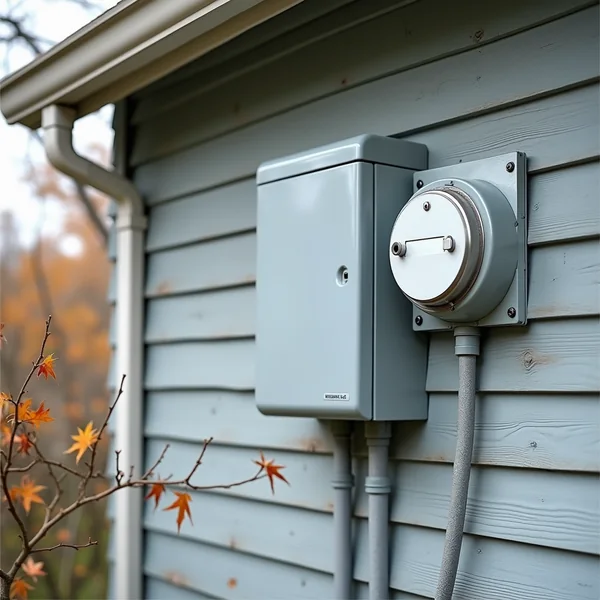
The five things that actually set the size of the cable feeding your house, and why the number is settled by a load calculation and an inspector rather than by a chart.
What decides service entrance cable size on a New York home
The service entrance conductors are the stretch of cable between the utility’s
connection point and your main disconnect — the last piece of wire before the
electricity becomes yours. Everything past the main breaker is sized against one
circuit at a time. This cable is sized against the entire house at once, which is
why it turns out to be the quiet constraint behind so many New York
electrification projects: the heat pump fits, the range fits, the charger fits,
and then the cable feeding all three does not.
Most homeowners approach the question backwards. They read the amp rating
stamped on the main breaker and assume the cable matches it. Usually it does. But
a breaker rating is a decision somebody made, and a conductor size is a
calculation somebody performed, and in an older house in Buffalo or Yonkers the
two can quietly disagree — because the panel was swapped in the 1990s and the
cable running to it from the weatherhead was left where it was.
The inputs an electrician actually works from
The calculated load, not the appliance list
The starting point is not what you own, it is what the code says your dwelling
demands. A standard load calculation assigns fixed allowances for general lighting
and receptacles based on floor area, adds the fixed appliances, applies demand
factors that recognise a house never runs everything at once, and treats heating
and cooling as the larger of the two rather than the sum. The result is a
calculated load in amperes, and that number is what the conductor has to carry.
The dwelling-service allowance
Residential service conductors get a concession that feeder and branch
conductors do not. The code permits the main service and main power feeder of a
one-family dwelling to be sized on a reduced ampacity figure rather than the full
value the same conductor would need elsewhere, on the reasoning that a house’s
peak is brief and diversified. It is the provision most responsible for the gap
between what a homeowner calculates from a general ampacity table and what an
electrician actually pulls. The exact factor lives in the code edition your
jurisdiction has adopted, which is where it should be read from.
Copper or aluminium
Aluminium carries less current than copper of the same physical size, so an
aluminium service is always a larger cross-section for the same rating. Almost
every modern residential service entrance in New York is aluminium, for weight and
cost reasons, and that is entirely normal — the concerns people remember about
aluminium wiring in the 1960s and 1970s are about small branch conductors and
their terminations, not about service-size cable. What matters is that the
terminations are listed for the metal actually used and made up correctly, which
is an inspection item.
The termination temperature, which quietly governs
A conductor’s insulation may be rated for a high operating temperature, but the
lugs it lands on inside the meter enclosure and the main breaker are rated for
their own, usually lower, temperature. The code requires the whole combination to
be sized at the lowest-rated component in the path. This is the step most often
missed by someone reading an ampacity chart alone, and a common reason an
electrician specifies a size larger than a homeowner expected.
Length of run and voltage drop
Ampacity keeps the cable from overheating; it says nothing about whether the
voltage arriving at the panel is still usable. On a long run — a detached
garage, a house set well back from the road on a rural lot upstate, a riser up the
outside of a three-storey building — voltage drop can push the size up a step
even though the ampacity calculation was already satisfied. Voltage drop guidance
is advisory rather than mandatory, but ignoring it produces a house with dimming
lights and a heat pump that trips on low voltage in January.
How each input moves the answer
| Input | Which way it moves the conductor size | Who settles it |
|---|---|---|
| Calculated dwelling load | Sets the floor. Adding a heat pump, a charger and an induction range raises it | The electrician’s load calculation, reviewed with the permit |
| Dwelling-service allowance | Reduces it, relative to a general ampacity table | The code edition your jurisdiction has adopted |
| Conductor material | Aluminium needs a larger size than copper for the same rating | Design choice, then the inspector confirms terminations match |
| Termination temperature rating | Can force a size up regardless of the insulation rating | The listings on the meter socket and main breaker |
| Length of run | Long runs push it up a step for voltage drop | The electrician, using an advisory code provision |
| Installation method | Overhead, buried or in conduit each change the permitted cable type | Code plus the utility’s own service requirements |
| Utility service standard | Fixes the attachment point, meter position and clearances the cable must reach | Your utility’s published construction standard |
Overhead, underground and what changes between them
An overhead service ends at a weatherhead and drops through cable rated for sun
and weather exposure. An underground service uses a different cable type or runs
in conduit, has to survive being wet along its whole length, and is subject to
burial depth rules. The two are not interchangeable. When a New York homeowner
converts an overhead drop to an underground lateral — common when a driveway
or an addition is rebuilt — the conductor question reopens from the start,
because the ampacity conditions changed along with the cable type.
The New York layer on top of the national code
New York State’s Uniform Code adopts a national electrical standard with state
amendments, administered by your local code enforcement office. New York City is
different: it maintains its own Electrical Code, with its own amendments and its
own filing and inspection route, so a specification that is routine in Rochester
may need different treatment in Queens. On top of either, your utility publishes a
service standard governing where the point of attachment sits, how the meter is
mounted and what clearances the cable has to hold. The conductor has to satisfy
all three, and the one people forget is the utility’s, because it is not part of
the electrical code at all. In practice the size is settled by a licensed
electrician working to the adopted edition, filed on a permit and confirmed at
inspection.
What this means if you are planning to electrify
If you are staging a project — and staging is the right way to do it
— the service entrance question belongs at the front, not after the equipment
is chosen. Our walkthrough of
the right order to electrify a New York home makes the same
argument from the other direction, and
when a project needs an electrical panel upgrade covers the
panel itself, which is a separate decision from the cable feeding it. A charger is
usually the load that exposes the problem first, and the
EV charging and solar piece walks through how it interacts with
everything else on the service; capacity for heating is handled in the
heat pump sizing guide.
The useful sequence is: get a load calculation for the house you intend to have
in five years, not the one you have now; let the electrician establish whether the
existing conductors support it; and only then decide between upgrading the service
and managing the load so an upgrade is not needed. Load management devices and
circuit-sharing arrangements are recognised by the code precisely because a service
upgrade is expensive and sometimes avoidable.
What you can check yourself, and what you must not touch
You can read the rating on the main breaker, photograph the label inside the
panel door, note whether the service arrives overhead or underground and roughly
how far the cable runs, and find whether the utility has already recorded a service
size — which comes up in the same paperwork as
a meter exchange.
What you should not do is open the meter enclosure or the service equipment.
The service entrance conductors are energised ahead of your main breaker, and
nothing you can switch off in the house de-energises them. Only the utility can.
That is not a caution about voiding a warranty; it is the reason this particular
cable is the one part of a residential electrical system a competent
do-it-yourselfer still leaves alone.
When the cable, not the panel, is the bottleneck
A few patterns repeat in older New York housing stock: a panel upgraded without
the service being upgraded; a service that was adequate for a gas-heated house and
is not adequate once heating becomes electric; a long rural lateral where voltage
drop rather than ampacity governs; and multi-family buildings where the apartment
feeders are fine but the building’s own service is the ceiling for everybody. The
fix has the same shape every time — a load calculation, a licensed
electrician, a permit, and a conversation with the utility. The cable size falls
out of that work. It is not a number you choose in advance.
Frequently Asked Questions
Is service entrance cable size always the same as the main breaker rating?
Not necessarily. The breaker rating is a decision; the conductor size is a calculation. In older New York houses a panel is often replaced without the service conductors being replaced, which leaves a modern breaker fed by an older, smaller cable. Only a load calculation and an inspection of the actual conductors can confirm they match.
Why does an electrician sometimes specify a larger cable than an online chart suggests?
Usually because of the termination temperature rating. The lugs in the meter enclosure and main breaker have their own temperature rating, and the code requires the conductor to be sized at the lowest-rated component in the path. Voltage drop on a long run is the other common reason.
Does aluminium service entrance cable mean the installation is inferior?
No. Aluminium is standard for residential service entrance conductors and is used at a larger cross-section to carry the same current as copper. The historical concerns people remember relate to small aluminium branch wiring and its terminations, not to service-size cable. Correct, listed terminations are what matter, and they are an inspection item.
Do I need a bigger service entrance cable before adding a heat pump or an EV charger?
Sometimes, and sometimes not. A load calculation for the house as you intend it to be, rather than as it is today, answers this. Where the calculation lands close to the limit, a load management device or a circuit-sharing arrangement is recognised by the code and can be considerably cheaper than a service upgrade.
Who has the final say on service entrance cable size in New York?
Three parties, and the conductor has to satisfy all of them: the licensed electrician working to the code edition your jurisdiction has adopted, the local code enforcement office through the permit and inspection, and your utility through its published service standard governing the attachment point, meter position and clearances. New York City administers its own Electrical Code separately from the rest of the state.
Can I measure the existing cable myself to work out its size?
You can note whether the service is overhead or underground and read the main breaker rating, but you should not open the meter enclosure or service equipment. Those conductors are energised ahead of your main breaker and nothing inside the house de-energises them. Identifying the existing conductor is work for a licensed electrician, with the utility involved where the meter has to come off.
NY Solar Incentives
Independent New York solar research. We summarise NYSERDA, NY-Sun and federal programme rules from published sources and state plainly when a figure is an estimate. We are not a government agency and do not sell equipment.
Run the arithmetic on your own system
Check the dated program table and your arrangement before counting an incentive. Standard residential NY-Sun blocks are closed; Long Island Affordable Solar has a conditional income-verification route. The NY credit depends on qualified costs and tax liability, while the NYC abatement reduces future property-tax bills. The estimator keeps those timings separate.