The Real Cost of Installing Solar Panels in New York
The contract price and the household's final position are two different numbers. Here is the order incentives arrive in, the exemptions that never show on a quote, and what makes one quote higher than another.
On this page 9 sections
- 01Gross price, net price, and the gap between them
- 02What actually moves the price per watt
- 03NY-Sun used to come off first, at the contract
- 04The federal credit no longer reduces the cost of installing solar panels in New York
- 05The state credit arrives on a return, not on an invoice
- 06Two exemptions that never appear as a line on the quote
- 07In New York City, the abatement is slower still
- 08Financing changes the cost even when the price does not
- 09Frequently asked questions
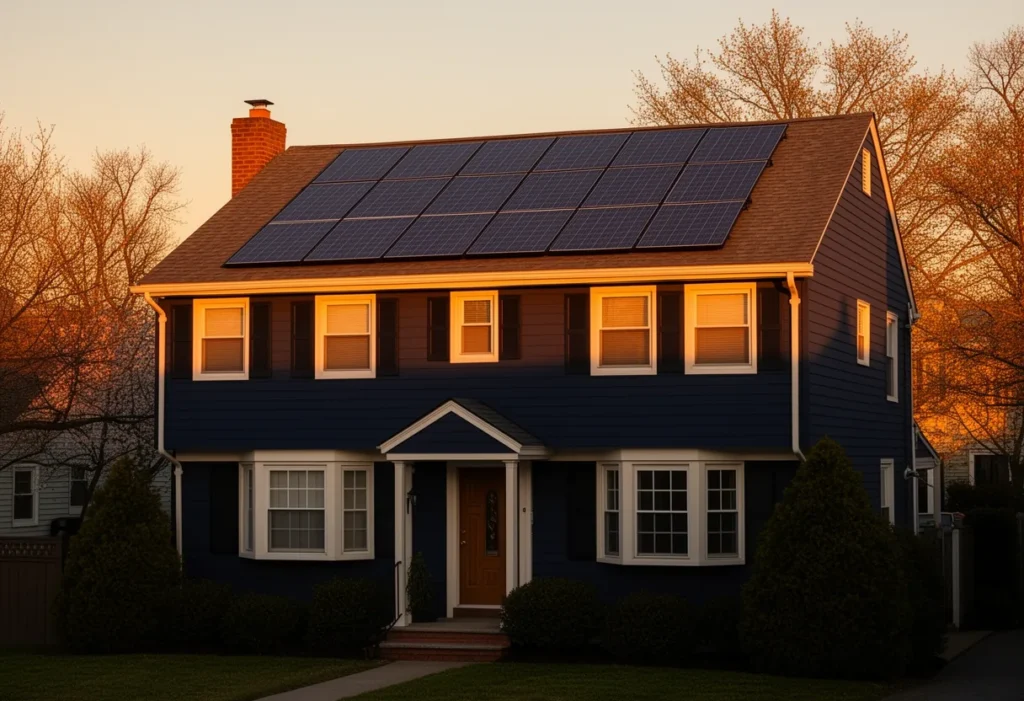
There are two numbers in every solar project and people conflate them constantly. One is the contract price. The other is what the household is actually out of pocket once every incentive has done what it does.
The cost of installing solar panels in New York depends less on which number you start with than on the order in which they arrive. One used to cut the invoice before you signed and, for homes, currently does not; others arrive a year later on a tax return, and only if you owe enough state tax to absorb them. Two never appear on the quote at all.
Gross price, net price, and the gap between them
The gross price is system size in watts multiplied by a price per watt, covering equipment, labour, permits, interconnection and overhead. The net contract price is what remains after any NY-Sun deduction — the figure you sign for and the figure any loan is written against. With no residential NY-Sun block open as of September 2026, on a home quote today the two are the same number. The final position is different again, because the state credit arrives later and, in New York City, a property tax abatement later still. Those two do not reduce what you borrow; they reduce what you owe elsewhere.
What actually moves the price per watt
Two households in the same county can get materially different quotes for the same nameplate capacity, and the reason is usually physical rather than commercial.
- Roof material, pitch and condition. Slate and tile take longer to flash than asphalt, and a steep pitch adds fall protection. A roof near the end of its life is worth replacing first, because removing and reinstalling an array later is a job you pay for twice.
- Access and structure. A row house where material is carried through the building costs more to work on than a detached house with driveway parking, and older framing sometimes needs strengthening first.
- The electrical service panel. The most common surprise in a scope. Too little spare capacity or too low a rating for the interconnection adds an upgrade — and in the city, its own filing.
- Equipment tier. Higher-efficiency modules cost more per watt but fit more capacity onto a small or shaded roof, which in the city is often the binding constraint.
- Permitting and review. Requirements differ by jurisdiction, and a landmarked building or historic district adds a visibility review.
When two quotes diverge, ask which of these each installer assumed rather than which company is cheaper.
NY-Sun used to come off first, at the contract
NYSERDA’s NY-Sun programme has paid a per-watt incentive for qualifying residential systems installed by participating contractors. It was paid to the contractor, not the homeowner, and a compliant contract showed it as a deduction. As of September 2026 NYSERDA has no open NY-Sun block for homes in any utility territory; check NYSERDA’s NY-Sun dashboard for a new one.
Its rate stepped down as regional megawatt blocks filled — New York is split broadly into Upstate, Con Edison territory and Long Island, each with its own block sequence, and the rate that applied was the one in effect when a project was registered. Con Edison’s last standard residential block closed on 29 May 2025 and Upstate’s on 17 December 2025, and the income-qualified Residential Affordable Solar blocks that followed closed on 15 October 2025 (Con Edison) and 9 March 2026 (Upstate). Because it landed before you paid anything, it had the largest effect on cash flow while a block was open. How the steps worked is set out on the NY-Sun incentive page.
The federal credit no longer reduces the cost of installing solar panels in New York
For buyers, the federal residential clean energy credit is finished. The One Big Beautiful Bill Act, signed 4 July 2025, moved the termination of the section 25D credit to 31 December 2025. A system bought and whose installation was completed in 2026 generates no federal credit for the homeowner, with no phase-down and no transition rule.
If your installation was completed in 2025, the previous rules applied and unused credit can generally be carried forward against later federal liability — worth raising with whoever prepares your return rather than assuming it is lost.
There is one live federal thread, and it does not run through your return. A business-side credit still applies to the company that owns a leased or third-party-owned system. That company can price part of its benefit into what it charges you, which is why some lease, power purchase and community solar offers still reference a federal incentive. You are not claiming it; the owner is.
This changes the buy versus lease comparison
Buying used to carry a large federal advantage that offset its higher upfront cost. In pure tax terms that advantage has gone, while the business-side credit available to system owners has not. That does not automatically make a lease better — ownership still captures all the production and the resale value — but the comparison is closer than it was. The lease versus buy analysis works through it.
The state credit arrives on a return, not on an invoice
New York’s solar energy system equipment credit is claimed on Form IT-255 with your state income tax return. It is a percentage of qualified expenditure, subject to a statutory cap, and applies to purchased systems and to some lease and PPA arrangements.
Two points follow. It only helps to the extent you have New York tax liability, with the balance generally carried forward; and it arrives when you file, which for a system installed early in a year can be a year or more after the invoice was paid. Confirm the current percentage, cap and carryforward rules with the Department of Taxation and Finance; the page on Form IT-255 explains where it sits in a return.
Two exemptions that never appear as a line on the quote
Two further exemptions lower the real cost without appearing as a deduction. Residential solar equipment and its installation are exempt from the state’s portion of sales tax, and local jurisdictions may elect the same — invisible by design, because the tax is simply not charged. Separately, state law (Real Property Tax Law section 487) exempts the increase in assessed value attributable to a solar system for 15 years, but only if you file form RP-487 with your assessor by the taxable status date, which is March 1 in most towns. Local taxing jurisdictions may opt out, so confirm with your assessor.
In New York City, the abatement is slower still
City properties may also qualify for a solar property tax abatement, filed with the Department of Buildings and applied against the property tax bill in four annual instalments. It is real money, but it arrives as a smaller bill each year rather than cash, and the property needs a tax liability to apply it against. An owner planning to sell within a couple of years captures only part of it — a genuine consideration alongside what happens to solar when a house is sold.
| Stage | What happens | Effect on your cash position |
|---|---|---|
| Quote and contract | No NY-Sun deduction while no residential block is open; no 4% state or MCTD sales tax charged | No state or MCTD sales tax added to what you pay or finance; local sales tax only where the county or city has not adopted the exemption (Publication 718-S, Part 1) |
| Installation and commissioning | Payment schedule per contract; interconnection approval | Cash out, or loan draws begin |
| First state tax filing | State equipment credit claimed on Form IT-255 | Reduces state tax owed, up to your liability |
| Annual assessment | Added value exempt if you filed form RP-487 and the jurisdiction has not opted out | Assessment does not rise for the solar |
| Following years, NYC only | Property tax abatement applied by the city | Lower property tax bill across four instalments |
| Federal return, 2026 purchase | No residential credit available to the buyer | No effect |
Financing changes the cost even when the price does not
A solar loan at an unusually low rate frequently carries a dealer fee, paid by the installer to the lender and recovered inside the system price. Two quotes at the same headline price can therefore represent different amounts of solar for your money.
Ask each installer for a cash price and a financed price for the identical system; the difference is the cost of the financing, however it is labelled. NYSERDA-supported loans are compared on the solar loans page.
Write out the cash timeline before signing
List the dates money leaves your account and the dates any credit or abatement reduces a bill. A state credit sitting fourteen months out, and a city abatement spread across four years, tends to change which financing option looks sensible.
Frequently asked questions
What do I actually pay on installation day?
Whatever the contract’s payment schedule specifies, based on the contract price; with no residential NY-Sun block open, there is no NY-Sun deduction to subtract. Most schedules split it between a deposit, a payment at substantial completion and a final payment after interconnection approval. The state credit and any NYC abatement play no part in that day’s numbers.
What if I owe very little New York State income tax?
The state equipment credit only offsets tax you actually owe, so a small liability limits how much you can use in one year. Unused amounts can generally be carried forward. Check your recent state returns before treating the full credit as guaranteed value, and confirm the rules with the Department of Taxation and Finance.
Does a solar loan increase the cost of installing solar panels?
Often yes, beyond the interest itself. Low advertised rates are frequently funded by a dealer fee embedded in the system price, so the financed system costs more than the same one bought with cash. Ask for a cash price and a financed price for an identical design.
Are lease and PPA offers now cheaper than buying?
In tax terms the gap has narrowed, because buyers no longer receive a federal credit while the company owning a leased system may still claim a business credit. Ownership still captures all the electricity value and any resale benefit, so it depends on your tax position and how long you stay.
Check current figures before you rely on them
NY-Sun has no residential block open as of September 2026, the state credit’s percentage and cap are statutory, and the property tax exemption depends on filing form RP-487 and on local opt-outs. Verify with NYSERDA, the Department of Taxation and Finance, your assessor, and the NYC Department of Buildings.
This article is general information, not tax, legal or financial advice. Incentive amounts, eligibility rules and deadlines change and depend on your utility, your tax situation and your property. Confirm current terms with NYSERDA, your utility and a qualified tax professional before making a decision.
NY Solar Incentives
Independent New York solar research. We summarise NYSERDA, NY-Sun and federal programme rules from published sources and state plainly when a figure is an estimate. We are not a government agency and do not sell equipment.
Run the arithmetic on your own system
Check the dated program table and your arrangement before counting an incentive. Standard residential NY-Sun blocks are closed; Long Island Affordable Solar has a conditional income-verification route. The NY credit depends on qualified costs and tax liability, while the NYC abatement reduces future property-tax bills. The estimator keeps those timings separate.