Solar Panel Installation in New York State: Step by Step
A New York solar installation is roughly seven stages, only one of which involves anyone on your roof. This is what happens at each one and where projects usually stall.
On this page 8 sections
- 01Solar panel installation in New York starts before a quote exists
- 02Where the NY-Sun incentive is applied, and where it stands in 2026
- 03Permits are local, and that is where timelines diverge
- 04What happens at each stage, and what stalls it
- 05Installation day is short, and the inspection queue is not
- 06Interconnection and permission to operate
- 07The tax side has changed, and it changes the comparison
- 08Frequently asked questions
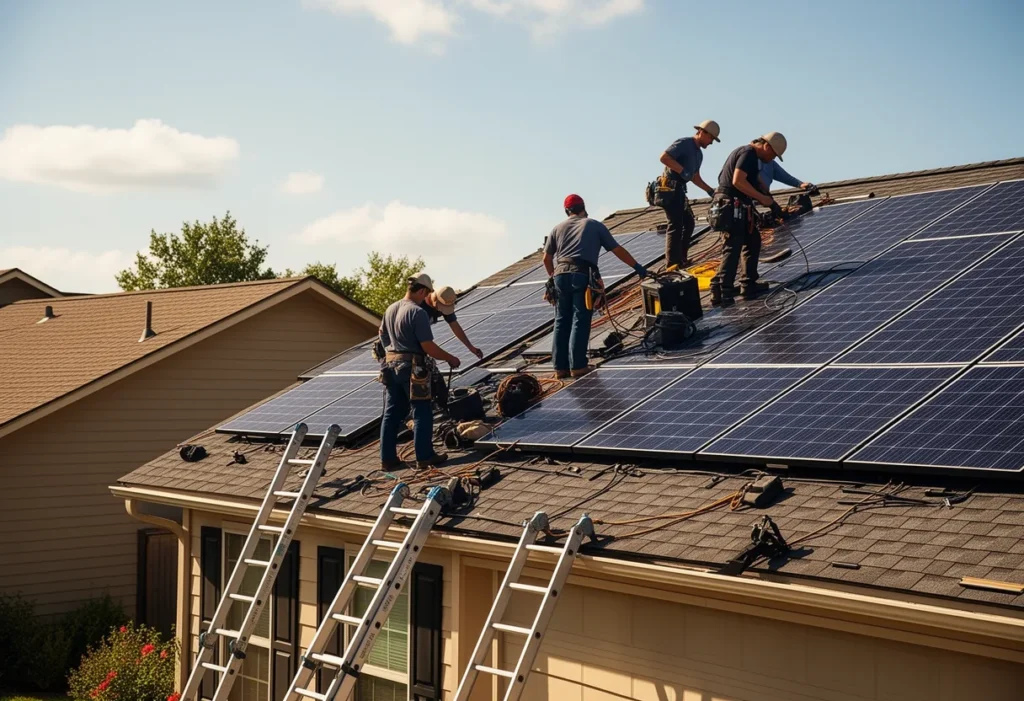
A solar panel installation in New York looks, from the outside, like a single day of work. In practice it is a sequence of roughly seven stages, only one of which involves anyone standing on your roof.
The stages differ from most home improvement projects because two outside parties can hold the job up indefinitely: the local permitting authority and the utility. Understanding where each one sits in the sequence explains most of the waiting.
Solar panel installation in New York starts before a quote exists
The first stage is a remote assessment. An installer pulls satellite imagery, roof measurements and a year of your electricity usage, then models a system size against that consumption. Nothing is binding at this point and no one has seen the property.
Usage history is the input that matters most. A system sized against a summer bill rather than twelve months of data will be wrong, and in New York the seasonal spread between a winter heating month and an air-conditioning month can be large. Ask which twelve months were used.
The second stage is the site visit, where an assessor confirms roof condition and framing, measures obstructions, checks the electrical panel and looks at where conduit can run. Designs frequently shrink between the remote model and the site visit, and that is normal rather than a warning sign.
Get the roof’s remaining life on the record
If the roof covering has under roughly a decade left, replacing it before installation is usually cheaper than removing and reinstalling an array later. Ask the assessor to state the roof’s condition in writing as part of the proposal, and treat any refusal to comment as a reason to get an independent roofing opinion.
Where the NY-Sun incentive is applied, and where it stands in 2026
As of September 2026 NYSERDA has no open NY-Sun block for homes in any utility territory; check NYSERDA’s NY-Sun dashboard for a new one. When a block is open, NYSERDA’s NY-Sun programme pays a per-watt incentive, but it is paid to the participating contractor, not to the homeowner. It should therefore appear on the proposal as a deduction from the gross price rather than as a payment you expect later.
The rate is not fixed. It is organised into regional megawatt blocks, and as installed capacity in a region fills a block, the incentive steps down to the next one. Two quotes taken months apart in the same county can legitimately carry different incentive amounts for that reason. The mechanism is explained further in the guide to the NY-Sun incentive programme.
Because the incentive flows through the contractor, only participating contractors can access it. That makes the list of NYSERDA-approved contractors a practical filter as well as a quality signal.
Permits are local, and that is where timelines diverge
New York has hundreds of separate permitting authorities. A town in the Hudson Valley, a village on Long Island and the New York City Department of Buildings all run different processes with different queues, fees and inspection practices.
Many municipalities outside the city have adopted the New York State Unified Solar Permit, a standardised application intended to shorten review for small residential systems. Where it is in use the paperwork is lighter, though a structural or electrical review still happens.
This is the single largest source of variation in how long a New York installation takes. Two identical systems ninety minutes apart can differ by weeks purely because of who reviews the file.
What happens at each stage, and what stalls it
| Stage | Who acts | What commonly stalls it |
|---|---|---|
| Remote assessment and proposal | Installer | Incomplete usage history; unclear roof ownership |
| Site survey | Installer, sometimes an engineer | Roof condition; undersized electrical service |
| Engineering and permit set | Design professional | Structural calculations; equipment substitutions |
| Permit application | Local building department | Review backlog; missing structural detail |
| Interconnection application | Installer to the utility | Circuit capacity studies; incomplete forms |
| Installation | Installation crew | Weather; equipment lead times |
| Inspection and permission to operate | Inspector, then the utility | Inspection scheduling; meter exchange queue |
Installation day is short, and the inspection queue is not
The physical work on a typical detached house is usually one to two days: mounting rails, setting modules, running conduit, fitting the inverter and disconnects, and tying into the service panel. Larger or more complex roofs run longer.
At the end of that work the system is complete but not permitted to run. An electrical inspection and a building inspection follow, and inspection availability varies by jurisdiction. Only after sign-off does the file go back to the utility.
Do not let a contract tie payment to installation alone
A system that is physically installed but not yet approved produces nothing. Read the payment schedule carefully and check whether a final payment is triggered by mechanical completion or by permission to operate. Clarify it before signing rather than after.
Interconnection and permission to operate
New York operates a standardised interconnection process across the investor-owned utilities, with an expedited path for small residential systems. Once inspections are passed, the utility verifies the paperwork, exchanges or reprograms the meter and issues permission to operate.
That letter is the moment the system may legally be switched on and the moment billing changes. From then on, exported energy is credited under New York’s net metering rules, with a separate per-kilowatt charge applied to systems interconnected after the phase-in date. The details are set out in the explainer on net metering in New York.
The tax side has changed, and it changes the comparison
The federal residential clean energy credit under section 25D ended for expenditures made after 31 December 2025. An expenditure counts as made when the original installation is completed, so a system finished in December 2025 but switched on in January 2026 still falls under the old rules. A homeowner who buys a system now, with cash or a loan, claims nothing on their federal return. There is no phase-down and no transition relief. A system whose installation was completed in 2025 was covered by the previous rules, and unused credit from that year can generally be carried forward.
New York’s own credit for solar energy system equipment continues. It is a percentage of qualified expenditure subject to a statutory cap and is claimed on Form IT-255. Notably, New York allows that credit for qualifying lease and power purchase agreements of sufficient length as well as for purchases, which is unusual among state credits.
There is one further consequence worth understanding. A separate business-side credit still applies to the company that owns a leased or third-party-owned system. That is why some lease and PPA offers still price in a federal incentive, even though the homeowner never claims it directly. In pure tax terms this now tilts the comparison toward third-party ownership and community solar in a way it did not before 2026.
Frequently asked questions
How long does a solar panel installation in New York take overall?
The roof work is typically one to two days on a detached house. The full sequence from signed contract to permission to operate is normally measured in months, and the largest variable is the local permitting authority rather than the installer. Ask each company for its current average in your specific town or city.
Do I apply for the NY-Sun incentive myself?
No. When a block for homes is open, NY-Sun is paid per watt to the participating contractor, which applies the value as a reduction on your price. As of September 2026 NYSERDA has no open NY-Sun block for homes in any utility territory; check NYSERDA’s NY-Sun dashboard for a new one before expecting a deduction on a proposal.
Can I turn the system on as soon as it is installed?
No. The system must pass electrical and building inspection, and the utility must then issue permission to operate. Running a system before that approval breaches the interconnection terms and can create billing and safety problems. The gap between mechanical completion and switch-on is a normal part of the process.
Is there still a federal tax credit for buying solar in New York?
Not for a homeowner purchasing a system whose installation is completed in 2026 or later. The section 25D residential credit terminated at the end of 2025. A separate business credit still applies to companies that own leased or PPA systems, which is why some third-party offers continue to reflect a federal incentive in their pricing.
Confirm the numbers before signing
Incentive block rates, credit caps and utility charges change during the year. Verify NY-Sun with NYSERDA, the state credit with the New York State Department of Taxation and Finance, and interconnection terms with your utility. This site is independent and has no affiliation with NYSERDA or any state agency.
NY Solar Incentives
Independent New York solar research. We summarise NYSERDA, NY-Sun and federal programme rules from published sources and state plainly when a figure is an estimate. We are not a government agency and do not sell equipment.
Run the arithmetic on your own system
Check the dated program table and your arrangement before counting an incentive. Standard residential NY-Sun blocks are closed; Long Island Affordable Solar has a conditional income-verification route. The NY credit depends on qualified costs and tax liability, while the NYC abatement reduces future property-tax bills. The estimator keeps those timings separate.