Insulating Around Knob-and-Tube Wiring in an Older New York Home
Active knob-and-tube cannot be buried in insulation under the code New York enforces. What your four real options are, and why 2026 removed the federal credit for the work.
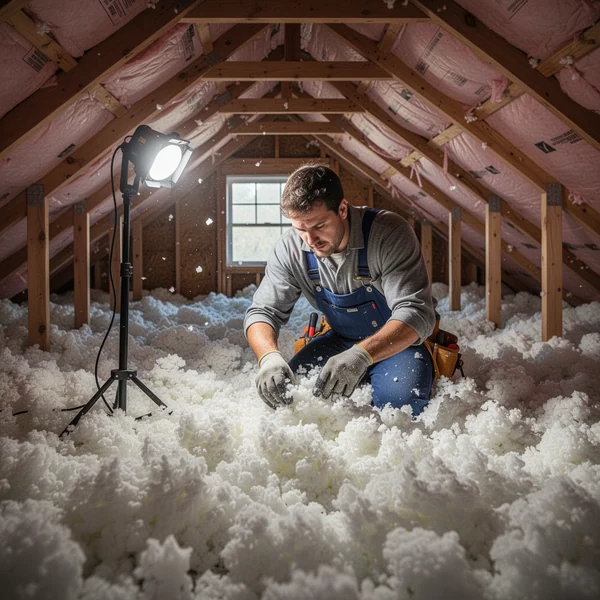
You cannot bury active knob-and-tube wiring in insulation. The National Electrical Code, which New York’s Uniform Fire Prevention and Building Code adopts, prohibits concealed knob-and-tube in hollow walls, ceilings and attic spaces filled with loose, rolled or foamed-in-place insulation that envelops the conductors — which is why an insulation crew will walk into your attic in Albany or Buffalo, look at the ceramic knobs, and stop work.
That is the whole answer, and it is the one most homeowners in New York’s pre-1940 housing stock do not hear until a contractor is already standing in the attic. What follows is what your options actually are, what the energy programmes will and will not pay for, and why the timing changed for 2026.
Why knob-and-tube wiring and insulation don’t mix in New York
Knob-and-tube was designed to shed heat. The two conductors run separately, spaced apart, held off the framing by ceramic knobs and passed through joists in ceramic tubes, with the surrounding air doing the cooling. Rubber-and-cloth insulation on those conductors was never rated for the temperatures it reaches when it is packed in cellulose or fibreglass. Wrap it and the insulation on the wire embrittles, cracks and falls away, leaving bare copper in a combustible cavity.
The relevant code section is in NEC Article 394, which covers concealed knob-and-tube wiring and lists the uses that are not permitted — insulated hollow spaces among them. New York’s Uniform Code references the National Electrical Code, so this is the section your electrical inspector and your weatherization contractor are both working from. Which edition of the NEC your jurisdiction is currently enforcing is worth confirming with your building department, but the knob-and-tube restriction is long-standing and has not softened.
A second problem sits alongside the code one. Knob-and-tube has no equipment grounding conductor. Every three-prong outlet in a house wired this way is either fed by a later circuit or is an ungrounded receptacle someone swapped in, which is a separate defect an electrician will find as soon as they start opening boxes.
What your real options are
1. Rewire the circuits in the area you want to insulate
This is the clean answer and usually the right one. You do not necessarily have to rewire the whole house — you have to remove active knob-and-tube from the spaces that will be insulated. In practice, in a Utica or Kingston foursquare, that is the attic floor and the top-floor knee walls, which is also where most of the heat is leaving.
Scope questions to put to the electrician in writing: how many circuits, whether the panel has space or needs replacing, whether the existing service is adequate, whether the walls will be opened and who patches, and whether the work triggers a permit and inspection with your municipality. In New York City that means a licensed electrician filing with the Department of Buildings; upstate it is a permit from the town or city building department and an inspection by a recognised electrical inspection agency.
2. Abandon it in place, properly
If the knob-and-tube in the attic is dead — superseded years ago by newer circuits — it can often stay where it is, but “we think it’s dead” is not a finding. It must be disconnected at the panel, physically separated from any live source, and verified de-energised by an electrician, ideally with the abandoned runs labelled. Only then does the insulation restriction stop applying to it. Half-abandoned systems are common in New York’s older housing, where circuits were extended piecemeal over eighty years, and it is normal for an electrician to find one attic run still live off a fuse nobody could account for.
3. Insulate only the areas with no knob-and-tube
A partial job is legitimate. Air sealing the attic plane, insulating a rim joist in the basement, or dense-packing a wall cavity that was rewired in the 1970s can all proceed while the untouched knob-and-tube areas wait for the electrician. Ask the contractor to map which cavities are in scope rather than accepting a blanket refusal or a blanket yes.
4. What is not an option
Building a box or a dam around the wiring and insulating around it is not a code-compliant workaround in most New York jurisdictions, and no reputable contractor will certify it. Neither is spray foam over the top of it. If someone offers to do this, the work will not pass inspection and it will surface again when you sell the house.
The insurance problem nobody mentions until renewal
Active knob-and-tube is a common reason a New York carrier declines to write a policy or refuses to renew one, and it is often the event that forces the decision rather than the energy project. If you are buying a pre-war house in Troy, Poughkeepsie or Niagara Falls, ask the question during the inspection contingency, not after closing. The same underwriting logic applies to other visible-equipment changes on an older house — our note on homeowners insurance with solar panels in New York covers how carriers treat electrical and roof changes.
What the programmes pay for, and what changed in 2026
Two things to be clear about before any contractor quotes you.
First, there is no federal credit for insulation or air sealing work done in 2026. Section 25C — the credit that covered insulation, air sealing, doors and windows under a $1,200 annual cap, with $600 for windows and $500 for doors — applied to property placed in service through 31 December 2025. Section 25D terminated for expenditures after the same date. A New York household weatherising this year gets nothing federal. Most of the pages ranking for knob-and-tube and insulation still say otherwise; they are describing a credit that has expired.
Second, electrical remediation is often treated by New York’s income-qualified programmes as a health-and-safety barrier rather than as an energy measure, which is a meaningful distinction: barriers are sometimes addressable with programme funds, sometimes not, and the rules differ by programme and by year. NYSERDA’s EmPower+ is the income-qualified route, and the Weatherization Assistance Program is administered through local sub-grantee agencies county by county. We could not verify current income thresholds or funding caps for either, so do not take a number from an article — call NYSERDA at 1-866-NYSERDA or go to the live programme page and ask specifically how knob-and-tube remediation is handled in your county.
For work you are paying for yourself, financing is often the practical lever. The NYSERDA On-Bill Recovery Loan repays through the utility bill, and rewiring plus insulation is exactly the kind of paired job it exists for. If you are also planning to electrify heating, note that NYS Clean Heat — NYSERDA plus seven sponsoring utilities, Central Hudson, Con Edison, National Fuel Gas, National Grid, NYSEG, Orange & Rockland and RG&E — is a separate programme with its own rebates, found by address at cleanheat.ny.gov. PSEG Long Island is not a Clean Heat sponsor. Our broader guide to New York State renewable energy incentives beyond solar sets out how these fit together.
The order of operations that saves money
Rewire first, insulate second, and only then size any heating equipment. Doing it the other way round means paying twice — once to insulate and once to pull it back out so the electrician can work — and it means a Manual J load calculation done against the leaky version of your house, which oversizes the heat pump you buy next.
What to do next
- Get an electrician into the attic and the basement to map what is live, what is abandoned, and what feeds each circuit. Ask for it in writing, circuit by circuit.
- Ask your building department which NEC edition is currently enforced in your municipality and what permit the rewire needs.
- Call your insurance agent before, not after, and ask what their carrier requires.
- Call NYSERDA at 1-866-NYSERDA and ask how knob-and-tube remediation is treated under EmPower+ and under the Weatherization Assistance Program in your county.
- Price the job with no federal tax credit, and reject any quote that includes one for 2026.
NY Solar Incentives
Independent New York solar research. We summarise NYSERDA, NY-Sun and federal programme rules from published sources and state plainly when a figure is an estimate. We are not a government agency and do not sell equipment.
Run the arithmetic on your own system
Check the dated program table and your arrangement before counting an incentive. Standard residential NY-Sun blocks are closed; Long Island Affordable Solar has a conditional income-verification route. The NY credit depends on qualified costs and tax liability, while the NYC abatement reduces future property-tax bills. The estimator keeps those timings separate.