Curbside EV Charging in NYC: What Exists Today
New York City has curbside Level 2 chargers from a DOT pilot, but none are assigned to your address and no permit lets you run a cable across the sidewalk. Here are the routes that work.
On this page 7 sections
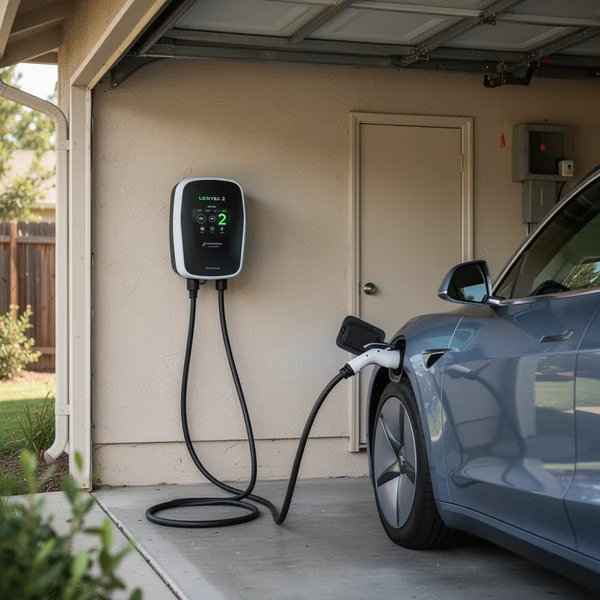
Curbside EV charging in NYC exists, but it is a public network run by the city and its partners — not something a homeowner can request in front of their own house. There is a small set of city-installed Level 2 chargers mounted on sidewalks and light poles across the five boroughs, available to any driver on a pay-per-session basis, and there is no programme that assigns one to your address or reserves the space in front of it.
If you park on the street in Brooklyn or Queens and were hoping the answer was “apply and they install one outside your door,” it is not. What follows is what genuinely exists today, what is off the table, and the routes that actually work for a New Yorker without a driveway.
What curbside EV charging in NYC actually looks like
The city’s curbside chargers came out of a New York City Department of Transportation pilot, installed with a charging network operator, placing Level 2 units at the kerb in all five boroughs. Practically, that means:
- Level 2, not fast charging. These are AC chargers. You are adding range over hours, not minutes — fine overnight, not useful if you need a top-up before a drive to Montauk.
- Public and first-come. The spaces are ordinary metered or regulated kerb space with a charger next to them. Alternate side parking rules, street cleaning and every other regulation still apply, and a charger does not exempt you from a ticket.
- Paid by session through the operator’s app. Rates and idle fees are set by the operator, not by the city, and they change. Check the app rather than any article quoting a price.
- Thin coverage. Locations were chosen for the pilot, not for demand at your block. The DOT electric vehicle page carries the current map — that is the only list worth trusting, because installations are added and moved.
Separately from the kerb, the New York Power Authority’s EVolve NY network operates DC fast charging hubs at sites around the state, including in and around the city. Those are the ones to plan a road trip around; they are not a substitute for overnight charging.
The thing you cannot do: run a cable across the sidewalk
This is the question every brownstone and row-house owner in the city asks, usually after seeing a photo of a cable ramp from another country. The sidewalk in front of your building is public right-of-way. Obstructing it, even with a low-profile cover, is not a homeowner’s decision to make, and it exposes you to a trip-and-fall claim that your homeowners policy may take an interest in.
If you want to pursue it anyway, the only honest route is to ask NYC DOT directly, in writing, whether any permit covers what you are proposing, and to act on their written answer rather than a neighbour’s. Do not buy the equipment first. The pattern that gets people into trouble is spending on a charger and a cable protector, then discovering the permit does not exist.
The routes that actually work without a driveway
For most New Yorkers the realistic answer is not the kerb at all. In rough order of how often they work:
- Your building’s garage or parking area. Charging installed in a co-op, condo or rental garage is the single most common solution in the city. It is a board and management conversation, and it is a project with a real electrical scope — service capacity, conduit routing, metering, and who pays for the electricity.
- A rented space in a commercial garage. Many garages have added charging. If you already pay monthly for a space, ask the operator whether a charger can be assigned; some will install one against a longer contract.
- Workplace charging. Slower to arrange but genuinely effective, because a car parked eight hours on Level 2 does not need much power to cover a New York commute.
- Public Level 2 near the apartment. Not glamorous, but if there is a charger within a few blocks and you are only driving on weekends, a session every week or two covers it.
The utility and state programmes behind all of it
Almost no charging infrastructure in the city is paid for entirely by the site host. Two mechanisms matter to New Yorkers:
Con Edison’s make-ready programme. Con Edison funds the electrical infrastructure — the utility-side and often customer-side work needed to get power to the parking spaces — for qualifying site hosts, including multifamily buildings. This is the money that makes a garage project viable, and it is the reason a board that was quoted a frightening number by an electrician should get the project scoped by a contractor who has actually run a make-ready application. Con Edison also runs a rewards programme for EV drivers who charge off-peak; the enrolment terms and the current name are on coned.com, and both have changed over the years, so check rather than assume.
NYSERDA’s charging programmes. NYSERDA funds workplace and multifamily charging for site hosts through its EV charging offerings. Again, the applicant is the building or the employer, not the individual driver. If your board is the obstacle, the argument that moves boards is not environmental — it is that the funding exists now, it is administered by a utility they already deal with, and the alternative is a special assessment later.
PSEG Long Island runs its own separate EV programmes for Nassau and Suffolk; if a relative in Huntington asks, do not send them to a Con Edison page.
Do not budget on a federal credit
The residential federal energy credits New Yorkers used for solar and efficiency work are gone for 2026. Section 25D, the Residential Clean Energy Credit, terminated for expenditures after 31 December 2025. Section 25C, the Energy Efficient Home Improvement Credit, was allowed for qualifying property placed in service before that same date, with its $1,200 general and $2,000 heat pump annual caps. Neither is available to a household installing in 2026.
If you have read about any other federal incentive attached to charging equipment, check the IRS page for that specific code section before you put a number in a budget — and check the date it was last updated. Contractor proposals written in 2025 are still circulating with credit lines that no longer apply, and our explainer on what changed with the federal credit in New York covers why so much published guidance is stale.
What does survive is at the state level. New York’s Form IT-255 solar credit — 25% of system cost, capped at $5,000, carried forward up to five years — applies to solar energy system equipment, not to a charger. It matters here only if you are pairing the two, which is a genuinely common New York project: see how EV charging and solar panels work together in New York for how the load and the array interact, and the borough-by-borough NYC installation guide for what a city roof can realistically carry.
If you own the building
Owners of small buildings in the outer boroughs have options a renter does not. A charger in a private driveway, a garage or a rear yard is a normal electrical permit job filed with the Department of Buildings by a licensed electrician. The real questions are the same as for any electrification project: what the existing service is, what the panel has room for, and whether a load-management device can keep you off a service upgrade. Ask for a whole-house load calculation for the configuration you expect to end up with — charger, and eventually a heat pump — rather than for today’s house, so you do not pay for the upgrade twice.
What to do next
- Check the NYC DOT electric vehicle page for the current curbside charger map before assuming your block does or does not have one.
- If you rent or own in a building with parking, put charging on the next board or management agenda and name Con Edison’s make-ready programme explicitly — that is what turns it from a spending item into a funded project.
- Do not buy a cable ramp. Ask DOT in writing first and keep the answer.
- Look up your actual weekly mileage. Most New York City driving is covered by one Level 2 session a week, which changes which of these routes you need.
- Strike any federal credit line out of a 2026 charging budget unless the IRS page for that section says it still applies.
NY Solar Incentives
Independent New York solar research. We summarise NYSERDA, NY-Sun and federal programme rules from published sources and state plainly when a figure is an estimate. We are not a government agency and do not sell equipment.
Run the arithmetic on your own system
Check the dated program table and your arrangement before counting an incentive. Standard residential NY-Sun blocks are closed; Long Island Affordable Solar has a conditional income-verification route. The NY credit depends on qualified costs and tax liability, while the NYC abatement reduces future property-tax bills. The estimator keeps those timings separate.