Getting Co-op Board Approval for an EV Charger in NYC
A co-op board controls the garage circuit, not you. Here is the capacity letter, alteration agreement and metering plan that turn an EV charger request into an approval.
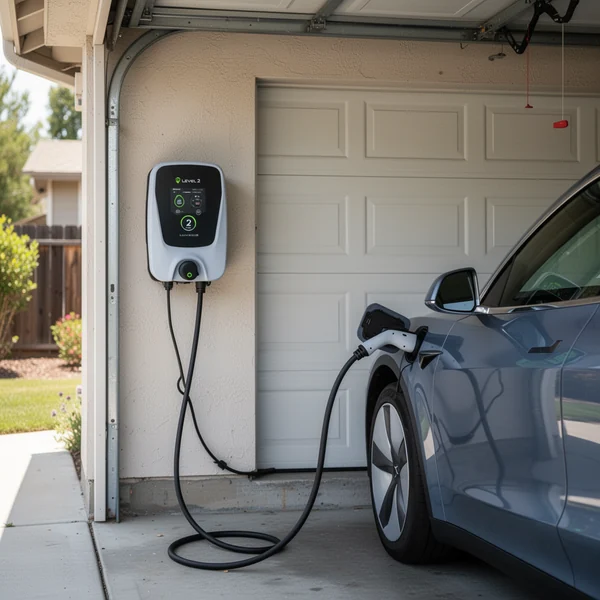
Getting co-op board approval for an EV charger in NYC is a property-law problem before it is an electrical one. You do not own your parking space — you own shares in a corporation and a proprietary lease that gives you the right to use it, and the garage circuit you want to tap is a common element the board controls outright.
That is the whole difficulty in one sentence, and it explains why shareholders who arrive with a Level 2 charger already bought get told no. The board is not evaluating your car. It is evaluating a permanent alteration to the building’s electrical infrastructure, who pays for the electricity afterwards, and what happens when the next eleven shareholders ask for the same thing.
Understand what you are actually asking for
In a co-op, the corporation owns the building. Your shares and proprietary lease give you exclusive use of your apartment and, if you are lucky, a parking space. The garage feeder, the house meter, the risers and the panel it all lands in are common elements. Installing a charger means:
- attaching equipment to a common element,
- drawing power that is almost certainly on the house meter, not yours, and
- changing the building’s electrical load, permanently.
Any one of those requires board consent. All three together mean you are asking for an alteration agreement — the same instrument that governs a kitchen renovation — plus a metering and cost-recovery arrangement that probably does not exist in your building yet.
One thing not to rely on: some states have “right to charge” statutes that override a board’s refusal. Do not assume New York gives a co-op shareholder that right. Check the current statute with a New York real estate attorney before you build a strategy on it, and plan on persuading the board rather than compelling it.
What the board is actually worried about
Boards refuse chargers for a short and predictable list of reasons. Address them in your proposal and your odds change dramatically.
| Board concern | What answers it |
|---|---|
| “Who pays for the electricity?” | A metering plan. A submeter on the charger circuit, or a networked charger that bills you directly, with a written arrangement for reimbursing the corporation. |
| “Do we have the capacity?” | A load study by the building’s electrical engineer against the existing service, not a contractor’s assurance. |
| “What if it causes a fire?” | Licensed master electrician, filed DOB permit, listed equipment, and your insurance naming the corporation as additional insured. |
| “What about the other shareholders?” | A policy, not a one-off. Boards fear precedent far more than they fear your charger. |
| “Who owns it if you sell?” | Spell it out in the alteration agreement: removal at your cost, or transfer with the space. |
The capacity question is the real gate
Most pre-war and mid-century NYC co-ops were wired for a building that had no electric vehicles, no window air conditioners in every room, and no induction ranges. The garage feeder is often small — sized for lighting, a door operator and a sump pump.
Before anything else, find out three things and put them in writing:
- What is the building’s electrical service size, and what is the measured peak demand? The managing agent has the Con Edison bills; peak demand is on them. That is a far better basis than a nameplate calculation.
- How is the garage fed and metered? A separate house panel, a submetered tenant panel, or a tap off the main.
- Is there spare capacity, and how much? This has to come from a licensed engineer, because the answer decides whether your project is a single circuit or a Con Edison service upgrade.
If capacity is tight, do not stop there. Ask specifically about load management: networked chargers that throttle or schedule charging so several cars share a limited feeder, and current-monitoring devices that cut charging when the building’s load rises. A managed 6 kW that charges overnight is a far easier board approval than an unmanaged 11.5 kW that arrives at 6pm with everyone’s air conditioning.
Con Edison and the paperwork
If the building genuinely needs more service, that becomes a Con Edison project with its own timeline, and it is no longer a shareholder-scale job. If it does not, you are in normal alteration territory: a licensed master electrician, an electrical permit filed with the NYC Department of Buildings, and inspection. In an enclosed garage expect the FDNY-adjacent questions about ventilation, clearances, bollard protection for the equipment and cable management across a walking surface — an EV cable lying across a shared aisle is a trip hazard a board will fixate on, correctly.
Larger buildings also have building-level greenhouse gas emissions limits under Local Law 97 to think about; the NYC Department of Buildings publishes which buildings are covered. Charger load is electric load, and how that interacts with a building’s compliance path is a question for the building’s LL97 consultant. Raise it before the board does; it makes you look like someone who has done the reading.
How to run the approval, in order
- Read your proprietary lease and house rules first. Look for the alteration clause and anything about the garage. Some leases assign parking by licence agreement that the board can revoke — worth knowing before you spend.
- Talk to the managing agent, not the board. The agent knows whether this has come up before, whether an engineer has already looked at the garage, and what the board’s temperature is.
- Get the engineer’s capacity letter. One page, from the building’s own engineer where possible. This is the single document that converts “we don’t know” into a decision.
- Propose a policy, not a favour. Draft it as a shareholder EV charging policy: who may apply, what equipment is permitted, how electricity is metered and billed, who insures it, who maintains it, what happens on resale. Boards approve policies. They stall on exceptions.
- Bring a contractor’s scope and a DOB filing plan. Named licensed master electrician, permit type, timeline, hours of work, and how the garage stays usable during the work.
- Offer to pay for everything. Installation, the engineer’s letter, the submeter, the electricity, the removal. Cost to the corporation is the objection you can eliminate entirely.
If the answer is no
It sometimes is, and usually for capacity reasons that are real. Fall back positions worth having ready: a Level 1 outlet on a dedicated circuit, which is slow but adequate for many city driving patterns; a shared charger owned by the corporation and billed by use, which spreads cost across shareholders and often passes where an individual installation fails; or a curbside and public charging strategy while the building plans a larger electrical project.
The pattern of a board controlling something on the outside of your unit will be familiar to anyone who has tried to put panels on a shared roof — the analysis in Can an HOA Stop You Installing Solar in New York? covers the same tension between a resident’s improvement and an association’s control of common elements.
The money, plainly
Do not budget a federal credit for a 2026 installation. The federal residential energy credits ended for property placed in service after 31 December 2025 — Section 25C for efficiency improvements and Section 25D for clean energy property alike. A 2026 install gets nothing federal, and that includes the charger.
Utility-side EV charging programmes are a separate matter and change frequently; Con Edison publishes its own, and the terms for a multifamily building differ from a single-family one. Check directly with Con Edison for current multifamily charging support rather than trusting a summary. And if the building is also weighing rooftop solar, note that New York’s Form IT-255 solar credit — 25% of system cost, capped at $5,000, carried forward up to five years — is a personal income tax credit tied to the system owner, which raises a different set of questions in a corporation. Our guide to EV Charging and Solar Panels in New York covers how the two loads interact, and Reading a Con Edison Bill After Solar is useful background on how Con Ed presents demand and delivery charges.
What to do next
- Email the managing agent this week asking for the building’s electrical service size, recent peak demand from the Con Edison bills, and whether any engineer has assessed the garage.
- Pull your proprietary lease and read the alteration clause and the parking provisions.
- Commission a one-page capacity letter from the building’s engineer, at your expense.
- Draft a shareholder EV charging policy and submit that, rather than a personal request.
- Line up a licensed master electrician who will file with DOB, and get their scope in writing before the board meeting.
NY Solar Incentives
Independent New York solar research. We summarise NYSERDA, NY-Sun and federal programme rules from published sources and state plainly when a figure is an estimate. We are not a government agency and do not sell equipment.
Run the arithmetic on your own system
Check the dated program table and your arrangement before counting an incentive. Standard residential NY-Sun blocks are closed; Long Island Affordable Solar has a conditional income-verification route. The NY credit depends on qualified costs and tax liability, while the NYC abatement reduces future property-tax bills. The estimator keeps those timings separate.