Community Solar in New York: How It Actually Works
Community solar in New York gives a household a share of a solar project built somewhere else, paid out as credits on its own electricity bill. Here is the mechanism, the money, and the paperwork.
On this page 9 sections
- 01Community solar in New York is a billing arrangement, not a wire to your house
- 02The credit is calculated under the Value Stack, not as a one-for-one swap
- 03There are two billing formats, and they look very different on paper
- 04The project has to sit in your utility’s territory
- 05Savings come from buying credits at a discount, and from nothing else
- 06How community solar compares with panels on your own roof
- 07The federal residential credit has ended, and it changes the comparison
- 08What to read before signing anything
- 09Frequently asked questions
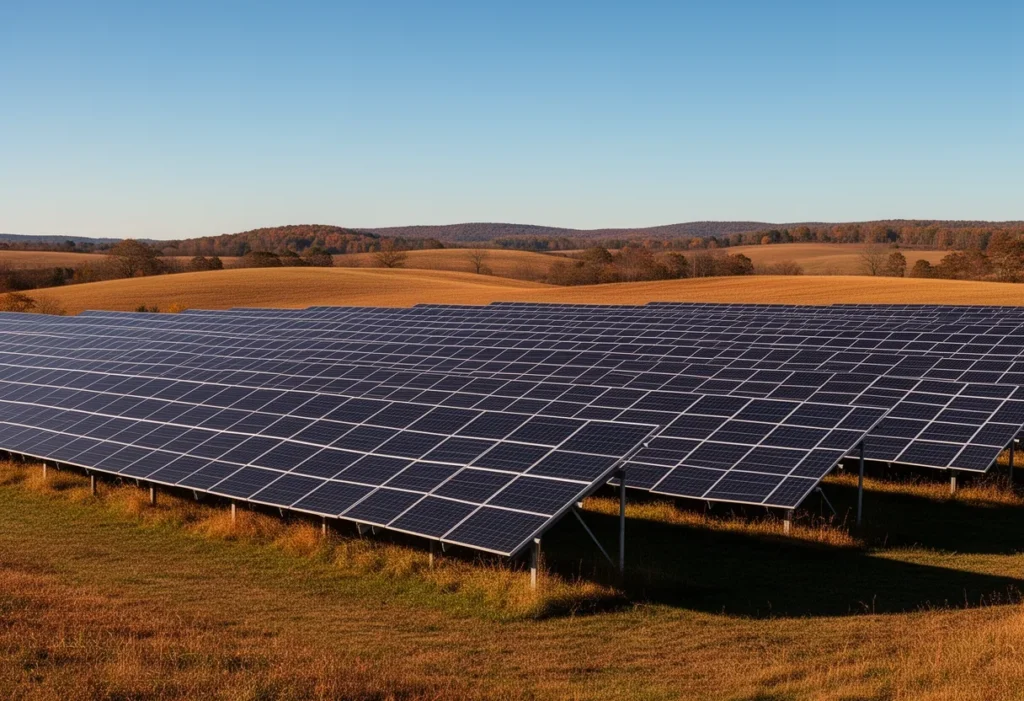
Community solar in New York lets a household take a share of a solar project built somewhere else and receive the value of that share as a credit on its own electricity bill. Nothing is installed at the house. The utility keeps delivering power the same way it always did.
What changes is the arithmetic on the bill. The project’s output is metered, converted into credits, and applied to the accounts of the people subscribed to it. The subscriber then pays the company running the project for those credits, at less than the credits are worth. That gap is the entire business model, and it explains most of what follows.
Community solar in New York is a billing arrangement, not a wire to your house
The formal name for this in New York is community distributed generation, a framework set up by the Public Service Commission. A developer builds an array somewhere on the local distribution grid, then sells subscriptions to households and small businesses served by the same utility.
None of the electricity produced by that array travels to any particular subscriber. It goes onto the grid where it is built. The relationship between the project and the subscriber is purely financial: the project earns credits, the utility posts a share of those credits to the subscriber’s account, and the subscriber pays the project sponsor for them.
State rules require a project to have a minimum number of members and place limits on how much of one project a single large customer can take, which is why residential allocations exist at all rather than every project being sold to one factory.
The credit is calculated under the Value Stack, not as a one-for-one swap
Most New Yorkers assume solar credits work like residential net metering, where a kilowatt-hour exported cancels a kilowatt-hour imported. Community projects are generally compensated differently, under the state’s Value of Distributed Energy Resources framework, usually called the Value Stack.
The Value Stack converts a project’s exports into a dollar amount built from several components: the wholesale energy value, a capacity value, an environmental value, and location- and time-based components that reward output where and when the grid needs it most. The result is a credit denominated in dollars, not in kilowatt-hours.
That distinction matters when you compare offers. A subscription advertised as a percentage discount is a discount on the dollar credits you receive, and the number of dollar credits generated per kilowatt-hour is not fixed forever.
Ask which compensation rules the project sits under
Older projects were grandfathered under earlier crediting arrangements; newer ones sit under the Value Stack. Ask the sponsor in writing which applies to the project you are joining, and whether the credits posted to your account are dollars or kilowatt-hours. The answer changes how a quoted savings percentage behaves over time.
There are two billing formats, and they look very different on paper
Under the older format, two bills arrive. The utility bill shows your usage and a credit line, and a separate invoice arrives from the subscription company for the credits you were allocated. Your net position is the difference between the two, which is easy to lose track of if you only glance at one.
New York has been moving community solar onto consolidated billing, where the credit and the subscriber charge both appear on the single utility bill. That is simpler to read and simpler to verify, but it is not universal, and legacy subscriptions can stay on the two-bill format.
Before signing, find out which format applies and what happens if you fall behind on the sponsor’s invoice. The consequences of not paying a subscription invoice are not the same as the consequences of not paying a utility bill, and they should be spelled out in the contract.
The project has to sit in your utility’s territory
A subscription only works if the project is connected in the same utility service territory as your meter. A Con Edison customer cannot subscribe to a project on National Grid’s system, and vice versa. The relevant utilities are Con Edison, National Grid, NYSEG, RG&E, Central Hudson, and Orange and Rockland.
Long Island is the exception worth knowing about. Service there is provided by PSEG Long Island on behalf of the Long Island Power Authority, which sits outside the Commission’s community distributed generation rules, so availability and terms are set separately.
This is also why availability feels arbitrary. Whether anything is open to you depends on how much capacity has been built in your territory and how much of it is already subscribed, not on how sunny your neighborhood is. Detail for the two largest territories is covered in the pieces on subscribing in New York City and on National Grid accounts upstate.
Savings come from buying credits at a discount, and from nothing else
A subscription does not lower your usage, your delivery charges, or your rate. It gives you credits you did not have, at a price below their face value. If the discount is ten percent, you keep ten cents of every dollar of credit generated on your behalf.
The risk in that structure is over-allocation. Your allocation is sized against your historical consumption, and if it is set too high, credits pile up faster than you can use them. Depending on the contract, you may still owe the sponsor for credits your account cannot absorb. Some contracts charge only for credits actually applied, some do not.
Know your annual kilowatt-hours before you talk to anyone
Pull twelve months of bills and add up the kilowatt-hours. That single figure lets you sanity-check any allocation offered to you, and it is the number a good sponsor will ask for anyway. An allocation sized above your annual usage is a warning sign, not a bigger saving.
How community solar compares with panels on your own roof
The two are not competitors so much as different products. One is a construction project you own and maintain; the other is a subscription you can usually leave.
| Feature | Buying a rooftop system | Lease or PPA | Community solar subscription |
|---|---|---|---|
| Who owns the equipment | You | The provider | The project sponsor |
| Upfront cost | Full system cost, cash or financed | Typically none | None |
| New York State credit on Form IT-255 | Available: a percentage of system cost up to a statutory cap | Available for qualifying long-term agreements; check the terms | A different arrangement entirely; confirm with the Department of Taxation and Finance |
| Federal credit on your own return | None for systems with installation completed from 2026 | None for you; the owner claims a business-side credit | None for you; the project owner’s economics reflect business-side credits |
| NYC property tax abatement | Possible on an eligible building | Possible depending on structure | No: the abatement follows installed equipment |
| Typical commitment | Permanent, tied to the building | Long-term contract tied to the property | Cancellable subscription, notice period applies |
| If you move | Conveys with the house | Assigned to the buyer or bought out | Often portable within the same utility territory |
The federal residential credit has ended, and it changes the comparison
The 30% federal residential clean energy credit under section 25D of the Internal Revenue Code was terminated by the One Big Beautiful Bill Act, signed on 4 July 2025. It no longer applies to systems with installation completed after 31 December 2025. A New Yorker buying a rooftop system today receives nothing on their federal return, with no phase-down and no transition rule. A system whose installation was completed in 2025 fell under the old rules, and unused credit from that year can generally be carried forward.
Community solar subscribers were never eligible for that credit in the first place, because they never owned equipment. What has changed is the relative picture: the tax advantage that used to favor buying has gone, while the business-side credit claimed by the company that owns a leased, PPA or community project still exists. That is why third-party offers can still price in an incentive that the household never claims directly. The full picture is set out in the pieces on the federal credit in New York and on the state solar energy system equipment credit.
What to read before signing anything
New York requires subscription sellers to give you a standardized disclosure statement covering price, term, cancellation and how the credits work. Read that document rather than the marketing page, and keep a copy.
The specific clauses worth arguing about, including auto-renewal, notice periods, resizing and assignment, are covered in more depth in the guide to what a New York community solar contract commits you to.
Frequently asked questions
Do I need to own my home to subscribe to community solar?
No. What you need is an electricity account in your own name with a participating utility. Renters qualify on the same basis as owners, because the credit attaches to the utility account rather than to the building. If the landlord holds the account and bills you directly, there is no account for the utility to credit.
Will community solar change my electricity rate or my supplier?
No. Your utility continues to deliver your power and your supply arrangement is unchanged, whether that is utility supply or an energy services company. Community solar adds a credit to the account; it does not switch anything. If a salesperson tells you that you need to change supplier to subscribe, that is a separate product being sold alongside it.
What happens to my subscription if I move?
Most contracts allow the subscription to move with you as long as your new address is served by the same utility. Moving out of that territory usually triggers the cancellation terms instead. Check the notice period and whether any fee applies, and confirm what happens to credits already banked on the old account.
Can I claim any tax credit for a community solar subscription?
Not on your federal return: the residential clean energy credit ended for expenditures made after 31 December 2025, and in any case it required owning equipment. An expenditure counts as made when the original installation is completed, so a system finished in December 2025 but switched on in January 2026 still falls under the old rules. The New York State credit claimed on Form IT-255 is built around solar equipment used at your residence and around certain long-term lease and power-purchase agreements, which is a different structure from a subscription. Confirm your own position with the Department of Taxation and Finance or a tax preparer before assuming anything.
Verify current figures before you act
Compensation rules, block availability and subscription terms in New York change from year to year. Confirm the current position with NYSERDA, with the Public Service Commission’s published rules for distributed energy resource suppliers, and with your own utility before signing anything. This site is independent and is not affiliated with NYSERDA or any state agency.
NY Solar Incentives
Independent New York solar research. We summarise NYSERDA, NY-Sun and federal programme rules from published sources and state plainly when a figure is an estimate. We are not a government agency and do not sell equipment.
Run the arithmetic on your own system
Check the dated program table and your arrangement before counting an incentive. Standard residential NY-Sun blocks are closed; Long Island Affordable Solar has a conditional income-verification route. The NY credit depends on qualified costs and tax liability, while the NYC abatement reduces future property-tax bills. The estimator keeps those timings separate.