Heat Pump Water Heater or Tankless, for a New York Home
Tankless covers two different machines, and only one path earns New York rebate money. How basement temperature, service capacity and your own fuel bill decide the answer.
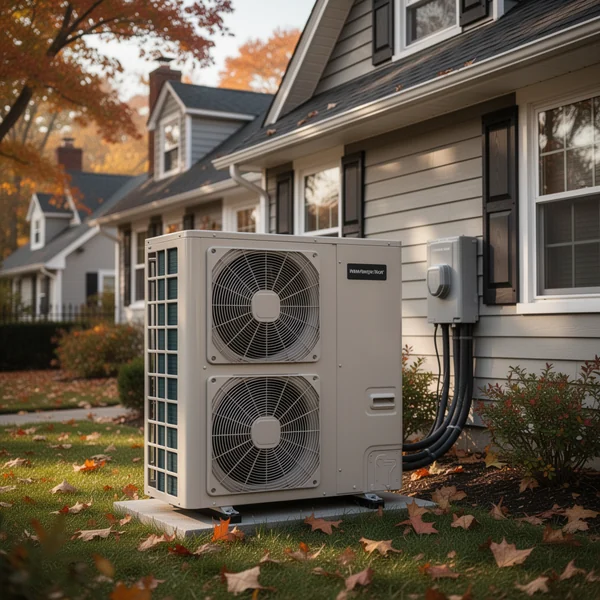
For most New York houses the choice between a heat pump water heater and a tankless unit comes down to two questions: is the tankless unit gas or electric, and do you have a basement with enough air volume and enough spare heat to feed a heat pump. A gas tankless is efficient but keeps you on a fuel New York is actively steering away from and earns no electrification rebate; an electric tankless is simple but draws more current than most older New York services can supply.
The comparison people actually want — heat pump water heater vs tankless in a New York home — is really three comparisons, because “tankless” covers two completely different machines.
The three machines on the table
- Heat pump water heater (HPWH). A tank with a small refrigeration circuit on top. It moves heat out of the surrounding air into the water instead of making heat with a resistance element, which is why it uses a fraction of the electricity of a standard electric tank. It also blows cold, dehumidified air back into the room it sits in, and it needs a minimum air volume around it to work.
- Gas tankless. A wall-hung burner that fires only when a tap opens. No standby loss, effectively endless hot water, but it needs a gas line sized for a high firing rate and a dedicated sealed venting run through a wall or roof.
- Electric tankless (whole-house). Resistance elements that heat water on demand. Cheap to buy, brutal on the electrical service — a whole-house model needs several dedicated double-pole circuits, and in a New York house on an older service that usually means a panel and service upgrade before you can even install it.
Heat pump water heater vs tankless in New York: the four things that decide it
1. Where the water heater sits, and how cold that room gets
A heat pump water heater takes heat from the air around it. In a walkout basement in Rochester or a Buffalo cellar that already sits in the fifties in February, the unit will still run, but it will spend more of the winter on its backup resistance elements, and the room will get colder. Manufacturers publish a minimum ambient operating temperature and a minimum room volume in the installation manual — read them for the specific model, not for the category.
That is a different problem on Long Island and in the lower Hudson Valley, where the water heater is often in a utility closet, a garage, or a slab-on-grade mechanical room. A closet has nowhere near the air volume a HPWH needs unless you duct it, and ducting kits exist for exactly this reason: intake and exhaust ducts to a larger space or outdoors. In a Brooklyn or Queens apartment, or a brownstone garden-level utility room, ducted is often the only viable configuration.
The cold exhaust is not always a downside. In a damp Westchester or Nassau County basement, the dehumidification a HPWH does as a side effect is genuinely useful in summer and may let you retire a dehumidifier that was running on the same circuit.
2. What your electrical service can actually carry
A HPWH runs on a standard 240-volt circuit and draws roughly what a conventional electric tank draws at its peak — it is not an electrical event. A whole-house electric tankless is. It is the appliance most likely to force a service upgrade in an older New York home, and if you are also planning an EV charger or a heat pump for space heating, it consumes the headroom you will want later. If your house is on 100-amp service, price the electrical work as part of the tankless quote or the comparison is not honest.
3. Which fuel you are trying to leave
If you currently heat water with an oil-fired boiler running year-round just to make domestic hot water — common in Suffolk County, the Hudson Valley and across upstate — the summer standby losses of that boiler are a large and invisible cost. Getting the boiler out of the hot-water business in June through September is often the strongest single argument for a HPWH, independent of the winter numbers.
If you are on natural gas in Con Edison or National Grid territory and considering a gas tankless, understand that you are buying a twenty-year appliance into a fuel whose regulatory direction in New York is not settled. That is a judgement call, not a technical fault.
4. What each one earns you in rebates
This is where the two options separate sharply, and where most of the advice online is now out of date.
There is no federal credit for a 2026 installation. Section 25C, which covered heat pump water heaters up to an annual cap of $2,000, applied to property placed in service through 31 December 2025. Section 25D terminated for expenditures after that date as well. A New York household installing this year gets nothing federal on either a HPWH or a tankless. If a plumber’s quote shows a 30% federal credit, it is wrong.
What is still live is state and utility money, and it only flows toward electrification. NYS Clean Heat is administered by NYSERDA with seven sponsoring utilities: Central Hudson, Con Edison, National Fuel Gas, National Grid, NYSEG, Orange & Rockland and RG&E. PSEG Long Island is not a Clean Heat sponsor and runs its own separate efficiency programmes, which is a genuinely important distinction if you are in Nassau or Suffolk.
Clean Heat rebate amounts are not published as one statewide table — they vary by utility and by equipment type — so put your service address into the finder at cleanheat.ny.gov to see whether your utility’s current offer covers heat pump water heaters and at what level. A gas tankless will not appear there at all. Our guide to New York State renewable energy incentives beyond solar explains how these programmes relate to the solar incentives the state still funds.
Running cost, honestly
Nobody can hand you a credible annual dollar comparison without your own numbers, and any article that does is guessing. The arithmetic that actually decides it is:
- Your electric rate — supply plus delivery, from your own bill, not a statewide average. Con Edison, National Grid upstate, NYSEG and PSEG Long Island are not close to each other.
- Your gas or oil price per therm or per gallon, from your own bill or delivery ticket.
- How much hot water your household actually uses, which is mostly a function of how many people shower.
Run those three against the rated efficiency on each unit’s EnergyGuide label. A HPWH’s advantage is largest where electric rates are moderate and the unit sits in a warm space; it narrows where rates are high and the unit sits in a cold cellar and leans on its resistance elements.
Practical failure modes worth knowing
- HPWH condensate. It produces condensate like an air conditioner and needs a drain or a condensate pump. A basement with no floor drain needs the pump priced in.
- HPWH noise. There is a compressor and a fan. Directly under a bedroom in a small house, people notice.
- Recovery rate. In heat pump mode a HPWH recovers more slowly than a gas tank. Households with back-to-back morning showers should size up rather than rely on the resistance backup, which erases the savings.
- Gas tankless and hard water. Much of upstate New York has hard water; tankless heat exchangers need periodic descaling and the unit needs isolation valves installed for it. Confirm they are in the scope of work.
- Venting. A gas tankless cannot reuse an old atmospheric chimney. If the boiler was sharing that flue, removing the water heater from it can create a chimney sizing problem for what is left.
What to do next
- Measure the room your water heater sits in and compare it against the minimum air volume in the installation manual of any HPWH you are quoted. If it fails, ask specifically about a ducted configuration.
- Pull your last twelve months of electric bills and one fuel delivery ticket, and note the supply and delivery rates separately.
- Run your address through cleanheat.ny.gov before you accept any quote, and confirm whether your utility is a Clean Heat sponsor at all — if you are a PSEG Long Island customer, look at PSEG LI’s own programme pages instead.
- If a whole-house electric tankless is on the list, get an electrician to confirm your service capacity first, and read our note on the NYSERDA On-Bill Recovery Loan if the electrical work turns the project into a financing question.
- Budget with zero federal credit and reject any quote that assumes otherwise.
NY Solar Incentives
Independent New York solar research. We summarise NYSERDA, NY-Sun and federal programme rules from published sources and state plainly when a figure is an estimate. We are not a government agency and do not sell equipment.
Run the arithmetic on your own system
Check the dated program table and your arrangement before counting an incentive. Standard residential NY-Sun blocks are closed; Long Island Affordable Solar has a conditional income-verification route. The NY credit depends on qualified costs and tax liability, while the NYC abatement reduces future property-tax bills. The estimator keeps those timings separate.