How Many Mini Split Heads a New York House Actually Needs
Head count comes from a room-by-room Manual J and from which spaces have doors, not from square footage. How over-heading fails in New York shoulder seasons, and where a ducted air handler beats three heads.
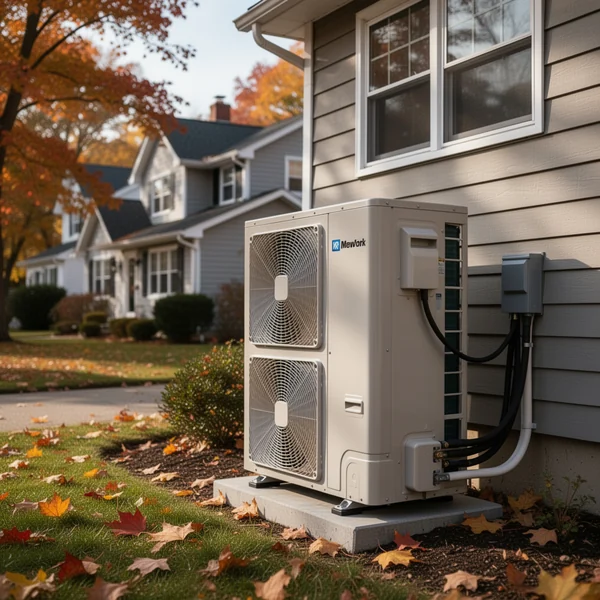
The number of mini split heads a house needs is set by how many spaces need their own temperature and by a room-by-room load calculation — not by how many bedrooms are on the deed. If you are asking how many mini split heads do I need, the honest answer is that nobody can tell you from the square footage, and any contractor who quotes a head count over the phone is guessing with your money.
That said, there is a real logic to it, and once you understand it you can read a proposal and tell whether it was designed or copied off the last job.
How many mini split heads do I need? Count doors, not rooms
A ductless head heats and cools whatever air can circulate to it. An open kitchen-dining-living space in a Long Island ranch is one thermal space, however many names it has on the floor plan. A bedroom behind a closed door at the end of a hall is a separate space, because the air in it does not mix with the rest of the house when that door is shut — and in most New York houses, bedroom doors are shut at night, which is exactly when the heating load peaks.
So the first pass is simple: walk the house and count the spaces that are genuinely isolated by doors and that someone will want at a different temperature. That number is usually smaller than the room count and larger than the “two heads will do it” estimate people arrive at online.
The load calculation is the answer; the head count is the output
The industry method is ACCA Manual J — a room-by-room heating and cooling load built from your actual wall assemblies, window areas and orientations, air leakage, and the outdoor design temperature published for your location. Manual S then matches equipment to that load, and Manual D sizes any ductwork. A contractor who has done a Manual J can tell you why the north-east bedroom gets its own head and the south-facing one does not. A contractor who has not will describe head counts in terms of “tons per square foot,” which is how New York houses end up with oversized equipment that short-cycles.
New York’s design temperatures vary enormously across the state, and that alone changes the answer. A house in Watertown or the Tug Hill snowbelt is designed against a very different winter than the same house in Nassau County. Ask which design temperature was used and where it came from — it should be the published figure for your nearest weather station, not a round number someone remembered.
Where too many heads goes wrong
Over-heading is the more common error in New York, and it is expensive twice: once at install and again every shoulder season.
- Multi-zone outdoor units have a minimum output. One outdoor condenser feeding four or five indoor heads cannot turn down below a certain capacity. In October and April, when only one small bedroom is calling, the system overshoots, shuts off, and cycles. Cycling costs efficiency and comfort, and it is a common reason people say their heat pump “feels drafty.”
- Single-zone systems generally modulate lower. A one-to-one pairing — one outdoor unit, one indoor head — can usually run at a much lower fraction of its rated capacity than the same brand’s multi-zone line. For a house that only needs two or three real zones, two or three single-zone systems can outperform one multi-zone with three heads, and each one keeps running if another fails.
- Every head is another line set, another wall penetration, another condensate path, and another filter someone has to clean. In an old Hudson Valley farmhouse with plaster walls and no chases, the line-set routing is often the hardest part of the job — and heads on exterior walls that face the road become a conversation with the neighbours and, in a historic district, with a review board.
Ducted air handlers can replace three heads with one
The option most New York homeowners are never shown: a small ducted air handler — a horizontal unit in a basement, attic, or knee wall — serving three bedrooms through short duct runs, counted as one indoor unit. You get one filter, no wall cassettes in the bedrooms, and even temperatures across the sleeping wing. In a Cape or a 1950s ranch with a full basement, this is frequently the better design and the quieter one.
The catch is that ducts in an unconditioned attic lose a large share of what they carry. If the air handler and the ducts sit above the insulation in an unvented January attic, that design gives back everything it saved. Either keep the ducts inside the thermal envelope or insulate and seal them properly — and price that work as part of the job, not as an afterthought.
What New York adds to the decision
Two things change the arithmetic here specifically.
NYS Clean Heat. The programme is run by NYSERDA together with seven sponsoring utilities — Central Hudson, Con Edison, National Fuel Gas, National Grid, NYSEG, Orange & Rockland, and RG&E. PSEG Long Island is not a Clean Heat sponsor; it runs its own separate efficiency and heat pump programmes, so Long Island readers should look there instead. Clean Heat rebates are not published as a single statewide table — they vary by utility and by equipment type, and the rebate is normally claimed by a participating contractor and shown on your contract rather than filed by you afterwards. The official route to your number is the address-based finder at cleanheat.ny.gov/find-available-rebates. Do not accept a dollar figure from a salesperson that you cannot find there.
Crucially, the rebate structure often distinguishes a system that carries the whole house from one that heats part of it. That distinction can make the difference between four heads and three, or between ductless heads and a ducted air handler — so ask your contractor how the design you have been quoted is being classified before you sign.
The federal credits are gone. Both the Section 25C energy efficient home improvement credit and the Section 25D residential clean energy credit ended for property placed in service after 31 December 2025. A New York household installing in 2026 gets nothing federal — no 30% credit, no $2,000 heat pump credit. Any quote that still shows a federal credit line is either out of date or dishonest, and if it is baked into the “net cost” on page one you are looking at a number that does not exist. New York State’s own incentives, including Clean Heat, are unaffected by that change, and the state’s separate solar equipment credit on Form IT-255 is still available for solar — but that is a solar credit, not a heat pump one.
A sanity check on any proposal
| What you see | What it usually means |
|---|---|
| One head per bedroom, no load calculation | Catalogue design; likely oversized and prone to shoulder-season cycling |
| A single head for a whole floor with closed doors | Under-designed; the far bedrooms will be cold in January |
| Multi-zone outdoor unit whose rated capacity equals the sum of the heads | Normal — heads are usually oversubscribed on purpose, but ask about minimum output |
| A ducted air handler offered as an alternative | Someone thought about it |
| A federal tax credit line in 2026 | Stop and re-read the whole quote |
What to do next
- Walk the house and write down the spaces that are separated by doors and need independent control. Bring that list to every site visit.
- Ask each contractor for the Manual J output — room-by-room loads and the design temperature used. Get it as a document, not a verbal summary.
- Ask explicitly for one option with fewer heads plus a ducted air handler for the bedroom wing, and compare it against the all-ductless design.
- Run your address through the Clean Heat rebate finder yourself before you talk price, and check that the contractor is on NYSERDA’s participating list — the same due diligence covered in what a NYSERDA-qualified contractor actually is.
- If air sealing and insulation have never been done, get that quoted first. Every leak you close removes load, and removed load can remove a head.
- Read up on the rest of the state’s programmes in the site’s guide to New York renewable energy incentives beyond solar before you commit to a design.
NY Solar Incentives
Independent New York solar research. We summarise NYSERDA, NY-Sun and federal programme rules from published sources and state plainly when a figure is an estimate. We are not a government agency and do not sell equipment.
Run the arithmetic on your own system
Check the dated program table and your arrangement before counting an incentive. Standard residential NY-Sun blocks are closed; Long Island Affordable Solar has a conditional income-verification route. The NY credit depends on qualified costs and tax liability, while the NYC abatement reduces future property-tax bills. The estimator keeps those timings separate.