New York State Tax Credit for Solar Panels in 2026
The NY purchase credit is 25% of qualified costs, up to $5,000, subject to principal-residence and utility conditions. It is not refundable; lease/PPA methods and valid older federal claims need separate rules.
On this page 8 sections
- 01How the New York State tax credit for solar panels is calculated
- 02Which federal rules apply to your system, and why the date is not the switch-on
- 03What still applies in New York
- 04Who now gets the tax benefit, by arrangement
- 05A purchase example: potential credit versus credit usable this year
- 06What this does to the arithmetic of buying
- 07Who can claim the state credit
- 08Frequently asked questions
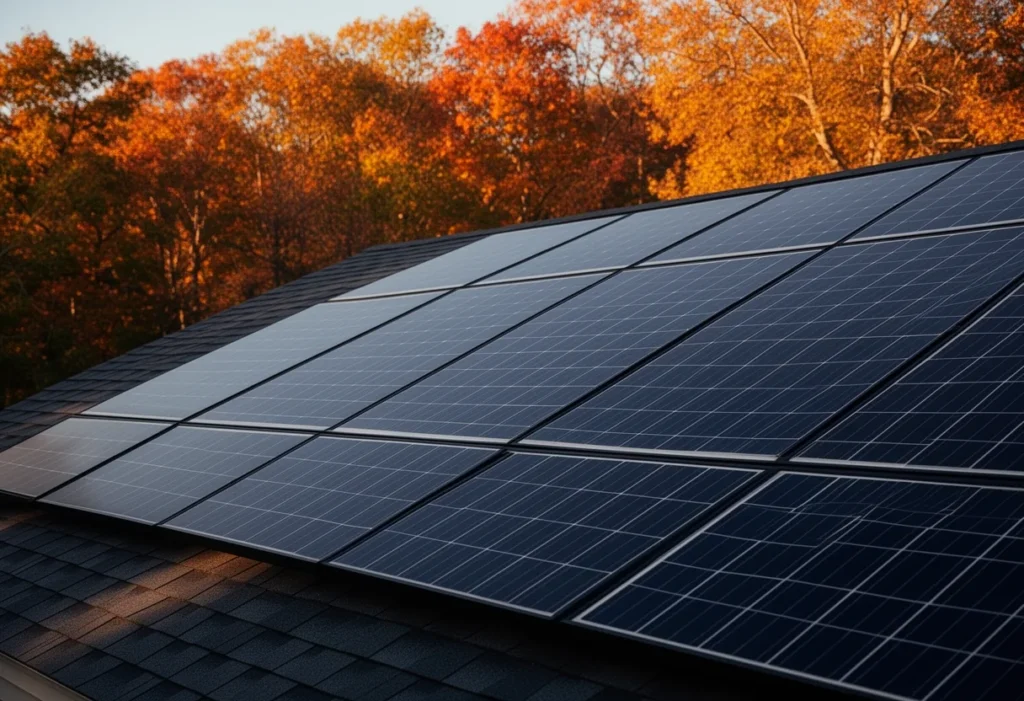
The New York State tax credit for solar panels is worth 25% of eligible expenditures, up to $5,000. For a qualifying 2026 purchase it remains available under current state law, even though the federal household credit does not apply to new installations completed after 2025. New York also permits qualifying long-term leases and PPAs, using different payment-based rules.
The federal residential clean energy credit under section 25D ended for expenditures made after 31 December 2025. The IRS timing FAQ (questions 1 and 7) explains the installation-completion rule and the separate construction/reconstruction rule. A qualifying 2025 installation may still support a 2025 claim and unused-credit carryforward; a 2025 deposit for an installation completed in 2026 does not preserve eligibility.
How the New York State tax credit for solar panels is calculated
For a qualifying purchase, the New York credit is the smaller of 25% of eligible expenditures or $5,000. This is a potential income-tax credit, not a discount on the installation invoice. The system must serve the taxpayer’s principal residence in New York; an eligible residence can be owned or rented. For electricity-generating equipment, the statutory net-metering requirements and completed utility connection also apply. See the official Form IT-255 instructions and New York Tax Law section 606(g-1).
At $20,000 of eligible expenditures, 25% reaches the $5,000 cap. Larger eligible purchase amounts do not increase that maximum. The cap alone is not a reason to increase a system’s size, and it does not establish how much credit a household can use.
The claim is made on Form IT-255, filed with the state return. The credit is nonrefundable: the amount used is limited by available New York State tax liability under the return’s calculation. An unused amount can be carried forward for the next five tax years, after which an unused remainder expires. Tax liability is different from the balance due after withholding or estimated payments; a person expecting a refund can still have tax liability. Do not show the full $5,000 as cash received now when a household’s usable credit has not been calculated.
Which costs enter the purchase calculation?
The official Form IT-255 instructions includes eligible solar equipment and properly allocated preparation and installation, architectural and engineering costs. Interest and financing charges are excluded, as are expenses paid with nontaxable grants. Keep the gross invoice, grant or incentive documents, and evidence of what you paid; exclude a grant-funded amount once rather than subtracting it again from an already net eligible figure. Do not treat every benefit labeled a rebate or tax credit as the same type of cost adjustment.
Ordinary roof replacement is not automatically an eligible solar equipment cost. Have any claimed allocation documented and checked. Solar equipment that generates electricity must also satisfy the state’s connection and net-metering requirements.
Which federal rules apply to your system, and why the date is not the switch-on
The One Big Beautiful Bill Act, signed on 4 July 2025, ended section 25D for expenditures made after 31 December 2025. New installations completed in 2026 do not receive a reduced or phased-down household credit.
For a normal equipment installation, the IRS treats the expenditure as made when the original installation is completed. A deposit, signed contract or advance payment in 2025 does not preserve section 25D for an installation completed in 2026. For an expenditure connected with construction or reconstruction of a structure, the IRS instead applies the date the taxpayer begins original use of that structure. See the IRS timing FAQ (questions 1 and 7). Utility permission to operate or a first bill credit, by itself, does not establish which timing rule or tax year applies.
A household paying cash or using a loan for a new installation completed in 2026 cannot claim section 25D for that expenditure. A 2025 installation must meet the historical eligibility rules before a credit can be claimed. The final 2025 Form 5695 instructions permit unused 2025 credit to be carried to 2026. That carryforward is not a credit for new 2026 costs.
If your project straddles that boundary, keep the contractor’s completion sign-off, inspection records, permit close-out, final invoice, payment evidence and utility records. These are evidence to review, not an automatic legal conclusion. A tax professional should determine which timing rule and year apply before you file.
Check any quote that shows a federal line
A quote for a new installation completed in 2026 should not subtract a 30% federal household credit from your purchase price. If it includes that line, ask for a revised calculation. A separately identified carryforward from an eligible 2025 project is a different matter.
What still applies in New York
The main routes discussed here are the New York income-tax credit, NY-Sun incentives when an eligible project receives approval, the NYC property-tax abatement for qualifying city buildings, and electricity-bill arrangements such as net metering. They affect different bills and have different eligibility rules.
NY-Sun is regional and program-specific. See the NY-Sun programme guide and NYSERDA’s regional dashboards. As checked on 7 October 2026, the regular residential NY-Sun blocks in the Con Edison, Upstate and Long Island regions are closed. The Con Edison and Upstate Affordable Solar blocks are also closed. However, the Affordable Solar intake accepts applications for PSEG Long Island customers, and the Long Island dashboard lists a conditional $0.40-per-watt Affordable Solar incentive. This does not establish remaining funding or an approved award for a particular project. Confirm income eligibility, current funding and contractor approval before including an incentive in a quote.
Who now gets the tax benefit, by arrangement
Ending the household section 25D credit does not establish whether a business owner qualifies for a separate federal investment credit. A third-party provider may have a business tax benefit under different eligibility rules and deadlines; this page does not determine that benefit.
A provider may reflect its own tax position in a lease or PPA price, but a household cannot assume the provider qualifies or that a tax saving is passed through. Compare the actual contract price, escalators, maintenance obligations and transfer terms rather than treating a provider’s potential credit as your own.
| How you get solar | Federal household credit for new 2026 installation costs | NY State credit on your return |
|---|---|---|
| Buy with cash | No section 25D credit | 25% of eligible expenditures, up to $5,000, subject to residence, equipment and tax-liability rules |
| Buy with a loan | No section 25D credit | Same purchase rules; interest and financing charges are excluded |
| Written lease of at least ten years | No household credit for leased equipment; a provider’s separate tax position is not determined here | Potential payment-based credit under separate IT-255 rules; verify the agreement and calculation |
| Written PPA of at least ten years | No household credit for the provider’s equipment; a provider’s separate tax position is not determined here | Potential payment-based credit under separate IT-255 rules; do not use the purchase formula |
| Ordinary community solar subscription | No section 25D credit for a new subscription | A subscription to an off-site project does not automatically qualify for the principal-residence equipment credit |
A qualifying written lease or power purchase agreement must run for at least ten years. New York has separate payment-based rules for these arrangements; the $5,000 cumulative limit is not a new $5,000 award every year, and payments after year 15 do not earn a new credit under an agreement longer than 15 years. The official Form IT-255 instructions and Tax Department lease/PPA guidance explain the calculations. The purchase formula below must not be applied to a lease or PPA. Have the agreement and payment calculation checked by a qualified tax professional; this page does not automate either calculation.
A purchase example: potential credit versus credit usable this year
Assume a system placed in service in 2026 at a New York principal residence, a completed qualifying utility connection, and $20,100 of fully eligible purchase and installation expenditures. Assume there are no grant-funded costs or financing charges in that amount.
| Item | Illustrative amount |
|---|---|
| Eligible purchase expenditures | $20,100 |
| 25% of eligible expenditures | $5,025 |
| Potential credit after the statutory cap | $5,000 |
| Assumed available NY tax liability this year | $1,500 |
| Credit used this year | $1,500 |
| Unused credit carried to the next five tax years | $3,500, usable only against sufficient future liability |
The installation still costs $20,100 before tax benefits. A $15,100 cost after the full credit is only a conditional illustration if all $5,000 is eventually usable; it is not an upfront invoice price or guaranteed cash payment.
What this does to the arithmetic of buying
For the same installed price and energy assumptions, removing a previously available federal credit increases the after-tax purchase cost. A current comparison still needs the actual price and benefits available to that particular project.
The relevant variables include the installed price, any separately confirmed incentive, your electricity rate, on-site use and exports, financing costs, and the state credit you can actually use. Installed cost in New York is a useful starting point; do not use an unapproved incentive or the maximum tax credit as guaranteed cash savings.
Recalculate rather than adjust
If you were quoted in 2025 and are deciding on a new installation in 2026, ask for a fresh calculation. Show the installed price, any approved incentive, financing charges, and the state credit separately. If tax liability is not known, label the state credit as a potential maximum rather than deducting it as money received today.
Who can claim the state credit
The system must be at your principal residence in New York State when placed in service. A qualifying home may be owned or rented, but a second or vacation home does not meet the principal-residence requirement. An owner who does not live in a rented-out property cannot assume that property qualifies for this individual credit. Equipment, utility-connection and other IT-255 conditions also apply.
The value to a household depends on available tax liability in the claim year and the next five tax years. Two neighbours with identical systems can therefore use different amounts. See the credit basics guide and the official IT-255 instructions, and use the final form for the tax year being filed.
Frequently asked questions
Can I still get 30% back on solar in New York?
For a new installation completed in 2026, section 25D does not provide a 30% household credit. An eligible 2025 installation and its unused carryforward are separate cases. New York’s purchase credit remains 25% of eligible expenditures up to $5,000, subject to its own conditions and available tax liability.
My system was installed in 2025 but commissioned in 2026. Which rules apply?
A later utility switch-on date does not, by itself, determine the claim year. For a normal installation, the IRS uses original installation completion; for construction or reconstruction of a structure it uses the taxpayer’s original-use date. Preserve completion, payment, inspection, permit and utility records and have a tax professional check whether the 2025 requirements were met.
Do leases and PPAs still include a tax incentive?
A provider may qualify for a separate business credit, but that does not become a household credit and does not prove a lower price. Separately, New York permits qualifying written leases and PPAs of at least ten years under its payment-based IT-255 rules. Have the agreement and calculation checked; do not apply the purchase formula to payments.
Does NY-Sun reduce the state credit I can claim?
The IT-255 purchase calculation excludes expenses paid with nontaxable grants. Keep the grant documentation and gross and net invoice figures so the excluded amount is removed once, rather than deducted twice. Do not automatically subtract a tax credit as if it were a grant. Current NY-Sun availability must be verified for the particular program and project; the Long Island Affordable Solar intake is a conditional route, not a guaranteed award.
Confirm the current position
Official-source check: 7 October 2026. The latest final IT-255 instructions reviewed here are for 2025; the current state statute does not terminate this credit at the federal 2025 cutoff. Use the final form for the return year when it is available. Confirm any project-specific calculation with the Tax Department or a qualified tax professional. This is not a claim that this article has received professional tax review.
This article is general information, not tax, legal or financial advice. Incentive amounts, eligibility rules and deadlines change and depend on your utility, your tax situation and your property. Confirm current terms with NYSERDA, your utility and a qualified tax professional before making a decision.
NY Solar Incentives
Independent New York solar research. We summarise NYSERDA, NY-Sun and federal programme rules from published sources and state plainly when a figure is an estimate. We are not a government agency and do not sell equipment.
Run the arithmetic on your own system
Check the dated program table and your arrangement before counting an incentive. Standard residential NY-Sun blocks are closed; Long Island Affordable Solar has a conditional income-verification route. The NY credit depends on qualified costs and tax liability, while the NYC abatement reduces future property-tax bills. The estimator keeps those timings separate.