Solar Panel Cost in Baldwinsville, NY: What Drives the Price
Solar in Baldwinsville is priced in two halves. The hardware is close to a commodity; the local half is where two quotes for the same roof end up thousands apart.
On this page 8 sections
- 01The line that has to come off every 2026 quote
- 02Three permit desks for one mailing address
- 03The four local items that move the number
- 04The only number that compares two proposals
- 05The low rate that is not cheap
- 06What the array costs every month once it is running
- 07The incentives that are live, and how to price them
- 08Frequently Asked Questions
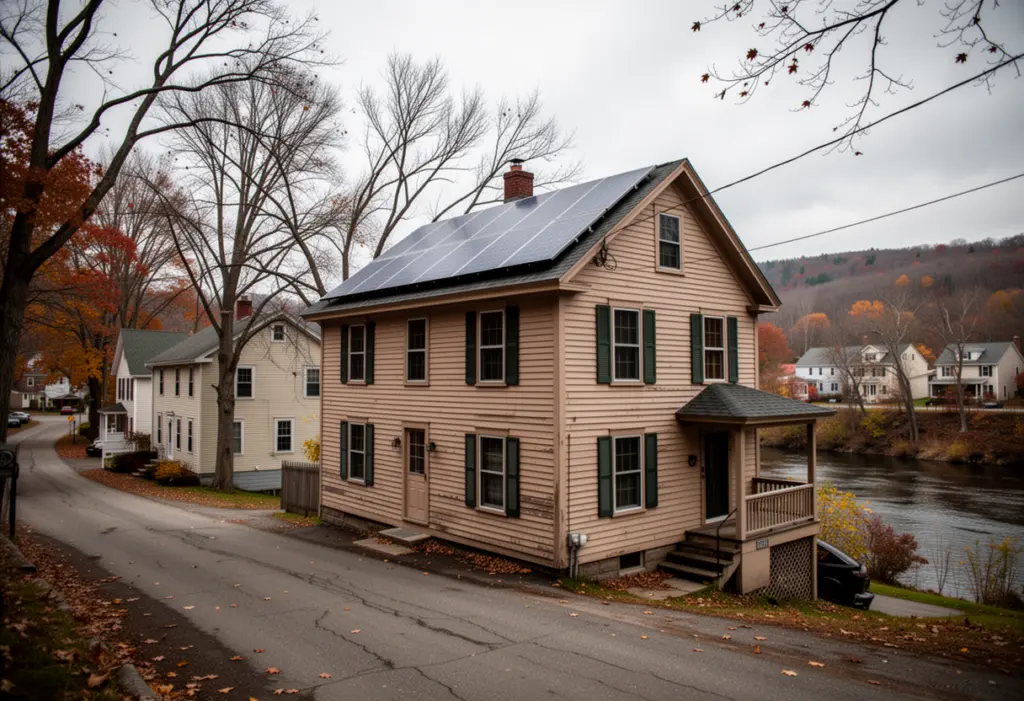
Solar in Baldwinsville is priced in two halves. The hardware half is close to a commodity and moves very little between installers. The local half — the roof, the service panel, the permit desk, the utility and the financing — is where two proposals for the same 13027 roof end up thousands of dollars apart. Reading a quote well mostly means knowing which half you are looking at.
The line that has to come off every 2026 quote
Start at the incentive block. The 30 percent federal residential credit is gone. Section 25D was terminated for expenditures made after 31 December 2025, and the statute treats an expenditure as made when the original installation is completed. A Baldwinsville homeowner signing in 2026 claims nothing federally: no phase-down, no transition, no carryover of a credit never earned. Where a proposal still shows that line, the net cost printed below it is overstated by thousands and every payback year calculated from it is wrong. Say so, and ask for the sheet again without it.
Three permit desks for one mailing address
The Village of Baldwinsville runs its own building department and sits inside the Town of Lysander, while the part of the village south of the Seneca River reaches into the Town of Van Buren. A 13027 address can therefore answer to the village, to Lysander or to Van Buren. That is a price question as much as an administrative one, because fee schedules and turnarounds differ, and an application filed at the wrong desk costs weeks rather than a correction. Ask which authority receives the paperwork and whether the permit fee in the proposal is that authority’s fee.
For systems of 25 kW DC and under, most authorities across New York work from the state Unified Solar Permit, which standardises the application. It does not standardise the fee, and it does not apply in the five boroughs.
The four local items that move the number
- Flood plain placement. Parcels near the river and the canal cut can be in mapped flood plain, and where they are, the inverter, the disconnects, the production meter and any battery have to sit above a set elevation. That is conduit and labour rather than panels, and it usually takes the basement off the table for a battery.
- Service capacity. Older houses in the village frequently have 100 amp service. Fitting a solar breaker can require a panel upgrade or a line-side tap, which is a four-figure item. Ask what your service is and whether the busbar has room.
- Roof age. With less than roughly ten years of shingle life left, re-roof first. Removing and reinstalling an array later costs considerably more than mounting once on a bare deck.
- Snow specification. Onondaga County takes heavy lake-effect snow. Ask what load the racking is specified for, and whether snow guards are needed where an array sits above a door, a walk or the driveway.
The only number that compares two proposals
Take the gross price before any incentive and divide it by the DC watts of the array. That gives dollars per watt, and it is the one figure that survives two installers using different incentive assumptions. Then make the exclusions match. Does each price include the electrical work, the permit, the interconnection filing and monitoring, and does either one exclude a service upgrade, tree removal or a re-roof? A cheaper quote that leaves out a panel upgrade you certainly need is not cheaper.
Ask as well for the annual production estimate in kilowatt-hours with December and January shown separately rather than folded into a yearly total. Two estimates that differ sharply for the same roof usually mean one installer has not stood on the property.
The low rate that is not cheap
A solar loan advertised at around one percent almost always carries a dealer fee, charged by the lender to the installer and built back into the system price. The rate on the paper is real; the price is higher because of it. Ask for the cash price and the financed price on the same page. If they are identical, ask what the finance partner charges and where in the quote it sits.
What the array costs every month once it is running
Baldwinsville is National Grid territory. The Customer Benefit Contribution is billed monthly on the DC size of the system rather than on what it produces, and for 2026 the residential rate is $0.97 per kW-month, the lowest of the state’s seven investor-owned utilities. A 9 kW array pays $8.73 a month, about $105 a year. It applies to systems interconnected on or after 1 January 2022, and the rates are recalculated annually rather than locked in at interconnection, so allow a little movement. Community solar subscribers pay none of it at all.
On the other side of the ledger, Phase One net metering credits exports at the full retail rate and holds that structure for 20 years from interconnection. That is what makes the arithmetic work this far north.
The incentives that are live, and how to price them
NY-Sun is the one most likely to be quoted loosely. It is applied by the contractor as a reduction in the price, not claimed by you, and it is paid in megawatt blocks that step down as each block fills. As of September 2026 NYSERDA has no open NY-Sun block for homes in any utility territory; check NYSERDA’s NY-Sun dashboard for a new one. A proposal that still shows a NY-Sun line should name the block it is quoted from, so you can look that block up yourself.
New York’s own 25 percent credit, capped at $5,000 on Form IT-255, remains available for a principal residence in the state. It is limited by your actual New York tax liability and unused amounts carry forward up to five years. The state sales tax exemption on residential solar equipment applies, with localities able to elect separately on their share, so ask whether the quote shows any tax at all. RPTL 487 exempts the added value for 15 years where the village or town, the county and the school district have each not opted out, for systems constructed before 1 January 2030. All of these change: confirm the current position with NYSERDA and the New York State Department of Taxation and Finance before you sign anything.
Frequently Asked Questions
Is there still a 30% federal tax credit on a Baldwinsville solar system?
No. Section 25D was terminated for expenditures made after 31 December 2025, and an expenditure counts as made when the original installation is completed. A 2026 quote showing a 30% federal line is materially wrong, and the net cost printed beneath it is wrong too.
How do I compare two Baldwinsville solar quotes fairly?
Divide each gross price, before incentives, by the DC watts of the array to get dollars per watt. Then check that the exclusions match — service upgrade, tree work, re-roofing, permit and interconnection fees — because a cheaper price with a missing line item is not cheaper.
Which building department issues the permit in Baldwinsville?
It depends on the parcel. The Village of Baldwinsville has its own building department, the village sits inside the Town of Lysander, and the part south of the Seneca River reaches into the Town of Van Buren. Ask which desk your application goes to before anyone files.
What is the monthly charge on a solar system in National Grid territory?
The Customer Benefit Contribution is $0.97 per kW-month of DC size for 2026 — about $8.73 a month, or roughly $105 a year, on a 9 kW array. It is billed on capacity regardless of production and applies to systems interconnected on or after 1 January 2022.
This article is general information, not tax, legal or financial advice. Incentive amounts, eligibility rules and deadlines change and depend on your utility, your tax situation and your property. Confirm current terms with NYSERDA, your utility and a qualified tax professional before making a decision.
NY Solar Incentives
Independent New York solar research. We summarise NYSERDA, NY-Sun and federal programme rules from published sources and state plainly when a figure is an estimate. We are not a government agency and do not sell equipment.
Run the arithmetic on your own system
Check the dated program table and your arrangement before counting an incentive. Standard residential NY-Sun blocks are closed; Long Island Affordable Solar has a conditional income-verification route. The NY credit depends on qualified costs and tax liability, while the NYC abatement reduces future property-tax bills. The estimator keeps those timings separate.