What Solar Panels Cost in Glens Falls, NY
Around Glens Falls the county line runs down the Hudson and the Adirondack Park boundary sits a short drive north, so two similar houses can face quite different paperwork.
On this page 7 sections
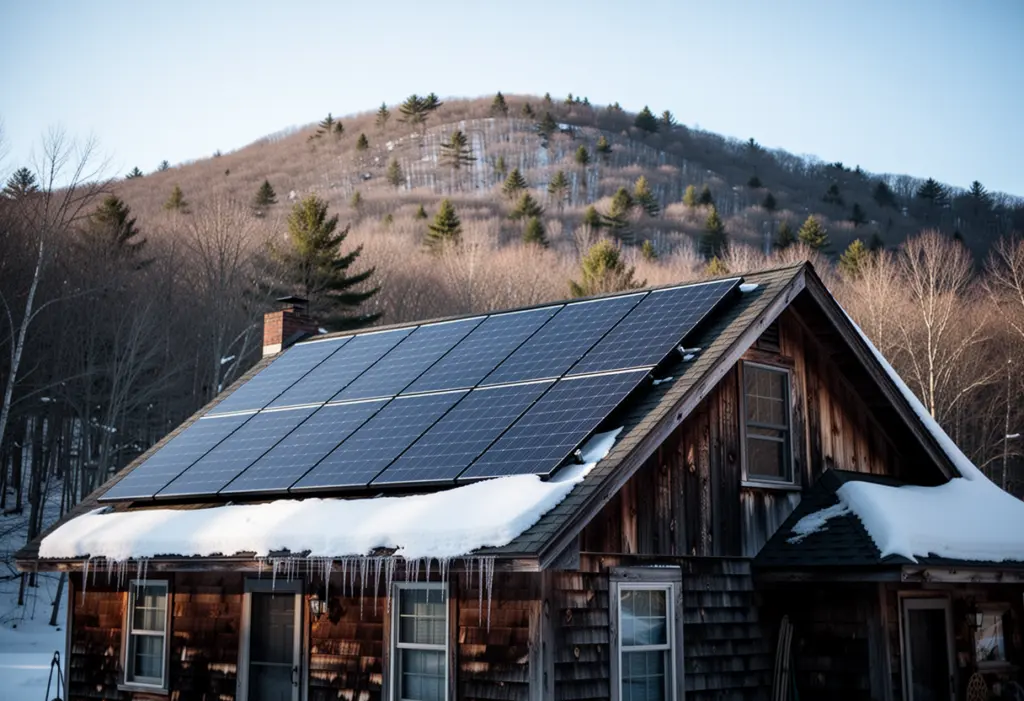
Glens Falls is a small city with three separate sets of rules inside a few miles of it, and which one your address falls under changes both the permitting cost and the property tax outcome. That is the first thing to establish, before anyone measures a roof.
Three jurisdictions, two counties, one river
The City of Glens Falls sits in Warren County around ZIP 12801. Immediately north, the Town of Queensbury covers a large suburban area around 12804. Across the Hudson to the south, the Village of South Glens Falls around 12803 is in Saratoga County. The permit comes from whichever of those you live in, and the fees and review times are theirs, not each other's.
The county line matters more than the postal address suggests. RPTL 487 exempts the added value of a solar system from property tax for 15 years only where the municipality, the county and the school district have each not opted out. Two houses a few hundred yards apart on opposite banks of the Hudson run that check against different counties and different municipalities, and can reach different answers. Systems must be constructed before 1 January 2030 to qualify.
Know which side of the Blue Line you are on
Glens Falls itself sits outside the Adirondack Park, but the Park boundary is a short drive north and addresses inside it can face Adirondack Park Agency involvement on top of the local building permit. This is not a reason to avoid solar; it is a reason to establish your status early, because discovering an extra review body after a contract is signed costs weeks rather than dollars. If your address is north of the city, ask the question before design work starts.
Snow country detailing is a real line item
This is the southern edge of the Adirondack foothills, and the snow here is not incidental. Three consequences belong in a quote:
- Winter production. Ask for modelled output month by month and ask specifically what the model assumes about snow cover. An annual total hides December and January entirely.
- Snow guards. A slick module surface on a steep roof sheds accumulated snow in one go. Over a doorway, a walkway or a parking space that is a safety problem with a real remedy that costs real money.
- Mechanical loading. Racking and attachment have to carry snow load as well as wind, which is a design input in this part of the state and a reason to be sceptical of a quote produced entirely from satellite imagery.
The utility, and the monthly charge on size
Most of the Glens Falls area is National Grid territory, and National Grid carries the lowest residential Customer Benefit Contribution rate in the state for 2026 at $0.97 per kW-month. That charge is billed on the DC size of the array whatever the weather does, for systems interconnected on or after 1 January 2022. On an 11 kW system it comes to $10.67 a month, or $128.04 a year. The identical array on Central Hudson, at $1.67, would pay $18.37 a month and $220.44 a year — roughly $92 a year of difference decided by nothing but the utility. Rates are recalculated annually and are not fixed at interconnection.
Confirm the utility from the name printed on your own bill. Elsewhere in the Capital Region, Green Island in Albany County is served by the Green Island Power Authority, a municipal electric utility, and municipal customers are outside Public Service Commission jurisdiction altogether — no PSC net metering, no Customer Benefit Contribution and no state interconnection process.
What the housing stock does to the number
The city's older streets bring the usual older-housing questions: a 100 amp service that cannot take a solar breaker alongside whatever else is planned, roofs on their second or third covering, and framing that warrants a structural letter. Ask whether the roof has more than one layer of shingles, because a tear-off changes both the attachment work and the honest remaining life of the roof. Newer stock in Queensbury tends toward larger simple planes and more modern services, which is genuinely cheaper to work on.
And whatever the age, if the roof has under ten years left, price the removal and reinstallation of the array now rather than later. That figure is easy to get before you sign and awkward to get afterwards.
The 2026 incentive position
NY-Sun used to be the incentive most specific to where you live: it was applied by your contractor as a reduction in the contract price, at a level set by your region, and it stepped down as each regional megawatt block filled. For this Upstate region the last standard residential block (Block 14, $0.15/W) closed on 17 December 2025 and the Residential Affordable Solar block on 9 March 2026. As of September 2026 NYSERDA has no open NY-Sun block for homes in any utility territory; check NYSERDA's NY-Sun dashboard for a new one, and question any proposal that still shows a NY-Sun deduction. What applies is New York's 25% credit capped at $5,000 on Form IT-255 for a principal residence, the state sales tax exemption, and the RPTL 487 exemption described above, which you claim by filing form RP-487 with your assessor.
There is no federal residential credit to add. Section 25D ended for expenditures made after 31 December 2025, with an expenditure treated as made when the original installation is completed, so a 2026 buyer claims nothing federally. Verify everything else at NYSERDA before it goes into your arithmetic.
Frequently Asked Questions
Who issues a solar permit near Glens Falls, NY?
It depends on the jurisdiction. The City of Glens Falls, the Town of Queensbury and the Village of South Glens Falls each permit separately, and South Glens Falls is in Saratoga County rather than Warren.
Does the Adirondack Park affect solar near Glens Falls?
The city sits outside the Park, but the boundary is a short drive north and addresses inside it can face Adirondack Park Agency involvement in addition to the local building permit. Establish your status early.
Does snow make solar a bad idea in this area?
No, but it needs to be designed for. Ask for month by month modelled output and the snow assumption behind it, and budget for snow guards where a roof sheds over a walkway, doorway or parking space.
What is the monthly capacity charge on National Grid?
For 2026 the residential Customer Benefit Contribution is $0.97 per kW-month, the lowest of the seven New York utilities. An 11 kW array pays $10.67 a month, or $128.04 a year, regardless of production.
This article is general information, not tax, legal or financial advice. Incentive amounts, eligibility rules and deadlines change and depend on your utility, your tax situation and your property. Confirm current terms with NYSERDA, your utility and a qualified tax professional before making a decision.
NY Solar Incentives
Independent New York solar research. We summarise NYSERDA, NY-Sun and federal programme rules from published sources and state plainly when a figure is an estimate. We are not a government agency and do not sell equipment.
Run the arithmetic on your own system
Check the dated program table and your arrangement before counting an incentive. Standard residential NY-Sun blocks are closed; Long Island Affordable Solar has a conditional income-verification route. The NY credit depends on qualified costs and tax liability, while the NYC abatement reduces future property-tax bills. The estimator keeps those timings separate.