Solar Cost for a Small House in New York
Square footage is not the input that sets the size of a solar array, and a small New York house can carry a bigger electrical load than a large one. Here is what actually decides the price.
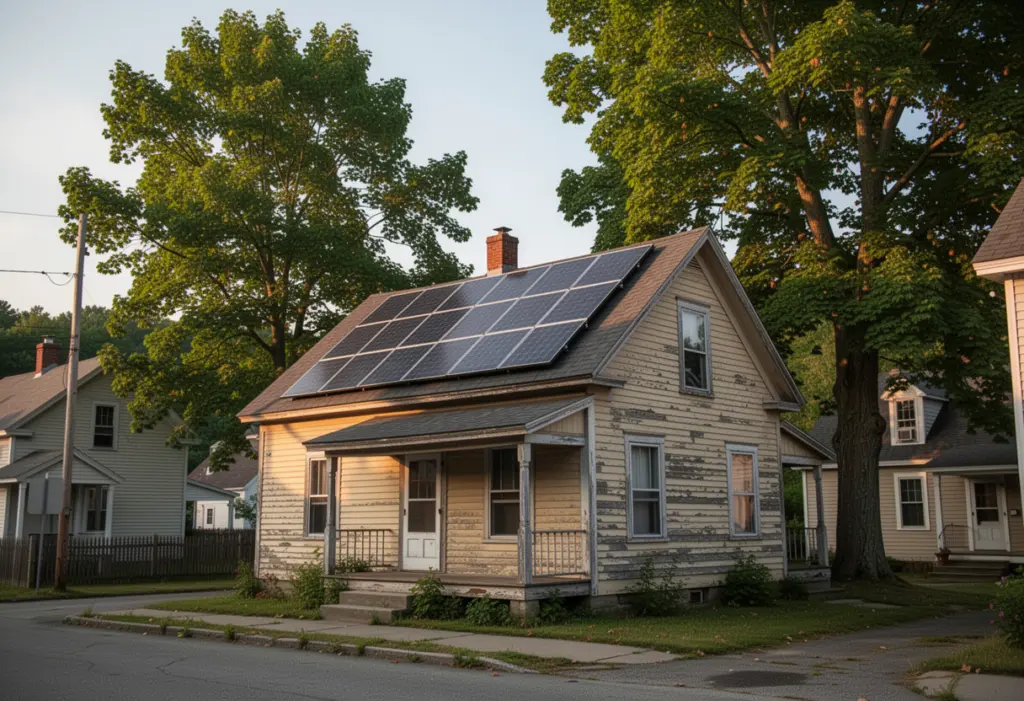
The first correction worth making is that the size of the house is not what sets the size of the array. Consumption does. A 1,100 square foot bungalow with electric hot water, a window air conditioner and a basement dehumidifier can draw more kilowatt-hours in a year than a much larger house heating with gas. Start with twelve months of bills and the annual kWh total, and treat floor area as irrelevant.
Three things about small New York houses that move the price
One usable roof plane. Small houses in New York are often storey-and-a-half Capes, gable cottages or bungalows with dormers, a chimney and a plumbing vent competing for the same south-facing slope. When the array has to be split across a smaller main plane and an east or west face, the design takes longer, the racking runs are shorter and less efficient, and production per installed watt falls. Ask to see the shading assessment for each plane separately rather than one annual figure for the whole system.
Age of the building. A lot of New York's small housing stock predates the electrical loads it now carries. A 60 or 100 amp service, an old fuse-style panel, undersized service entrance conductors or original rafters at wide spacing all turn up on this kind of house, and each is a real cost attached to a solar project rather than to the panels themselves. Get a service and structural check done during the site visit and written into the proposal.
Roof age. A small roof is cheap to replace and expensive to replace twice. If the shingles are near the end, replacing before installing is almost always the better order of operations, and the alternative — paying to remove and reinstall the array in a few years — should be priced today so the comparison is honest.
Why the per-watt number will look unflattering
Site visit, design, permit filing, the utility interconnection application, inspection, crew mobilisation and the day of electrical work at the service panel are broadly fixed. On a small array they are divided across fewer watts, so the dollars-per-watt figure rises even when nothing about the job is unusual. Judge a small system against other small systems, and ask for the total installed price rather than arguing about a ratio.
The arithmetic on a 4 kW array
Take a 4 kW system as the example. New York's solar energy system equipment credit is 25% of qualified expenditure capped at $5,000 on Form IT-255, and at this size the cap is unlikely to bind, so the credit is a genuine quarter of what you spend at your principal residence. The credit is limited by your actual New York State tax liability and carries forward up to five years if you cannot use it at once.
The Customer Benefit Contribution on 4 kW of DC capacity, at 2026 residential rates, runs from $3.88 a month on National Grid — $46.56 a year — through $5.16 on Con Edison, or $61.92 a year, to $6.68 on Central Hudson, which is $80.16 a year. It is charged on capacity, not production, for systems interconnected on or after 1 January 2022, and it is recalculated each year.
Nothing arrives from Washington. Section 25D was terminated for expenditures made after 31 December 2025, with an expenditure treated as made when the original installation is completed. On a small system that removal is proportionally the biggest change of the last decade, because the federal credit used to be the line that made a modest array pencil.
When the right answer is not a roof at all
If the usable plane will only carry a handful of modules, if a neighbour's mature oak owns the southern horizon, or if the house is rented, community solar deserves a serious look. A subscriber buys credits from an off-site array, pays no Customer Benefit Contribution at all, needs no roof, no permit and no interconnection application, and can leave. It gives up the property tax exemption and the equipment credit, since there is no equipment — but for a small house with a compromised roof, comparing the two honestly is the useful exercise, and no installer will do it for you.
2026 incentives on a small system
The two that used to matter most here are not available to homes at present. NY-Sun was applied by the contractor as a reduction in the price, and its per-watt level stepped down as each regional megawatt block filled; Affordable Solar, the higher rate for income-qualified households, worked the same way. As of September 2026 NYSERDA has no open NY-Sun block for homes in any utility territory; check NYSERDA’s NY-Sun dashboard for a new one. A figure someone quoted last season is not the figure today. What remains is the state sales tax exemption and RPTL 487, which exempts the added value from property tax for 15 years where the municipality, the county and the school district have each declined to opt out. On a small house the added value is modest, so this matters less than it does on a large array, but the three checks are the same. Confirm the current rules at NYSERDA before relying on any of it.
Frequently Asked Questions
How many solar panels does a small New York house need?
It is set by annual kilowatt-hours, not floor area. A small house with electric hot water can need more capacity than a larger house heating with gas, so start from twelve months of bills.
Why does a small solar system cost more per watt?
Design, permitting, the interconnection application, inspection and the electrical work at the panel are close to fixed. Divided across fewer watts they push the per-watt figure up.
Should I replace the roof before installing solar?
If the shingles are near the end of their life, yes. The alternative is paying to remove and reinstall the array later, and that price should be obtained in writing before you compare the two paths.
Is community solar better for a small house?
Often, where the roof is shaded, small or rented. Subscribers pay no Customer Benefit Contribution and need no permit or interconnection, but they get no equipment credit and no property tax exemption.
This article is general information, not tax, legal or financial advice. Incentive amounts, eligibility rules and deadlines change and depend on your utility, your tax situation and your property. Confirm current terms with NYSERDA, your utility and a qualified tax professional before making a decision.
NY Solar Incentives
Independent New York solar research. We summarise NYSERDA, NY-Sun and federal programme rules from published sources and state plainly when a figure is an estimate. We are not a government agency and do not sell equipment.
Run the arithmetic on your own system
Check the dated program table and your arrangement before counting an incentive. Standard residential NY-Sun blocks are closed; Long Island Affordable Solar has a conditional income-verification route. The NY credit depends on qualified costs and tax liability, while the NYC abatement reduces future property-tax bills. The estimator keeps those timings separate.