Solar Permit Costs in New York: What the Fees Cover
There is no statewide solar permit fee in New York. What you can do in an afternoon is find out exactly which body issues yours and ask for its schedule.
On this page 8 sections
- 01First establish who your authority actually is
- 02What the Unified Solar Permit changes, and what it does not
- 03The five things hiding inside one proposal line
- 04The questions that produce a real number
- 05Engineering costs travel with the permit
- 06The charge that arrives after the permit is closed out
- 07Where the state keeps tax off the invoice
- 08Frequently Asked Questions
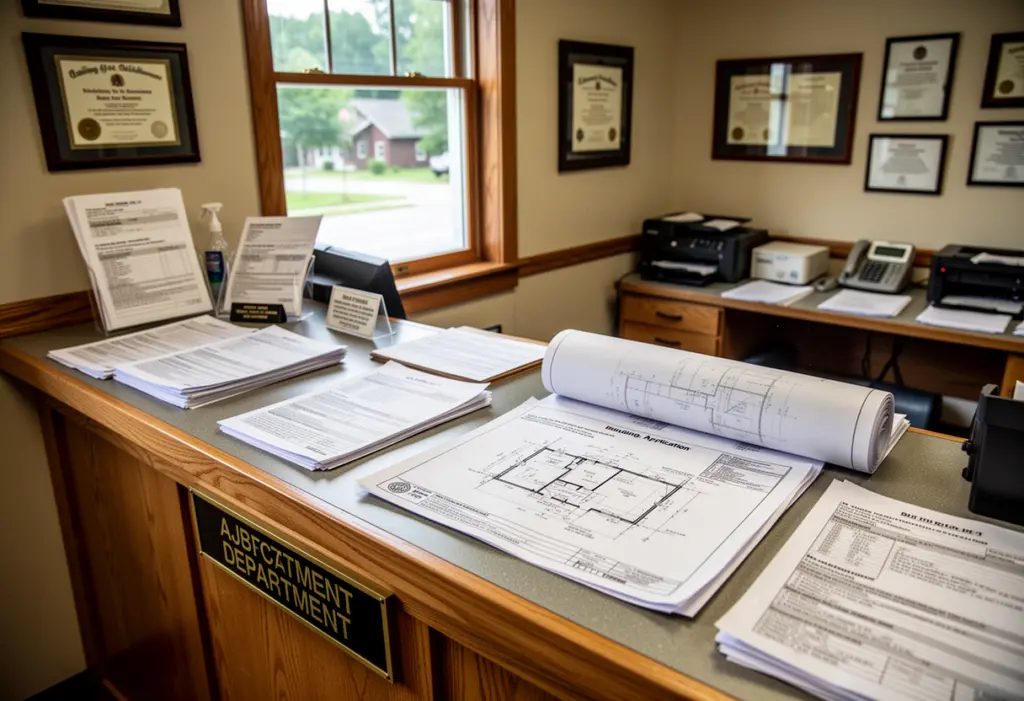
There is no statewide solar permit fee in New York, and any figure presented as one is a guess. Permit fees are set by the authority having jurisdiction — your town, your village or your city — and they differ from one municipal boundary to the next. What you can do, in an afternoon, is establish exactly which body will issue your permit and ask them for their fee schedule.
First establish who your authority actually is
This is where homeowners lose weeks. A property inside an incorporated village is usually permitted by the village, not by the town that surrounds it. A city permits its own. In the five boroughs the New York City Department of Buildings runs the process and the state Unified Solar Permit does not apply.
Look at your property tax bill. If it carries a village line as well as a town line, start with the village building department. Then ask the installer to name the authority they intend to file with, in writing, on the proposal. If the two answers differ, resolve it before the contract is signed rather than after.
What the Unified Solar Permit changes, and what it does not
NYSERDA and the New York Department of State developed the New York State Unified Solar Permit to standardise residential and small commercial solar permitting. It applies to systems of 25 kW DC and under and has been adopted by over 300 authorities having jurisdiction. It standardises the application and the review, which shortens the process and reduces the cost of preparing it.
What it does not do is fix a price. An adopting municipality still sets its own fee, and adoption does not remove the separate electrical inspection, the certificate of compliance, or any zoning review the project happens to trigger.
The five things hiding inside one proposal line
A proposal that says permits and interconnection as a single number is bundling at least five different things:
- The building permit fee paid to the authority having jurisdiction.
- The electrical permit or inspection fee. Many New York jurisdictions require sign-off from an approved electrical inspection agency, which is a separate company sending a separate invoice.
- Zoning, planning or historic review where the project triggers it, each with its own fee and its own calendar.
- The certificate of compliance or completion issued after the final inspection.
- The installer labour to prepare and file — drawings, structural letter, forms, and the time spent chasing them.
The utility interconnection application is usually inside that line too, and it is not a permit at all. It runs on a separate track with a separate authority and its own timetable.
The questions that produce a real number
- Which authority issues the permit, by name.
- What is that authority current fee schedule for a residential solar installation.
- Is the fee a flat charge or based on declared job valuation, and if it is valuation-based, what valuation is being declared.
- Is a third-party electrical inspection required, and is it inside or outside the quoted price.
- What happens to price and schedule if a variance, site plan review or historic review is required, and who pays.
- Is the permit fee refundable if the project does not proceed.
Question three is the one that moves money. A fee based on declared job valuation on a large residential system is a very different figure from a flat residential charge, and it is exactly the sort of thing discovered after signing rather than before.
Engineering costs travel with the permit
Most New York authorities want a structural letter or stamped drawings from an engineer licensed in this state, particularly on older housing stock, and that cost sits next to the permit rather than inside it. Slate, standing seam, and roofs carrying decades of accumulated layers all raise the probability of a real engineering review rather than a template letter. Ask whether the engineering is included, and what happens if the engineer concludes the roof needs work first.
The charge that arrives after the permit is closed out
Permit fees are one-off. The Customer Benefit Contribution is not. It is billed monthly on the DC size of the system, for systems interconnected on or after 1 January 2022, whatever the array produces. An 8 kW system pays 8 multiplied by $1.29, about $10.32 a month, under Con Edison; the identical system under National Grid pays 8 multiplied by $0.97, about $7.76. Annualised, that is roughly $93 to $160 for the same array depending only on which utility serves the address. Rates are recalculated annually.
A municipal electric utility customer is outside all of this — no state interconnection process, no Commission net metering and no Customer Benefit Contribution — because municipal utilities sit outside Public Service Commission jurisdiction. The permit still comes from the local authority, but the utility side is whatever that utility says it is. Read your own bill to confirm which applies to you.
Where the state keeps tax off the invoice
On a question about fees, the incentive that deserves top billing is the one that applies at the point of sale: New York State exempts the sale and installation of residential solar energy systems equipment from the 4% state sales tax and the MCTD tax, and localities may separately elect to exempt their local share, so the total exemption differs by county and by city. A quote is normally stated before tax, so the exemption means no tax is added rather than a deduction from the quoted price. Ask your installer to show the tax treatment on the quote rather than assuming it has been applied. Alongside that sit the 25% credit capped at $5,000 on Form IT-255 for a principal residence, and the RPTL 487 exemption on added property value where the municipality, the county and the school district have each not opted out and you file form RP-487 with the assessor by the taxable status date. The NY-Sun reduction the contractor used to apply, and the income-qualified Affordable Solar blocks, are not part of it now: as of September 2026 NYSERDA has no open NY-Sun block for homes in any utility territory; check NYSERDA’s NY-Sun dashboard for a new one. The federal 30% residential credit is not available: it ended for expenditures made after 31 December 2025.
Frequently Asked Questions
How much is a solar permit in New York?
There is no statewide figure. The authority having jurisdiction — town, village or city — sets the fee, and some charge a flat residential rate while others base it on declared job valuation. Ask the named authority for its current schedule.
Does the Unified Solar Permit make permits free?
No. It standardises the application and review for systems of 25 kW DC and under across more than 300 adopting authorities, which cuts preparation cost and time, but each municipality still sets its own fee. It does not apply in the five boroughs.
Is the electrical inspection included in the permit fee?
Often not. Many New York jurisdictions require sign-off from an approved electrical inspection agency, a separate company invoicing separately. Ask whether it sits inside or outside the quoted price.
Who pays if my solar project needs a variance?
Whoever your contract says, which is why it is worth reading before signing. Ask directly what happens to both price and schedule if zoning, planning or historic review is triggered.
This article is general information, not tax, legal or financial advice. Incentive amounts, eligibility rules and deadlines change and depend on your utility, your tax situation and your property. Confirm current terms with NYSERDA, your utility and a qualified tax professional before making a decision.
NY Solar Incentives
Independent New York solar research. We summarise NYSERDA, NY-Sun and federal programme rules from published sources and state plainly when a figure is an estimate. We are not a government agency and do not sell equipment.
Run the arithmetic on your own system
Check the dated program table and your arrangement before counting an incentive. Standard residential NY-Sun blocks are closed; Long Island Affordable Solar has a conditional income-verification route. The NY credit depends on qualified costs and tax liability, while the NYC abatement reduces future property-tax bills. The estimator keeps those timings separate.