Solar Panel Installation in Levittown, NY: What to Expect
A Levittown installation is shaped by two things that are not panels: the Town of Hempstead permit process, and seventy years of extensions to houses originally built to a handful of repeating plans.
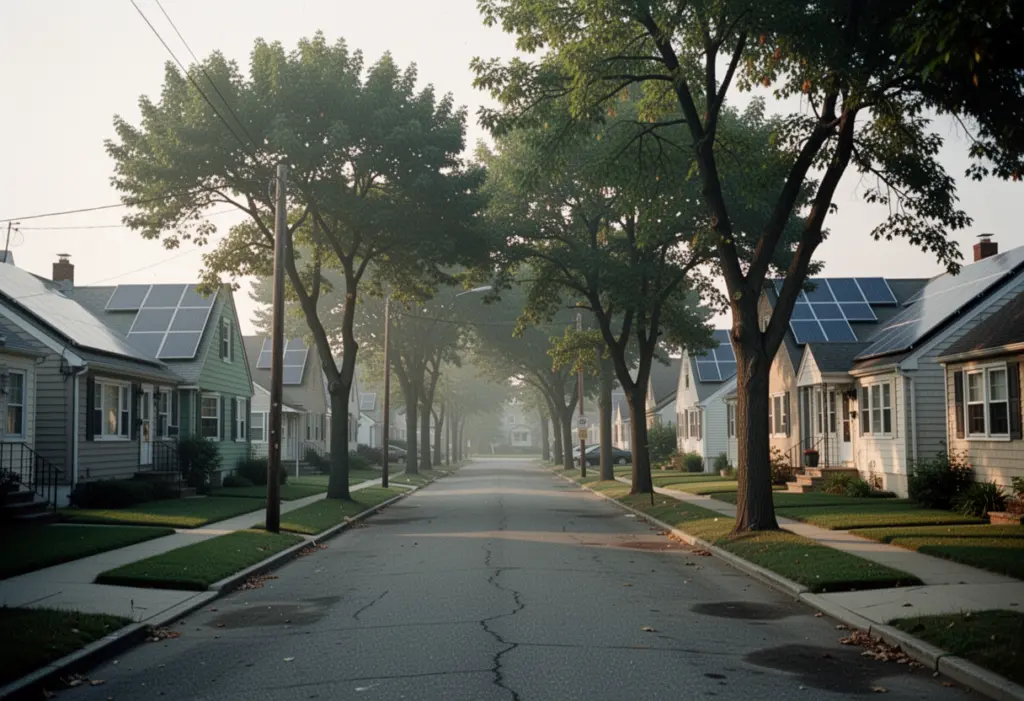
A solar installation in Levittown is decided by two things that have nothing to do with panels: the Town of Hempstead permit process, and the fact that the housing here was built to a small number of repeating plans in the late 1940s and early 1950s and then extended in every direction ever since. Both are predictable, which is the good news. Neither is optional.
Levittown is a hamlet, so the town issues the permit
Levittown, in the 11756 ZIP code, is not an incorporated village. It is an unincorporated hamlet within the Town of Hempstead, which means the town is the authority having jurisdiction for the building and electrical permits rather than a village hall. That is a real difference from neighbouring Nassau communities that are incorporated villages and run their own building departments, and it changes who your installer files with, which fee schedule applies, and which inspector signs the work off.
Ask the installer to name the authority in writing, to confirm whether it has adopted the NYS Unified Solar Permit for systems of 25 kW DC and under, and to state who pays if the application comes back for correction.
The roof is the whole job
The original houses here were compact, with simple roofs. Almost none of them stayed that way. Dormers, rear extensions, garage conversions and second storeys added over seventy years mean the roof a designer sees on satellite imagery is frequently several roofs of different ages, pitches and orientations meeting at awkward junctions.
- Ask for the plane by plane layout rather than a total kilowatt figure, and ask which planes are carrying the production estimate.
- Ask the age of each section. A twenty year old rear addition and an eight year old main roof are two different decisions about whether to reroof first.
- Ask about the structure. Where an addition went up without a stamped drawing, or where rafters are undersized or widely spaced, a structural letter may be required before the permit is issued.
- Ask about shade. The street trees planted when these subdivisions were new are now mature, and a tree that was irrelevant in 1955 can take a whole morning off your production. Insist on an on site shade assessment rather than a satellite estimate.
The electrical service is the second gate
Post-war housing was wired for post-war loads. Many houses have been upgraded once already, but not all of them, and a 100 amp service with a full panel is a common finding. A solar breaker needs room, and if you are also planning an EV charger or a heat pump then the panel is the constraint long before the roof is. Have the service capacity established at the survey, priced as its own line, and settled before you compare quotes, because a quote that includes an upgrade and one that excludes it are not comparable numbers.
Interconnection and the sequence
Levittown is served by PSEG Long Island, which operates the LIPA system. The sequence in practice is site survey, design, permit application, installation, electrical inspection, and then utility approval to operate. Nothing is switched on at the end of the installation day. Ask for the expected elapsed time at each stage, and ask what happens to the quoted price if any interval stretches.
Under Phase One net metering exports are credited at the full retail rate, and that structure holds for 20 years from interconnection, which is why the interconnection date matters more than the installation date. Note too that mass market LIPA projects cannot opt into the Value Stack, so the retail rate arrangement is the one that applies to you.
The monthly charge on capacity
The Customer Benefit Contribution is billed on the DC size of the array in kilowatts, every month, regardless of production, on systems interconnected on or after 1 January 2022. At the 2026 PSEG Long Island residential rate of $1.13 per kW-month, a 7 kW array pays 7 x $1.13 = $7.91 a month, roughly $95 a year. The rates are recalculated annually and are not fixed at interconnection. The practical consequence is worth stating plainly: an array sized well beyond your consumption builds credits you never use and pays a capacity charge every month for the privilege.
PSEG Long Island does not serve everyone on the island. The villages of Freeport and Rockville Centre in Nassau, and Greenport and Fishers Island in Suffolk, run their own municipal electric utilities and sit outside Public Service Commission jurisdiction entirely, with no Customer Benefit Contribution and no state interconnection process. Read the utility name printed on your own bill.
What the 2026 incentives actually are
There is no federal residential credit. Section 25D was terminated for expenditures made after 31 December 2025, measured by when the original installation is completed, so any Levittown proposal in 2026 carrying a 30% federal line is wrong and should be corrected before you read anything else on the page.
New York State’s 25% credit capped at $5,000 on Form IT-255 remains, limited by your actual state tax liability and carried forward up to five years where you cannot use it all at once. It reaches leases and power purchase agreements as well as purchases, but only where the agreement runs ten years or more: the ten year minimum applies to the lease just as it does to the PPA, and a shorter lease qualifies for nothing at all. NY-Sun used to be applied by the contractor as a reduction in the price rather than claimed by you, but the Long Island residential block closed on 17 April 2016, and as of September 2026 NYSERDA has no open NY-Sun block for homes in any utility territory, the income-qualified Affordable Solar blocks included. Check NYSERDA’s NY-Sun dashboard for a new one. Programmes change annually, so confirm the current position with NYSERDA and the Department of Taxation and Finance before you sign anything.
Frequently Asked Questions
Who issues the solar permit in Levittown?
The Town of Hempstead. Levittown is an unincorporated hamlet rather than an incorporated village, so the town building department is the authority having jurisdiction for both the building and electrical permits.
How long does a Levittown solar installation take?
The installation itself is short but the sequence around it is not. Site survey, design, permit, install, electrical inspection and utility approval to operate all take time, and nothing is energised on installation day.
Will my roof and electrical panel handle solar?
Post-war housing here has usually been extended, so expect several roof sections of different ages and pitches, and check the service capacity. A 100 amp service with a full panel is a common finding.
Which utility serves Levittown and what does it charge?
PSEG Long Island, operating the LIPA system. The 2026 residential Customer Benefit Contribution is $1.13 per kW-month, so a 7 kW array pays about $7.91 a month regardless of what it produces.
This article is general information, not tax, legal or financial advice. Incentive amounts, eligibility rules and deadlines change and depend on your utility, your tax situation and your property. Confirm current terms with NYSERDA, your utility and a qualified tax professional before making a decision.
NY Solar Incentives
Independent New York solar research. We summarise NYSERDA, NY-Sun and federal programme rules from published sources and state plainly when a figure is an estimate. We are not a government agency and do not sell equipment.
Run the arithmetic on your own system
Check the dated program table and your arrangement before counting an incentive. Standard residential NY-Sun blocks are closed; Long Island Affordable Solar has a conditional income-verification route. The NY credit depends on qualified costs and tax liability, while the NYC abatement reduces future property-tax bills. The estimator keeps those timings separate.