What Solar Panels Cost in Rhinebeck, New York
There is no single price for solar in Rhinebeck. The roof covering, the electrical service and which office issues your permit move the number far more than the choice of panel does.
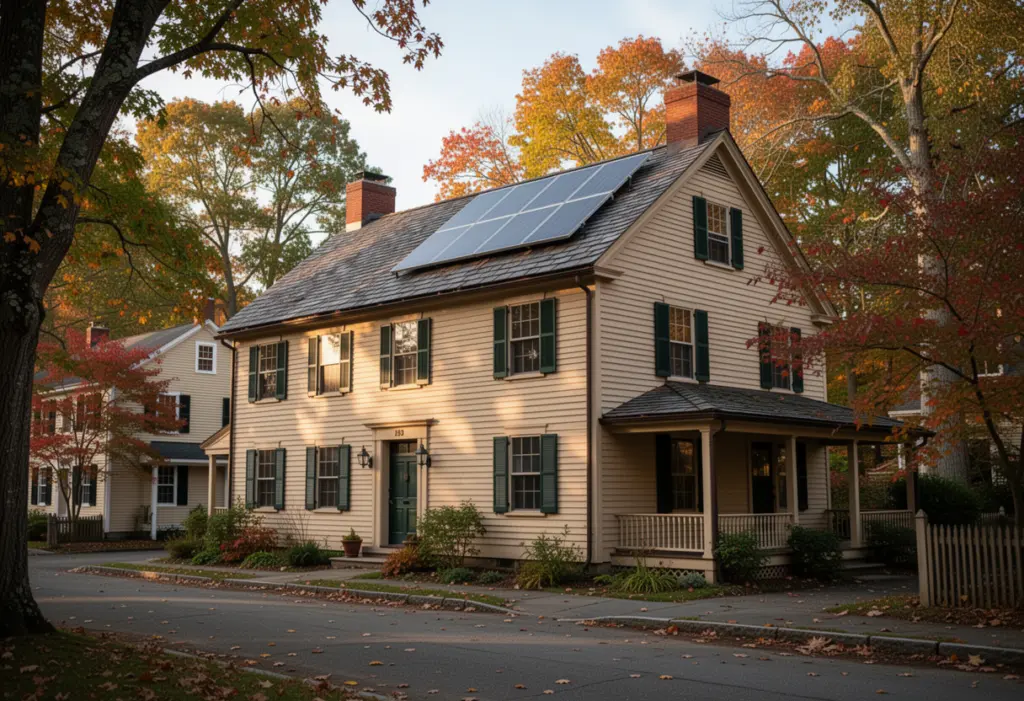
There is no single price for solar in Rhinebeck, and a figure quoted before anyone has looked at your roof is a marketing number rather than an estimate. What sets the cost here is the age of the house, the roof covering, the electrical service, and whether the address sits inside the village or out in the town — the last of which decides who issues the permit and how long it takes.
Rhinebeck sits under the steepest capacity charge in the state
Central Hudson serves most of Rhinebeck, including village addresses at 12572 and the riverside hamlet of Rhinecliff at 12574. For 2026 its residential Customer Benefit Contribution is $1.67 per kW-month of DC system size, the highest of the seven utilities in the state table, and it is charged on capacity whether or not the array produces anything that month. It reaches only systems interconnected on or after 1 January 2022, so an older array a few doors away carries no such line and its bill is not a guide to yours.
On a 9 kW system that is 9 × $1.67 = $15.03 a month, a little over $180 across a year. The same array under National Grid, an hour to the north, would be charged $0.97 per kW-month, or $8.73. Nothing about the hardware changes; only the utility does. The rates are recalculated annually and are not locked in at interconnection, so treat the figure as this year rather than as a twenty-year assumption.
What moves the number on a Rhinebeck roof
- Roof covering. Slate and standing-seam metal are both common on the older houses here, and each changes the mounting hardware and the labour hours. Slate is a specialist job, and a quote priced on asphalt shingle is not a quote for your roof.
- Roof age. If the covering has under about ten years left in it, taking an array off and putting it back later costs more than reroofing first. Ask for both sequences priced separately rather than accepting a verbal reassurance.
- Service capacity. A 100 amp panel is ordinary in a house of this vintage. A service upgrade is a real line item and it belongs in the written proposal, not in a change order discovered on install day.
- Trees. Mature street trees in the village and heavier cover on the larger parcels beyond it take real production out of a south-facing roof. Ask for shading by month rather than for a single annual kilowatt-hour total.
Who issues the permit decides your timeline
A village address is permitted by the Village of Rhinebeck; a town address is permitted by the Town of Rhinebeck. Separate offices, separate schedules, and an installer who works mostly in one may not know the other. Ask which applies to you, and whether that authority uses the New York State Unified Solar Permit, the standardised application for systems of 25 kW DC and under.
Ask as well whether your property falls inside the village historic district. Where a local design review applies, a street-facing array can need its own approval before anything is ordered. That is a scheduling question: the array cannot start offsetting your bill until it is approved and built.
The incentives that change the net figure
The 30% federal residential credit is gone. Section 25D was terminated for expenditures made after 31 December 2025, and an expenditure is treated as made when the original installation is completed. If a proposal you are holding still nets out a 30% federal line, its bottom figure is materially wrong and it should be redone before you compare it with anything else.
New York State still gives 25% of qualifying cost, capped at $5,000, claimed on Form IT-255 for equipment at your principal residence. The ceiling binds once eligible cost passes roughly twenty thousand dollars, so a large Rhinebeck array and a modest one can end up receiving exactly the same credit. It is limited by your actual New York State tax liability, and anything unused carries forward for up to five years.
Underneath sit two more. The state sales tax exemption covers residential solar equipment, with the local share exempt only where the county or city has separately elected it. RPTL 487 exempts the added assessed value for fifteen years, but it requires that the municipality, Dutchess County and your school district have each not opted out — three separate checks, all answered locally, and the system must be constructed before 1 January 2030. NY-Sun, which a contractor used to apply as a reduction in the contract price, is not currently one of them: as of September 2026 NYSERDA has no open NY-Sun block for homes in any utility territory; check NYSERDA’s NY-Sun dashboard for a new one.
All of this moves. Before you sign, check whether NYSERDA has opened a new NY-Sun block for homes, ask the assessor about the opt-out position in writing, and read the utility name printed on your own bill instead of inferring it from a map.
Frequently Asked Questions
How much do solar panels cost in Rhinebeck?
There is no single figure, and any number quoted before a site visit is marketing rather than an estimate. Roof covering, roof age, electrical service capacity and shading move a Rhinebeck price far more than the choice of panel brand does.
What does Central Hudson charge per kW of solar?
The 2026 residential Customer Benefit Contribution is $1.67 per kW-month of DC size, charged on capacity rather than production. A 9 kW array pays $15.03 a month, a little over $180 a year, and the rate is recalculated annually.
Can I still claim the 30% federal solar credit?
No. Section 25D was terminated for expenditures made after 31 December 2025, and an expenditure counts as made when the original installation is completed. A 2026 purchase claims nothing federally.
Does the historic district affect a solar installation?
Ask the village directly whether your address falls inside it and whether a street-facing array needs design approval. Where review applies it is a scheduling question, because the array cannot start offsetting your bill until it is approved and built.
This article is general information, not tax, legal or financial advice. Incentive amounts, eligibility rules and deadlines change and depend on your utility, your tax situation and your property. Confirm current terms with NYSERDA, your utility and a qualified tax professional before making a decision.
NY Solar Incentives
Independent New York solar research. We summarise NYSERDA, NY-Sun and federal programme rules from published sources and state plainly when a figure is an estimate. We are not a government agency and do not sell equipment.
Run the arithmetic on your own system
Check the dated program table and your arrangement before counting an incentive. Standard residential NY-Sun blocks are closed; Long Island Affordable Solar has a conditional income-verification route. The NY credit depends on qualified costs and tax liability, while the NYC abatement reduces future property-tax bills. The estimator keeps those timings separate.