The Average Electric Bill After Solar in New York
A New York bill after solar does not go to zero. The fixed customer charge stays, the capacity charge on system size stays, and one of them grows with the array.
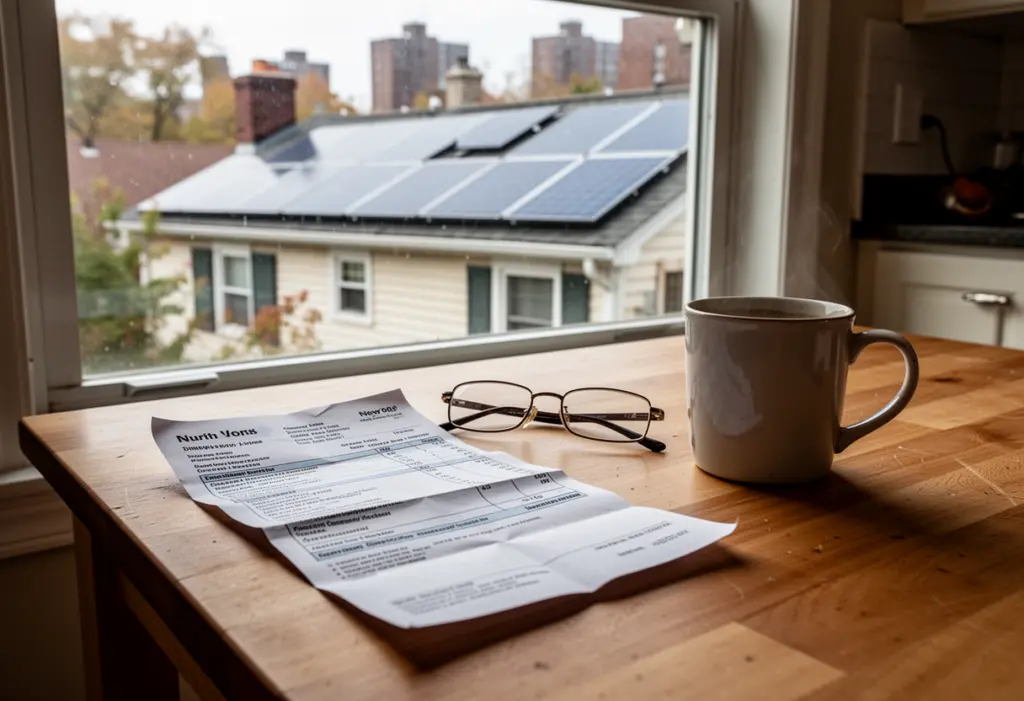
The honest answer is that a New York electric bill after solar does not reach zero, and a proposal promising that it will has already told you something about its arithmetic. Under Phase One net metering the volumetric part of the bill, the part driven by kilowatt-hours, can genuinely be reduced to nothing across a full year by a correctly sized array. What survives is everything that was never charged per kilowatt-hour in the first place.
What is still on the bill in month one
- The basic service charge. A fixed monthly amount for being connected. Solar does not touch it, and no array size changes it.
- The Customer Benefit Contribution. Charged on the DC size of your system, every month, regardless of what it produced. This one gets bigger as the array does.
- Taxes and surcharges applied to the charges that remain.
- Any month where you used more than you generated, netted against banked credits from earlier months.
Put a number on the second item, because it is the one nobody mentions on the doorstep. A 9 kW array in RG&E territory pays 9 × $1.31, which is $11.79 a month or $141.48 a year. The same array under Orange & Rockland pays $9.00 a month. Across the 2026 residential rates the spread runs from $0.97 per kW-month on National Grid to $1.67 on Central Hudson, and it applies to systems interconnected on or after 1 January 2022. It is recalculated annually, so it is not fixed by your interconnection date.
Why the monthly figure swings so hard
Ask to see two projected bills rather than an annual average: one for January and one for July. In a New York summer a well-sized array will generate more than the house consumes, and the surplus is credited at the full retail rate under Phase One net metering, which holds for 20 years from interconnection. In December and January production collapses and the house draws down the credit balance it built in June. An annual number that reads as a comfortable average hides the fact that four months of the year will show a real charge.
This is also why a heat pump, an electric vehicle or an induction range changes the answer. Each adds load, and heat pump load lands in exactly the months production is lowest.
Why a bigger array does not push the bill lower
Past the point where annual production matches annual consumption, extra capacity buys credits you never consume. You paid for those panels, and you pay the capacity charge on them every month for as long as they are connected. An oversized array is one of the few solar decisions that costs money in both directions at once, and it is a common outcome when a system is sized from a sales target rather than from twelve months of usage data.
The mirror image is the battery question. Under full retail-rate net metering the grid is already acting as a costless store of value for your surplus, so a battery in New York is a resilience purchase and not an economic one. Buy it if outages matter to you. Do not buy it expecting it to lower the bill.
What to ask before signing
- Show me the projected bill for January and for July, line by line, including the fixed customer charge.
- What monthly capacity charge does this DC size carry at my utility’s 2026 rate?
- What annual consumption figure was used, and does it come from my own twelve months of bills?
- What happens to unused credits at the annual reconciliation, and what does my utility do with them?
Two situations where none of this holds
Community solar subscribers see a different shape entirely: a credit arriving on the bill at a discount, no equipment, and no capacity charge, because front-of-the-meter projects and their subscribers pay none. And customers of a municipal electric utility are outside Public Service Commission jurisdiction altogether, which means no state net metering, no Customer Benefit Contribution and no state interconnection process. Terms come from the utility itself. Check the name printed on your bill before assuming which of these you are.
Where the incentives land on the bill
Almost nowhere, and that is the point worth making at the end. NY-Sun, when a block is open, arrives as a lower purchase price through the contractor, not as a credit on the utility bill, and as of September 2026 NYSERDA has no open NY-Sun block for homes in any utility territory; check NYSERDA’s NY-Sun dashboard for a new one. New York’s 25 percent credit capped at $5,000 arrives on Form IT-255 at tax time, for equipment at your principal residence in New York, and only against liability you actually have. RPTL 487 changes a property tax bill rather than an electric one, and only where the municipality, the county and the school district have each not opted out and the system is constructed before 1 January 2030. The one thing that does not arrive at all is the 30 percent federal residential credit, terminated for expenditures made after 31 December 2025 with an expenditure treated as made when the original installation is completed. Verify the current capacity charge and NY-Sun position before signing, since both move annually.
Frequently Asked Questions
Does solar make my electric bill zero in New York?
No. The fixed basic service charge remains, the Customer Benefit Contribution on system size remains, and taxes apply to what is left. The kilowatt-hour portion can net to nothing across a year with a correctly sized array.
How much is the monthly charge on my system size?
It depends on the utility. A 9 kW array pays $11.79 a month on RG&E and $9.00 on Orange & Rockland at 2026 residential rates. The range runs from $0.97 to $1.67 per kW-month, recalculated each year.
Why is my winter bill still high?
Production collapses in December and January while consumption rises, so the house draws down credits banked in summer. Ask for projected January and July bills rather than an annual average before you sign.
Would a battery lower the bill?
Not meaningfully under full retail-rate net metering, because the grid already stores your surplus at full value. A battery in New York is a resilience purchase rather than an economic one.
This article is general information, not tax, legal or financial advice. Incentive amounts, eligibility rules and deadlines change and depend on your utility, your tax situation and your property. Confirm current terms with NYSERDA, your utility and a qualified tax professional before making a decision.
NY Solar Incentives
Independent New York solar research. We summarise NYSERDA, NY-Sun and federal programme rules from published sources and state plainly when a figure is an estimate. We are not a government agency and do not sell equipment.
Run the arithmetic on your own system
Check the dated program table and your arrangement before counting an incentive. Standard residential NY-Sun blocks are closed; Long Island Affordable Solar has a conditional income-verification route. The NY credit depends on qualified costs and tax liability, while the NYC abatement reduces future property-tax bills. The estimator keeps those timings separate.