Affordable Solar in New York: Who the Income Limits Cover
Affordable Solar was a NYSERDA incentive for households under 80% of area median income, and no block is open as of September 2026. If one opens, it is applied by the contractor rather than claimed by you, which is why it can go missing from quotes.
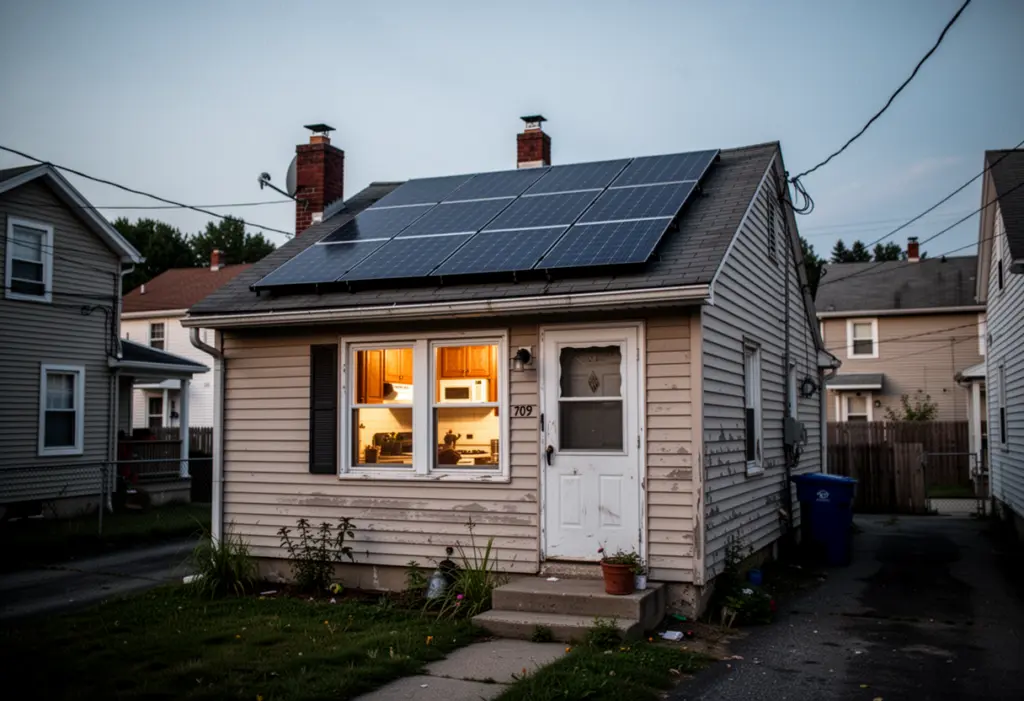
Affordable Solar was a NYSERDA incentive for households under 80% of area median income, and it is closed. The income-qualified blocks paid $0.80 per watt and ran in Con Edison territory from 30 May to 15 October 2025 and in NYSERDA’s Upstate region from 18 December 2025 to 9 March 2026, and Long Island’s last residential block closed in April 2016. As of September 2026 NYSERDA has no open NY-Sun block for homes in any utility territory; check NYSERDA’s NY-Sun dashboard for a new one. If one opens, two things about it decide whether you actually receive it. It would be applied by the contractor as a reduction in the price rather than claimed by you on a form. And area median income is set by county and by household size, so there is no single dollar figure that answers the question for New York.
How the limit is defined
The threshold is a percentage of area median income, not a flat number. Two households of different sizes in the same county face different limits, and the same household size faces different limits in different counties. The figures are published and they are revised, so the only correct way to check is against the current table for your own county on the programme page, rather than against a number somebody quoted last year or a rule of thumb offered over the phone.
There may be more than one way to demonstrate that you are under the threshold, and which one applies decides how much paperwork you assemble. Ask NYSERDA or the contractor directly what evidence the programme accepts for your household before you start gathering documents, rather than assuming an income statement is the only route.
The part that quietly costs people money
NY-Sun incentives, this adder included, were paid through the contractor and appeared as a lower contract price. Nothing arrived in the post and nothing was claimed on a return. The practical consequence was blunt: if you did not raise it, it could simply never appear in your quote. If NYSERDA opens a new income-qualified block, ask directly whether the proposal includes it, ask what the price would be without it, and ask for the two lines to be shown separately. Until then, a 2026 quote that shows an Affordable Solar line needs an explanation of which open block it comes from.
It is also worth understanding that the base NY-Sun incentive is structured in megawatt blocks by region, and the amount per watt steps down as each block fills until the last one closes. For homes that has now happened everywhere: Con Edison’s last standard residential block closed on 29 May 2025, the Upstate region’s on 17 December 2025 and Long Island’s on 17 April 2016. A 2026 quote carrying any NY-Sun amount is worth questioning for that reason alone.
The uncomfortable arithmetic on the state tax credit
New York's 25% credit capped at $5,000 on Form IT-255, which requires the equipment to be installed and used at your principal residence in New York State, is usually presented alongside the income-based programmes as though the two stack neatly for everybody. They do not stack the same way for everybody. The credit is not refundable: it can reduce your New York State tax liability to zero, but it cannot pay you anything beyond that. A household with a low state liability may take years to absorb it, and unused credit carries forward for only five years before it lapses.
That is not an argument against the credit. It is an argument for working out your own likely liability before a monthly payment is built on the assumption that a full $5,000 arrives next spring.
What the income limits do not gate
Several things do not turn on income at all and belong in the same conversation:
- The state sales tax exemption on residential solar energy systems equipment, with localities separately able to exempt their own local share.
- RPTL 487, a 15-year property tax exemption on the added value of the system, where the municipality, the county and the school district have each not opted out, for systems constructed before 1 January 2030.
- Phase One net metering, which credits exports at the full retail rate and holds that structure for 20 years from interconnection.
- Financing through Energy Finance Solutions, including the On-Bill Recovery Loan, repaid on the utility bill, and the Smart Energy Loan. Ask what terms your household is offered, since the terms are not necessarily the same for everybody.
And one charge that is not income-tested either. The Customer Benefit Contribution is billed monthly on the DC size of the array, on systems interconnected on or after 1 January 2022. A 5 kW system pays $4.85 a month on National Grid at the 2026 residential rate and $6.45 on Con Edison. Small, but it is a fixed cost that does not care what the array produced that month.
If the numbers still do not work
Community solar is the honest alternative, and it is not a consolation prize. There is no equipment, no roof requirement and no loan to qualify for, and community solar subscribers pay no Customer Benefit Contribution at all. It is also the only route open to most tenants, since a rooftop array needs a roof you control and a utility account the system can be wired into.
2026, and what is no longer there
The 30% federal residential credit is gone. Section 25D was terminated for expenditures made after 31 December 2025, and an expenditure is treated as made when the original installation is completed. It was non-refundable too, so for many of the households these income-based programmes exist to serve, it delivered less than the headline suggested even while it lasted. Any 2026 proposal still showing it is wrong.
Thresholds and incentive levels change every year. Check the current income table and block levels at nyserda.ny.gov and the credit rules at tax.ny.gov rather than relying on any printed summary, including this one.
Frequently Asked Questions
What is the income limit for Affordable Solar in New York?
The adder was for households under 80% of area median income, which is set by county and by household size rather than as one statewide figure. It is closed: as of September 2026 NYSERDA has no open NY-Sun block for homes in any utility territory, so check NYSERDA’s NY-Sun dashboard for a new block before checking the income table for your county.
How do I claim the Affordable Solar incentive?
At present you cannot: the Affordable Solar blocks closed in Con Edison territory on 15 October 2025 and in NYSERDA’s Upstate region on 9 March 2026. When a block is open you do not claim it yourself: the contractor applies it as a reduction in the contract price, so ask directly whether your quote includes it and what the price would be without it.
Can I get the state tax credit as well?
Yes, if the equipment serves your principal residence in New York State. It is not refundable though: the 25% credit capped at $5,000 on Form IT-255 can only reduce your state tax liability to zero, with unused credit carried forward for up to five years.
What if I do not qualify or cannot use the credit?
Community solar needs no equipment, no roof and no loan, and subscribers pay no Customer Benefit Contribution at all. It is also the only practical route for most tenants.
This article is general information, not tax, legal or financial advice. Incentive amounts, eligibility rules and deadlines change and depend on your utility, your tax situation and your property. Confirm current terms with NYSERDA, your utility and a qualified tax professional before making a decision.
NY Solar Incentives
Independent New York solar research. We summarise NYSERDA, NY-Sun and federal programme rules from published sources and state plainly when a figure is an estimate. We are not a government agency and do not sell equipment.
Run the arithmetic on your own system
Check the dated program table and your arrangement before counting an incentive. Standard residential NY-Sun blocks are closed; Long Island Affordable Solar has a conditional income-verification route. The NY credit depends on qualified costs and tax liability, while the NYC abatement reduces future property-tax bills. The estimator keeps those timings separate.