Solar Panel Installation in Brewster NY: What to Check
In Brewster the two questions that shape a solar project are which side of the village line your parcel sits on, and which utility name is printed on your bill. Both change the paperwork before anyone touches the roof.
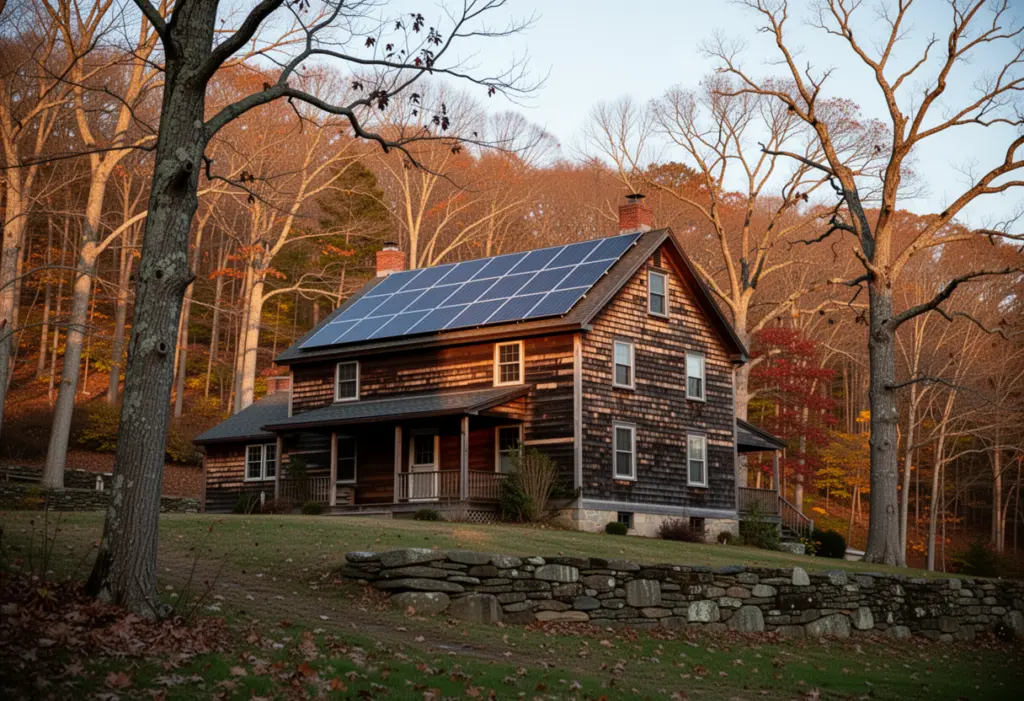
Two answers decide almost everything about a Brewster solar project, and both are available before you take a single quote. The first is whether your parcel sits inside the Village of Brewster or in the surrounding Town of Southeast, because that determines which building office issues the permit and inspects the work. The second is which utility name is printed on your electricity bill, because that sets your monthly capacity charge and which interconnection process you go through.
Village or town decides your permit office
The Village of Brewster is a small incorporated village inside the Town of Southeast, and the village line runs through neighbourhoods rather than around them. Brewster addresses use the 10509 ZIP code, which reaches well past the village boundary, so a ZIP code is not evidence of which office holds your file. Ask your installer to name the authority having jurisdiction in writing on the proposal, and ask whether that authority has adopted the New York State Unified Solar Permit.
The Unified Solar Permit was developed by NYSERDA and the Department of State to standardise residential permitting, it covers systems of 25 kW DC and under, and more than 300 authorities across the state have adopted it. Where it is in force the application is a known quantity. Where it is not, the town or village writes its own requirements, and that is where surprise submittals appear.
The utility on your bill sets the monthly charge
Putnam County sits in the mid-Hudson region, which is largely Central Hudson territory, while NYSEG serves parts of the Hudson Valley as well. Territory boundaries here do not follow county lines, so read the utility name off your own bill rather than assuming from the county.
It matters in dollars. The Customer Benefit Contribution is billed monthly on the DC size of your array, not on what it produces, and it applies to systems interconnected on or after 1 January 2022. For 2026 the residential rate is $1.67 per kW-month on Central Hudson and $1.19 on NYSEG. A 7 kW array therefore pays $11.69 a month, about $140 a year, under Central Hudson, and $8.33 a month, about $100 a year, under NYSEG. Same roof, same panels, a $40 annual difference decided by a name on a bill.
If your service comes from a municipal electric utility rather than an investor-owned one, none of this applies: municipal utilities sit outside Public Service Commission jurisdiction, so there is no state net metering, no Customer Benefit Contribution and no state interconnection process. Terms come from the utility directly.
What Putnam land and Putnam houses do to a design
- Ridges and mature oak. This is hill country, and the thing that ruins a southern horizon here is usually a neighbouring ridge or a stand of tall oak on the property line, not the roof pitch. Ask for a shade assessment taken on site rather than a satellite estimate.
- Watershed rules on ground mounts. Much of Putnam County lies within the New York City Croton watershed. A ground mount disturbs soil, so ask the town early whether watershed regulations apply to your parcel before assuming a ground mount is the simpler option.
- Older service panels. Village housing here includes plenty of pre-war frame construction on 100 amp service. A service upgrade is a real line item, and it should appear on the quote rather than emerge after the contract is signed.
- Roof age. If the roof has under ten years left, reroof first. Removing and reinstalling an array later is labour you pay for twice.
The property tax exemption is four checks here, not three
RPTL 487 gives a 15-year exemption on the added assessed value of a solar system, and it requires construction before 1 January 2030. But the exemption can be opted out of separately by a county, a city, a town or a village by local law, and by a school district by resolution. A village parcel in Brewster is levied by the village and the town, so there are four separate opt-out questions to ask, not the three a generic New York guide describes. Read the taxing jurisdictions off your own tax bill and ask about each one by name.
What is actually available in 2026
Start with what is gone. The 30% federal residential credit under section 25D was terminated for expenditures made after 31 December 2025, and an expenditure is treated as made when the original installation is completed. A 2026 Brewster proposal showing a 30% federal line is materially wrong, and that is a reason to question the rest of the arithmetic on it.
The incentive worth interrogating on a Brewster proposal is NY-Sun, because it is the one that used to arrive silently. It was paid through the contractor as a reduction in the price rather than as anything you claim, in megawatt blocks whose per-watt amount stepped down as each block filled, and for homes those blocks have run out: as of September 2026 NYSERDA has no open NY-Sun block for homes in any utility territory. So if a 2026 quote shows a NY-Sun line or a per-watt discount, ask which open block it comes from, and check NYSERDA’s NY-Sun dashboard for a new one. What is left is the state credit of 25% of qualified expenditure capped at $5,000 on Form IT-255, for a principal residence and reaching leases and power purchase agreements of ten years or more, the exemption from state sales tax (Putnam County still charges its own local sales tax on residential solar, according to Publication 718-S), and the RPTL 487 exemption above. Programme terms move, so confirm the current position with NYSERDA and the Department of Taxation and Finance before you sign anything.
Frequently Asked Questions
Who issues a solar permit in Brewster?
It depends on whether your parcel is inside the Village of Brewster or in the surrounding Town of Southeast. The 10509 ZIP code covers both, so ask your installer to name the authority having jurisdiction in writing, and ask whether it has adopted the NYS Unified Solar Permit.
Which electric utility serves Brewster?
Putnam County sits in the mid-Hudson region, largely Central Hudson territory, with NYSEG serving parts of the Hudson Valley. Boundaries do not follow county lines, so read the utility name printed on your own bill before assuming which rules apply.
What will the monthly capacity charge be?
The Customer Benefit Contribution is billed on DC system size regardless of production. For 2026 that is $1.67 per kW-month on Central Hudson and $1.19 on NYSEG, so a 7 kW array pays about $140 a year on one and about $100 on the other.
Is the 30% federal tax credit still available?
No. Section 25D was terminated for expenditures made after 31 December 2025, with an expenditure treated as made when the original installation is completed. Any 2026 quote showing a 30% federal line is wrong.
This article is general information, not tax, legal or financial advice. Incentive amounts, eligibility rules and deadlines change and depend on your utility, your tax situation and your property. Confirm current terms with NYSERDA, your utility and a qualified tax professional before making a decision.
NY Solar Incentives
Independent New York solar research. We summarise NYSERDA, NY-Sun and federal programme rules from published sources and state plainly when a figure is an estimate. We are not a government agency and do not sell equipment.
Run the arithmetic on your own system
Check the dated program table and your arrangement before counting an incentive. Standard residential NY-Sun blocks are closed; Long Island Affordable Solar has a conditional income-verification route. The NY credit depends on qualified costs and tax liability, while the NYC abatement reduces future property-tax bills. The estimator keeps those timings separate.