Solar Panel Installation in Suffern, NY
Suffern is an incorporated village, so the property tax exemption has a fourth level to check and the permit comes from the village rather than the town.
On this page 8 sections
- 01The village issues the permit, not the town
- 02RPTL 487: four authorities, and the smallest bill is the one that catches people
- 03The Ramapo River, and where the equipment may sit
- 04The ridge a satellite model cannot see
- 05Older village housing
- 06Orange and Rockland
- 07What is left in 2026
- 08Frequently Asked Questions
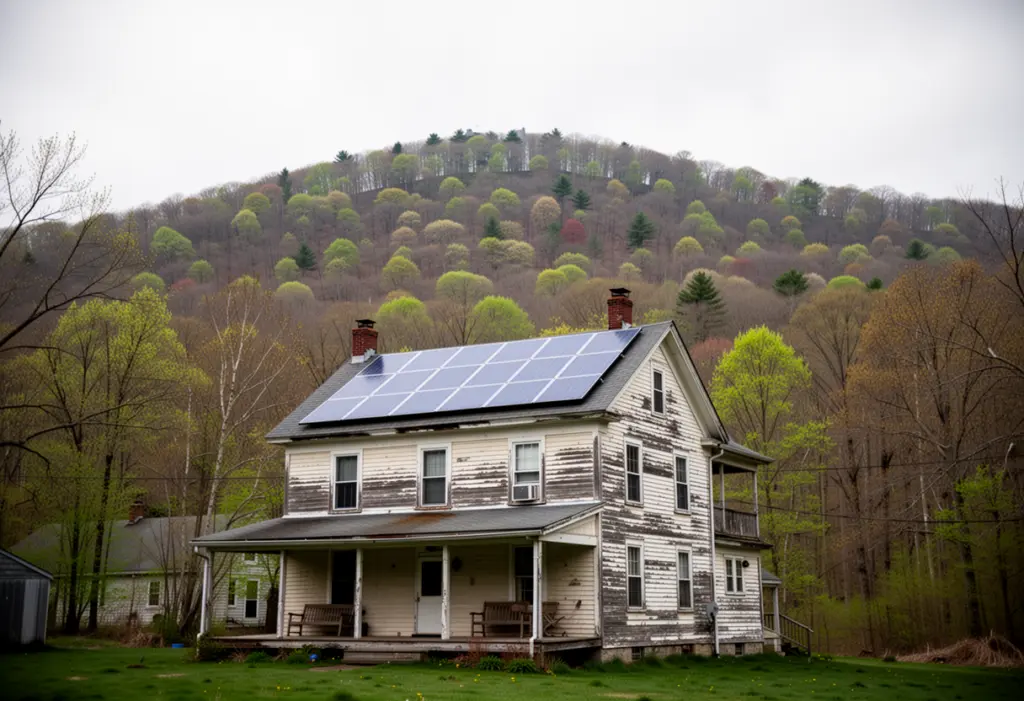
Suffern is an incorporated village in the Town of Ramapo, in the south-western corner of Rockland County where the Ramapo River cuts through the mountains and New York meets New Jersey. ZIP code 10901. Being a village rather than a hamlet changes both the permit and the tax question; the river and the ridge change the design.
The village issues the permit, not the town
A parcel inside the village line is permitted by the Village of Suffern building department. A parcel outside it goes to the Town of Ramapo, or to a different village entirely, since Ramapo also contains Montebello, Airmont and Hillburn among others, each its own authority. A Suffern mailing address is not proof of being inside the village. Check the parcel, not the postmark, before an installer files.
RPTL 487: four authorities, and the smallest bill is the one that catches people
The fifteen-year exemption on the added value of a solar system exists only where the taxing authority has not opted out, and a village address has four of them, each deciding on its own account:
- The Village of Suffern, which may opt out by local law.
- The Town of Ramapo, separately.
- Rockland County, separately again.
- Your school district, which opts out by resolution rather than local law; for most Suffern addresses that is the Suffern Central School District.
Village taxes are the smallest of the four bills, which is precisely why the village level gets skipped in a sales conversation, and skipping it is how a homeowner meets a taxable increment they were told did not exist. Ask for the position on each of the four, in writing, for your parcel. Construction must also be complete before 1 January 2030.
The Ramapo River, and where the equipment may sit
Low-lying property along the river is in mapped flood plain, and where that applies it governs where the electrical equipment is mounted rather than where the panels go. Equipment usually has to sit above a specified elevation, which can mean a different wall, a greater height, or an interior position rather than the default spot beside the meter; a basement is frequently the wrong home for a battery on these parcels however convenient it looks; and the design has to be right first time, because moving equipment after inspection is expensive. Ask whether your parcel is in a mapped zone and what the village requires before a design is drawn. An installer who has not worked along the river may not raise it at all.
The ridge a satellite model cannot see
Suffern sits in the gap where the river passes through the Ramapo Mountains, so a great many properties have rising ground close by. A ridge to the south or west removes real production and removes it disproportionately in winter, when the sun is low. A model that reads your roof plane and the trees on your own lot does not necessarily account for the horizon beyond them. Ask whether the estimate models the horizon as well as the roof, and ask for December and January rather than an annual total.
Older village housing
The village core is old. Roof age is the usual gate, and with under roughly ten years of remaining shingle life the sensible order is to re-roof first. Slate and standing-seam metal both appear here: slate needs a mounting approach not every installer is equipped for, while standing seam is the best case, since the racking clamps to the seams without penetrating the roof at all. Service panels of 100 amps are common, and fitting a solar breaker can require an upgrade or a line-side tap, which belongs in the quote. Where the older streets carry historic character, architectural review can apply ahead of the building permit, so design for approval rather than argue after refusal: a rear or secondary roof plane, all-black modules in black frames, flush mounting that follows the plane, and conduit run out of sight.
Orange and Rockland
The whole county is Orange & Rockland territory, and its 2026 residential Customer Benefit Contribution works out at a dollar per kilowatt of DC capacity per month for anyone who interconnected on or after 1 January 2022. A 6 kW array therefore costs $6.00 a month, about $72 over a year, and a 9 kW array $9.00 a month, roughly $108. The charge follows the size of the system rather than its output, and the rate is reset each year. Phase One net metering runs the other way, crediting exports at the full retail rate for twenty years from interconnection. Confirm the utility name from your own bill.
What is left in 2026
The property tax exemption above deserves most of your attention here, because it is the item with four separate ways to fail and the one an installer is least likely to have checked at village level. A village that has opted out does not remove the exemption entirely; it removes the village share of it, and the same is true of each of the other three. That is why a yes or no answer about New York State is worthless and a parcel-level answer is not.
Behind it sit two more. Form IT-255 carries the state credit at 25% of qualified expenditure with a $5,000 ceiling, for a system serving the home you actually live in, set against your New York State liability and carried forward for as much as five years where a single year cannot absorb it, and open to a lease or power purchase agreement running a decade or longer. The state sales tax exemption lifts the tax from residential solar equipment, with each locality free to decide on its own share. NY-Sun and its Affordable Solar incentive for households at or below 80% of area median income used to arrive as money off the contractor’s price. As of September 2026 NYSERDA has no open NY-Sun block for homes in any utility territory; check NYSERDA’s NY-Sun dashboard for a new one.
The federal residential credit is not among them. Congress ended section 25D for expenditures made after 31 December 2025, and the test the statute applies is completion of the original installation, not the day the utility grants permission to operate. Buy in 2026 and there is no federal credit at any system size, at any income, on any timetable: nothing tapers, nothing transitions, and nothing carries over from a credit that was never earned. A quote showing a 30% federal line describes last year. Check where each remaining programme stands before you sign, because they change.
Frequently Asked Questions
Does the Village of Suffern or the Town of Ramapo issue my permit?
The village, if the parcel is inside the village line. Outside it you are with the Town of Ramapo or with another village such as Montebello, Airmont or Hillburn. A Suffern mailing address does not settle it — check the parcel.
Why does the village matter for the property tax exemption?
Because RPTL 487 requires that each taxing authority has not opted out, and a village address has four: village, town, county and school district. The village is the smallest bill and the one most often skipped, and one opt-out leaves part of the added value taxable.
Does the flood plain affect a solar installation in Suffern?
On low-lying property along the Ramapo River, yes. The inverter, disconnects, meter and any battery generally have to sit above a specified elevation, which means a basement battery is often the wrong answer however convenient that location would otherwise be.
Will the mountains cut my production?
They can, and disproportionately in winter when the sun is low. Ask whether the production estimate models the horizon as well as your own roof and trees, and ask to see December and January rather than only the annual total.
This article is general information, not tax, legal or financial advice. Incentive amounts, eligibility rules and deadlines change and depend on your utility, your tax situation and your property. Confirm current terms with NYSERDA, your utility and a qualified tax professional before making a decision.
NY Solar Incentives
Independent New York solar research. We summarise NYSERDA, NY-Sun and federal programme rules from published sources and state plainly when a figure is an estimate. We are not a government agency and do not sell equipment.
Run the arithmetic on your own system
Check the dated program table and your arrangement before counting an incentive. Standard residential NY-Sun blocks are closed; Long Island Affordable Solar has a conditional income-verification route. The NY credit depends on qualified costs and tax liability, while the NYC abatement reduces future property-tax bills. The estimator keeps those timings separate.