What Solar Costs in Monticello, NY
Monticello sits in wooded second-home country, and two things there change the arithmetic more than any equipment choice: the trees, and whether the house is where you actually live.
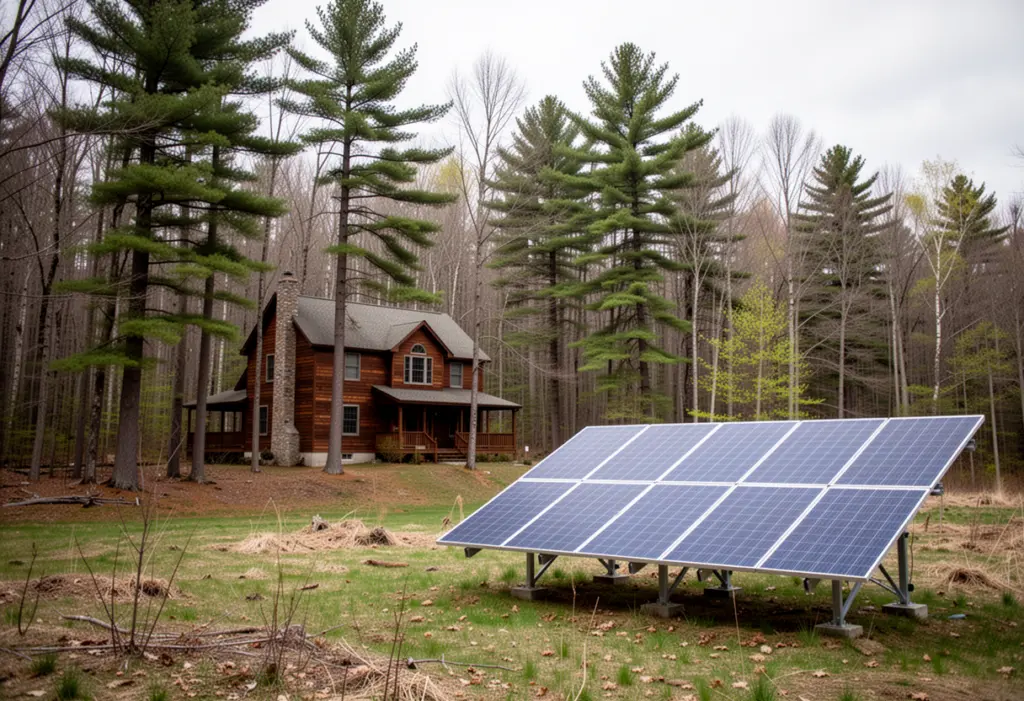
Monticello is a village in the Town of Thompson and the seat of Sullivan County. ZIP code 12701. Sullivan is heavily wooded second-home country, and two local facts move the cost of a solar project here more than any choice of panel or inverter.
The principal residence test is the one that decides it
New York’s 25% credit, capped at $5,000 on Form IT-255, requires the system to be installed and used at the taxpayer’s principal residence in New York State. A seasonal house, a second home or a property held and let does not qualify.
In a county with as much second-home ownership as this one, that single line changes the answer for a large number of households. With the federal residential credit gone, the state credit is the largest remaining tax benefit available to a buyer, so a weekend house in Sullivan County is being priced without it. Establish which category your property falls into before a proposal is built around a credit you cannot claim, and confirm the position with your own accountant rather than with a salesperson.
Note that the credit does reach a lease of ten years or more and a power purchase agreement of ten years or more as well as an outright purchase, but the principal residence requirement applies in every case. It is also limited by your actual New York State tax liability.
Trees are a cost, and the cost is not on the quote
Second-growth forest covers much of this area, and mature canopy on the southern side of a house is frequently what decides whether a roof array is viable at all. Three things to insist on:
- An on-site shading assessment, not a satellite estimate. Where two quotes for the same roof differ sharply on production, one installer usually never visited.
- December and January figures rather than an annual total. The low winter sun is what turns a tolerable obstruction into a decisive one.
- Tree removal treated as your decision, not an assumption folded quietly into a production estimate. It has real cost, it is permanent, and on a wooded Sullivan County parcel the trees are frequently part of what the property is worth.
Where the roof is genuinely shaded, a ground mount in an open part of the parcel is the honest alternative. Ask for it to be quoted alongside the roof option, and ask about setbacks, site plan review, trenching distance back to the house, foundation depth below the frost line and clearance beneath the lowest row, because an array set too low is buried by drifted snow for weeks up here. Community solar is the other route, and it needs no roof, no clearing and no up-front cost.
Three utilities, three different monthly charges
Sullivan County is not served by one company, and the Customer Benefit Contribution differs sharply between them. It falls on any system interconnected on or after 1 January 2022, is calculated from DC capacity rather than from production, and is re-set annually.
- Central Hudson, $1.67 per kW-month and the highest rate in the state: a 7 kW system pays $11.69 a month, about $140 a year, and a 13 kW ground mount pays $21.71, about $261.
- NYSEG, $1.19: the same 7 kW pays $8.33 a month and the 13 kW pays $15.47.
- Orange & Rockland, $1.00: $7.00 and $13.00 respectively.
That is a spread of roughly $105 a year on a 13 kW system for identical equipment, decided only by which company is printed on the bill. Confirm yours from the bill itself rather than assuming from the county.
Set against it, Phase One net metering pays full retail for exports and locks that arrangement in for 20 years from the day you interconnect, and a community solar subscriber owes no Customer Benefit Contribution whatever.
Village or town, and the rest of the stack
The Village of Monticello and the Town of Thompson are separate authorities with their own building departments. Establish which covers your address before anything is filed.
The 30% federal residential credit is gone — section 25D was terminated for expenditures made after 31 December 2025, and an expenditure is treated as made when the original installation is completed. Any quote still showing it is materially wrong. What is left, once the principal residence question above is settled, is the state sales tax exemption, which removes the 4% state tax but not Sullivan County’s own 4%, because the county does not provide the local exemption (Publication 718-S), and RPTL 487, a 15-year exemption on the added value where the village, the town, Sullivan County and your school district have each not opted out. NY-Sun and its Affordable Solar incentive at or below 80% of area median income are not available to a home at present. As of September 2026 NYSERDA has no open NY-Sun block for homes in any utility territory; check NYSERDA’s NY-Sun dashboard for a new one. Programmes change, so check the current position yourself before signing.
Frequently Asked Questions
Can I claim the New York credit on a Sullivan County weekend house?
No. Form IT-255 requires the system to be installed and used at your principal residence in New York State, and a seasonal, second or let property does not qualify. With the federal residential credit gone, that is the largest tax benefit a buyer loses.
How much do trees really cost me here?
Potentially the whole project. Insist on an on-site shading assessment and on December and January production figures rather than an annual total, and treat any proposed tree removal as your own decision with its own price rather than an assumption inside an estimate.
Which utility serves Monticello, and does it matter?
It matters a great deal. The monthly Customer Benefit Contribution is $1.67 per kW-month on Central Hudson, $1.19 on NYSEG and $1.00 on Orange and Rockland. On a 13 kW system that is roughly $105 a year of difference for identical equipment. Read the name on your bill.
Is a ground mount worth quoting in Monticello?
On a wooded parcel with open ground, frequently yes. Tilt and orientation are chosen rather than inherited and the roof-age question disappears. Ask about setbacks, site plan review, trenching distance and clearance beneath the lowest row so snow does not bury it.
This article is general information, not tax, legal or financial advice. Incentive amounts, eligibility rules and deadlines change and depend on your utility, your tax situation and your property. Confirm current terms with NYSERDA, your utility and a qualified tax professional before making a decision.
NY Solar Incentives
Independent New York solar research. We summarise NYSERDA, NY-Sun and federal programme rules from published sources and state plainly when a figure is an estimate. We are not a government agency and do not sell equipment.
Run the arithmetic on your own system
Check the dated program table and your arrangement before counting an incentive. Standard residential NY-Sun blocks are closed; Long Island Affordable Solar has a conditional income-verification route. The NY credit depends on qualified costs and tax liability, while the NYC abatement reduces future property-tax bills. The estimator keeps those timings separate.