RG&E Solar Rebate: What Actually Exists in 2026
There is no RG&E solar rebate, and NYSERDA's NY-Sun has no open block for homes as of September 2026, so what is left comes from the state tax code. RG&E adds a monthly charge of its own.
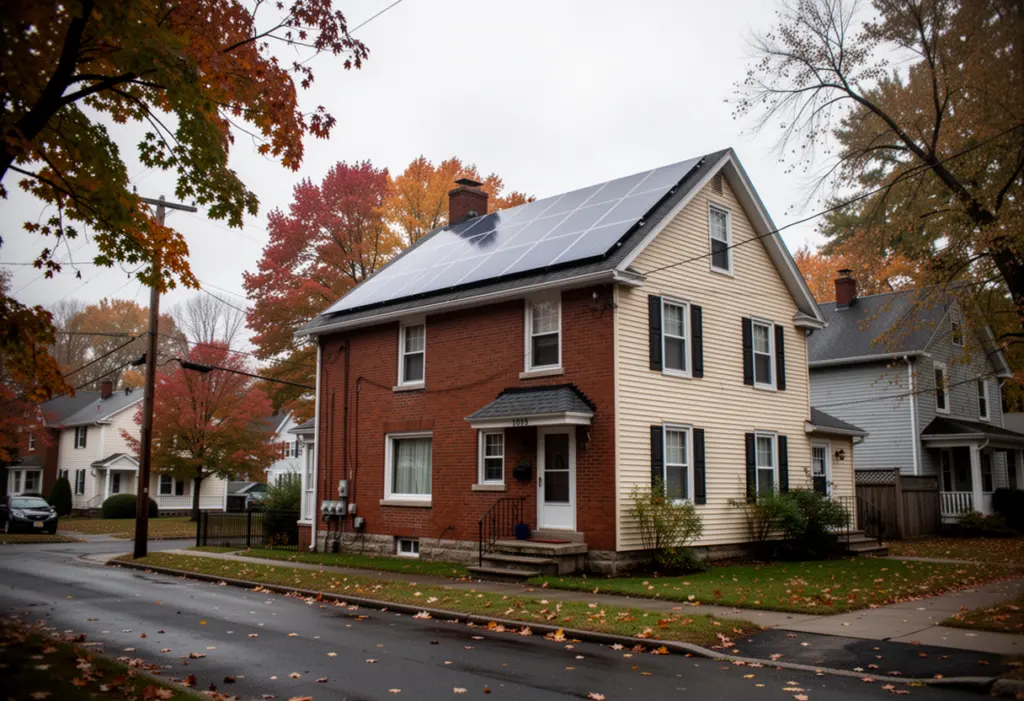
RG&E does not run a residential solar rebate. If a proposal for a Rochester or Monroe County home shows a line described as an RG&E rebate, ask what it actually is, because the reductions in a New York solar quote come from somewhere else entirely. RG&E’s role is the interconnection, the meter, net metering — and one monthly charge that gets added rather than deducted.
Where the money in the quote comes from
NY-Sun. This is the incentive most often mislabelled as a utility rebate. It is a NYSERDA programme, applied by the contractor as a reduction on the contract price rather than paid to you, and structured in megawatt blocks: each region had capacity blocks, and the per-watt amount stepped down as each block filled. It was designed to phase out as the market matured, and for homes it now has. RG&E is in NYSERDA’s Upstate region, whose last residential block ($0.15 per watt, limited to NYSEG, RG&E and National Grid territory) closed on 17 December 2025. As of September 2026 NYSERDA has no open NY-Sun block for homes in any utility territory; check NYSERDA’s NY-Sun dashboard for a new one, and if a Rochester quote still shows a NY-Sun line, ask the installer which open block it comes from.
Affordable Solar. NYSERDA’s income-qualified NY-Sun incentive, $0.80 per watt for households under 80% of area median income, which the contractor applied as a price reduction. In the Upstate region it ran from 18 December 2025 to 9 March 2026 and is now closed, so it should not appear on a 2026 quote unless NYSERDA opens a new block.
The New York State credit. 25% of qualified solar energy system equipment expenditure capped at $5,000, claimed on Form IT-255. It requires the equipment to be installed and used at your principal residence in New York, so a camp on a Finger Lake or a rental property does not qualify. It is not refundable, it is limited by the New York tax you actually owe, and unused amounts carry forward up to five years. It reaches a lease or a power purchase agreement only where the agreement runs ten years or more, and for those the $5,000 is a lifetime ceiling per agreement.
Sales tax. Residential solar energy systems equipment is exempt from New York State sales tax, and localities separately elect whether to exempt their own share. Monroe County has not: Publication 718-S lists it among the jurisdictions that do not provide the exemption, so the county’s local sales tax still applies in the city and the surrounding towns alike.
Property tax. RPTL 487 exempts the added value of the system for 15 years where the taxing authority has not opted out, and requires construction before 1 January 2030. Inside the City of Rochester there is a detail worth knowing: Rochester is one of the Big Five city school districts, which are fiscally dependent and levy no separate property tax, so there is no separate school district check to make. In the surrounding towns and villages there is, and it is a genuine third question alongside Monroe County and your own municipality.
What RG&E adds rather than pays
The Customer Benefit Contribution is billed monthly on the DC size of the array rather than on what it produces, and applies to systems interconnected on or after 1 January 2022. For 2026 the RG&E residential rate is $1.31 per kW-month — the second highest in the state. An 8 kW system therefore pays $10.48 a month, about $126 a year, every year the system runs. Rates are recalculated annually and are not fixed at interconnection.
One oddity worth knowing if you also own a small business: RG&E’s small commercial rate is $0.96, below its residential rate. It is one of only three utilities in the state where the small commercial figure sits below the residential one.
Because the charge follows capacity rather than output, an array built larger than your consumption is charged for every surplus kilowatt, every month, while banking credits that annual reconciliation never turns into money. Size to the load you actually have.
The territory check that catches people
RG&E covers Rochester and Monroe County, but not the whole county. The villages of Fairport, Spencerport and Churchville run their own municipal electric utilities, and a municipal customer is outside everything described here: no Public Service Commission net metering, no Customer Benefit Contribution and no state interconnection process. Terms are set by that utility and must be asked for directly. The reliable check is the utility name printed on your own bill, not a coverage map and not an address lookup.
What is not available at all
The 30% federal residential credit is gone. Section 25D was terminated for expenditures made after 31 December 2025, and an expenditure is treated as made when the original installation is completed rather than when it is placed in service. A 2026 buyer claims nothing federally — there is no phase-down and no transition. Any Rochester quote still showing a federal line is materially wrong, and the honest response is to ask for it to be reissued and then look again at what the payback becomes.
What does survive federally is the business-side credit taken by whoever owns the system, which is why lease and power purchase offers remain aggressively marketed here. That benefit is not yours and does not appear on your return.
Two financing routes are worth pricing alongside a bank loan: the On-Bill Recovery Loan, repaid through the utility bill, and the Smart Energy Loan, both available through Energy Finance Solutions. And treat any low advertised interest rate carefully — a below-market rate is frequently paid for by a dealer fee built into the system price, so compare the total contract price at each rate rather than the rate alone. Incentive terms change annually; confirm the current position with NYSERDA and the New York State Department of Taxation and Finance before signing.
Frequently Asked Questions
Does RG&E offer a solar rebate?
No. RG&E does not run a residential solar rebate. NYSERDA's NY-Sun programme, which contractors applied as a price reduction, has no open block for homes as of September 2026, so the main incentive left for a Rochester buyer is the New York State tax credit claimed on Form IT-255.
What does RG&E charge solar customers in 2026?
The Customer Benefit Contribution, billed monthly on the DC size of the array rather than on production, at $1.31 per kW-month residential for 2026. An 8 kW system pays $10.48 a month, about $126 a year, and the rate is recalculated annually.
Do I need to check my school district for the property tax exemption?
In the towns and villages of Monroe County, yes — county, municipality and school district each opt out separately. Inside the City of Rochester there is no separate school check, because Rochester is one of the Big Five fiscally dependent districts.
Is all of Monroe County served by RG&E?
No. Fairport, Spencerport and Churchville run their own municipal electric utilities, and their customers are outside Public Service Commission net metering, the Customer Benefit Contribution and the state interconnection process. Check the name on your bill.
This article is general information, not tax, legal or financial advice. Incentive amounts, eligibility rules and deadlines change and depend on your utility, your tax situation and your property. Confirm current terms with NYSERDA, your utility and a qualified tax professional before making a decision.
NY Solar Incentives
Independent New York solar research. We summarise NYSERDA, NY-Sun and federal programme rules from published sources and state plainly when a figure is an estimate. We are not a government agency and do not sell equipment.
Run the arithmetic on your own system
Check the dated program table and your arrangement before counting an incentive. Standard residential NY-Sun blocks are closed; Long Island Affordable Solar has a conditional income-verification route. The NY credit depends on qualified costs and tax liability, while the NYC abatement reduces future property-tax bills. The estimator keeps those timings separate.