Shared Solar for an Apartment Building in New York
Shared solar can mean three quite different things in an apartment building, and they benefit different people. Establishing which one is proposed comes before any savings model.
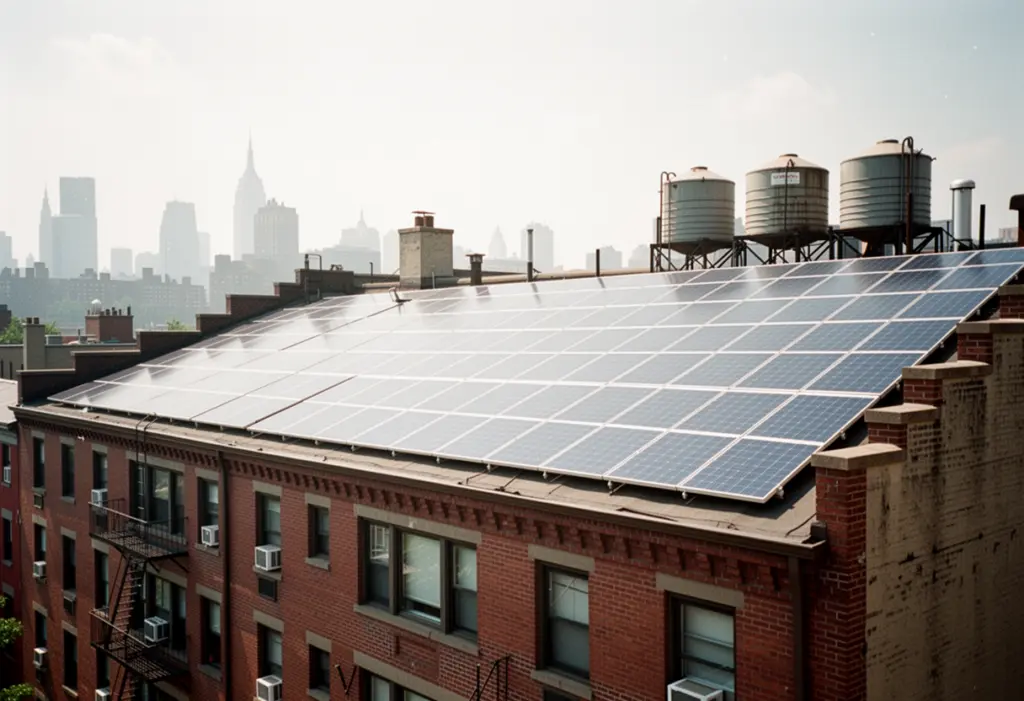
Shared solar is not one thing. In a New York apartment building it usually means one of three arrangements, and they benefit different people, run on different compensation rules and carry different obligations. Establish which one is on the table before anyone shows you a savings figure, because a number attached to the wrong arrangement is not a mistake you can spot from the number itself.
The three arrangements
- An array serving the building’s own account. The system is connected to the house meter that serves hallways, lifts, pumps and common lighting. The benefit lands on the building account, which reaches residents only through whatever pays that bill — common charges, maintenance or rent.
- An on-site array whose output is allocated among residents. This is the genuinely shared version, and it is the one that runs under community distributed generation rules and the Value Stack rather than the mass-market residential net metering most single-family rooftops use. Allocation, administration and billing all have to be defined in writing.
- Off-site community solar taken individually. No equipment on the building at all. Each household subscribes in its own name and credits appear on its own utility bill. It is the simplest arrangement and often the only realistic one for a rented building.
The metering architecture decides what is possible
Before anything else, find out whether the building is master metered — one utility account for everything — or individually metered, with each apartment holding its own account. That fact determines whether allocated credits can reach residents at all, and it is the first question any competent proposal answers rather than the last.
Ask also whether the compensation is net metering or the Value Stack. Phase One net metering credits exports at the full retail rate and holds for 20 years from interconnection, and it is what most residential rooftop customers are on. The Value Stack applies to community distributed generation and larger projects, and it values exports differently. A proposal that does not name which one it assumes has not been modelled properly.
Questions to put in writing before anyone signs
- Whose name is on the interconnection agreement, and who owns the equipment?
- How are credits allocated between units, how often is that reviewed, and how does it appear on a resident’s bill?
- What happens when a resident moves out mid-year, and who reallocates their share?
- Is there a subscription fee, an escalator or a minimum term, and what are the cancellation rights?
- Who is responsible for maintenance, monitoring and roof repairs under the array, and who pays if the roof has to be redone?
- What happens if the building is sold or the managing agent changes?
The roof question is the one that gets skipped and the one that costs. An array installed on a roof with a few years of life left means removing and reinstalling it at somebody’s expense, and that somebody should be named in the agreement.
Who can claim what
Ownership structure decides this, and it is worth paying a professional rather than guessing. The New York 25% credit capped at $5,000 on Form IT-255 requires equipment installed and used at the taxpayer’s principal residence in New York State, and it reaches a lease or a power purchase agreement only where the agreement runs ten years or more — that minimum applies to the lease as well as the PPA, and for a lease or PPA the $5,000 is a lifetime ceiling for that agreement rather than an annual figure. How that interacts with a cooperative or condominium structure is a question for a tax preparer who can see the documents.
Building and business-side projects sit under different provisions from the terminated residential credit, so send that question to an accountant too. What is settled is the residential side: the 30% federal residential credit is gone, terminated for expenditures made after 31 December 2025, and any proposal still carrying it is materially wrong.
The recurring charge, and the arrangement that avoids it
For a behind-the-meter array the Customer Benefit Contribution is billed monthly on DC capacity rather than production, on systems interconnected on or after 1 January 2022. On a residential-classified account a 15 kW array in National Grid territory pays 15 x $0.97, about $14.55 a month or $175 a year. The rate that applies to your building depends on its service classification and on whether the project is compensated under net metering or the Value Stack, so ask which applies before anyone models savings.
Community solar subscribers pay no Customer Benefit Contribution at all, which is a real and often unmentioned difference between subscribing off site and building on the roof. NY-Sun incentives are applied by the contractor as a price reduction and step down as regional capacity blocks fill, so ask which block the project is being priced against. Confirm the live position with NYSERDA, and the tax position with the New York State Department of Taxation and Finance, before the building commits to anything.
Frequently Asked Questions
What does shared solar mean for an apartment building?
One of three things: an array serving the building's own house meter, an on-site array whose output is allocated among residents under community distributed generation rules, or off-site community solar subscribed individually. Establish which is proposed first.
Does the building need to be individually metered?
It determines what is possible. A master-metered building has one utility account for everything, which changes whether allocated credits can reach residents at all. Any competent proposal answers this question first, not last.
Is shared solar on net metering or the Value Stack?
On-site allocated projects run under community distributed generation and the Value Stack, while most single-family rooftops are on Phase One net metering at the full retail rate for 20 years. A proposal that does not say which it assumes has not been modelled.
What should the agreement say about the roof?
Who maintains the array, who monitors it, and who pays to remove and reinstall it if the roof needs replacing. It is the clause most often skipped and the one most likely to cost real money later.
This article is general information, not tax, legal or financial advice. Incentive amounts, eligibility rules and deadlines change and depend on your utility, your tax situation and your property. Confirm current terms with NYSERDA, your utility and a qualified tax professional before making a decision.
NY Solar Incentives
Independent New York solar research. We summarise NYSERDA, NY-Sun and federal programme rules from published sources and state plainly when a figure is an estimate. We are not a government agency and do not sell equipment.
Run the arithmetic on your own system
Check the dated program table and your arrangement before counting an incentive. Standard residential NY-Sun blocks are closed; Long Island Affordable Solar has a conditional income-verification route. The NY credit depends on qualified costs and tax liability, while the NYC abatement reduces future property-tax bills. The estimator keeps those timings separate.