Roof Age and Solar: What Installers Require
There is no state rule on how old a roof may be before panels go on it. Each company sets its own threshold, which means the requirement you are quoted is a policy, not a law.
On this page 7 sections
- 01The real test is remaining life against system life
- 02Why New York is harder on a roof than the brochure assumes
- 03Sequence: roof first, if the roof is close
- 04The cost of waiting, which nobody quantifies for you
- 05The uncomfortable part
- 06Incentives worth confirming before you schedule either job
- 07Frequently Asked Questions
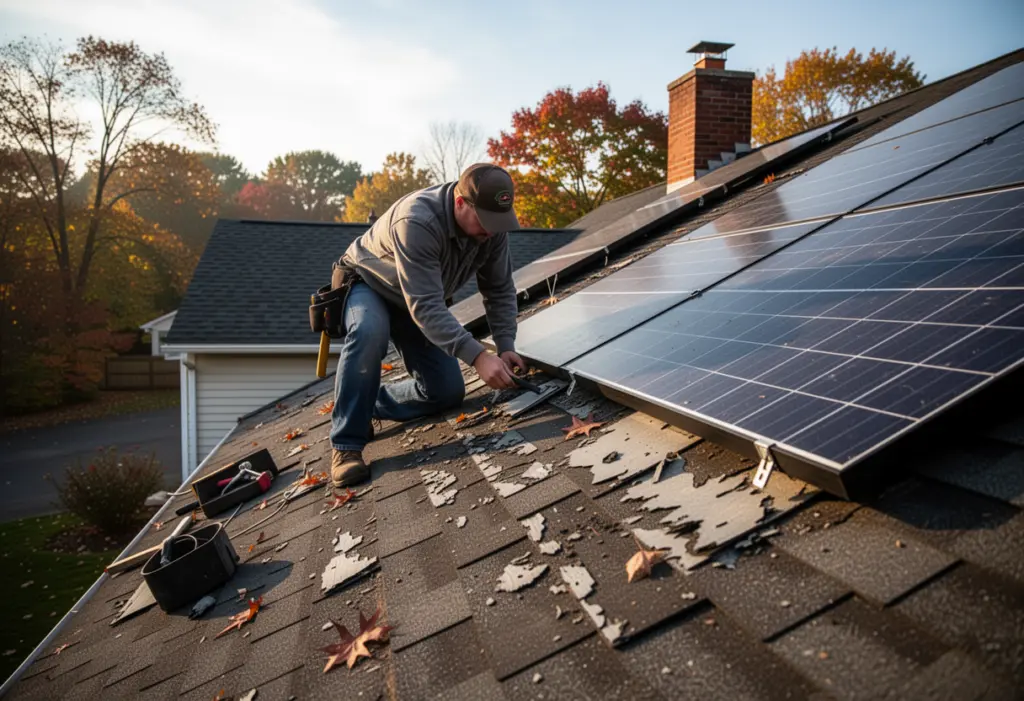
There is no statewide rule setting a maximum roof age for a solar installation. Each company sets its own threshold, so when an installer tells you the roof must be under a certain age, that is that company’s policy, not a legal requirement — and the useful question is not what the number is but what happens if the roof fails while their array is bolted to it.
The real test is remaining life against system life
An array is on the roof for decades. A covering with a handful of years left will need replacing while the panels are still working, and that means paying to remove the array, re-roof, and reinstate it. Any comparison between doing the roof now and doing it later has to include that cost, which is why you should get it as a written figure at quotation time rather than as a reassurance.
Ask for these in writing, from each bidder:
- Their stated roof age or condition requirement, and whether a roofer’s assessment of remaining life satisfies it in place of an age.
- The removal and reinstatement price for the proposed system, as a number.
- What the workmanship warranty covers on penetrations and flashing, and for how many years.
- Who is liable for a leak that appears near a mount, and how that is determined.
- Whether the decking is inspected before mounting, and what happens if soft decking is found once work starts.
- What paperwork a later removal and reinstatement triggers with the permitting authority and the utility.
Why New York is harder on a roof than the brochure assumes
Freeze and thaw cycling works on every penetration through the winter, and a detail that is fine in a mild climate has a different service life here. Ice damming loads the eaves of a house with marginal ventilation, snow slides carry load into whatever is in their path, and wind uplift on a partially covered plane is not the same problem as on a bare one. None of that is an argument against rooftop solar in New York. It is an argument for asking how the flashing is detailed and who stands behind it.
Sequence: roof first, if the roof is close
If the covering is near the end of its life, replace it before the array goes up. Doing it in that order means one set of scaffolding, one set of access, no removal and reinstatement cost, and no argument later about which trade caused a leak. It also gives the solar designer a clean deck to lay out on.
If you are replacing the roof anyway, tell the roofer solar is coming. Layout, ventilation and the position of vents and pipes can all be arranged to leave better usable plane area, and that is free while the roof is open and expensive afterwards.
The cost of waiting, which nobody quantifies for you
Delay is not free, and two of its effects are dated rather than vague.
Phase One net metering runs 20 years from interconnection. A system interconnected in 2027 rather than 2026 holds that structure a year later at both ends, which is a genuine trade-off rather than a reason to rush a bad roof.
RPTL 487 requires construction before 1 January 2030. The 15-year property tax exemption on added value has an outer limit, so a plan of doing the roof now and the solar in a few years should be checked against that date. The exemption also depends on your municipality, your county and your school district each not having opted out — three separate checks with your assessor.
What waiting does not change is the monthly capacity charge. The Customer Benefit Contribution applies to systems interconnected on or after 1 January 2022, so any new system pays it regardless of when in the next few years it goes up. On National Grid the 2026 residential rate is $0.97 per kW-month, so an 8.4 kW array pays 8.4 x $0.97, about $8.15 a month or roughly $98 a year. Rates are recalculated annually, and a municipal electric utility customer pays no such charge because those utilities sit outside Public Service Commission jurisdiction along with state net metering and the state interconnection process.
The uncomfortable part
A quote that never mentions the roof is not a cheaper quote. It is a quote that has moved a decision onto you without telling you, and the decision resurfaces the first time water appears in a bedroom ceiling. An installer who will not put a removal and reinstatement figure in writing has given you information, and so has one who declines to inspect the decking.
Incentives worth confirming before you schedule either job
Roofing work is not solar equipment, and mixing the two on one invoice makes the tax position harder rather than easier. New York’s credit is 25% of qualified solar energy system equipment expenditure capped at $5,000 on Form IT-255, for a principal residence in the state, so ask for a clear line item split and put the question to your own tax preparer. The state sales tax exemption covers residential solar equipment, and the 30% federal residential credit is gone — section 25D ended for expenditures made after 31 December 2025, with the test being when the original installation is completed. NY-Sun is not in the picture either: as of September 2026 NYSERDA has no open NY-Sun block for homes in any utility territory; check NYSERDA’s NY-Sun dashboard for a new one. Confirm the current position with NYSERDA and the Department of Taxation and Finance before committing to a sequence.
Frequently Asked Questions
How old is too old for a roof to take solar panels?
There is no statewide rule. Each installer sets its own threshold, so ask for that requirement in writing and ask whether a roofer's assessment of remaining life is accepted in place of an age.
Should I replace the roof before installing solar?
If the covering is near the end of its life, yes. Doing it afterwards means paying to remove the array, re-roof and reinstate it, and it invites disputes over which trade caused any leak.
What does removing and reinstating an array cost?
Ask each bidder for a written figure for your proposed system at quotation time. A company that will not put that number in writing has told you something useful about how the job would go.
Does waiting a year to install solar cost anything?
Phase One net metering runs 20 years from interconnection, so the whole term shifts later. RPTL 487 also requires construction before 1 January 2030, which puts an outer limit on a plan to install some years from now.
This article is general information, not tax, legal or financial advice. Incentive amounts, eligibility rules and deadlines change and depend on your utility, your tax situation and your property. Confirm current terms with NYSERDA, your utility and a qualified tax professional before making a decision.
NY Solar Incentives
Independent New York solar research. We summarise NYSERDA, NY-Sun and federal programme rules from published sources and state plainly when a figure is an estimate. We are not a government agency and do not sell equipment.
Run the arithmetic on your own system
Check the dated program table and your arrangement before counting an incentive. Standard residential NY-Sun blocks are closed; Long Island Affordable Solar has a conditional income-verification route. The NY credit depends on qualified costs and tax liability, while the NYC abatement reduces future property-tax bills. The estimator keeps those timings separate.