Landlord Installed Solar: Who Gets the Credit?
Two different credits get confused in this question: the income tax credit, which follows who paid and where they live, and the net metering credit, which follows whichever utility account the system is tied to.
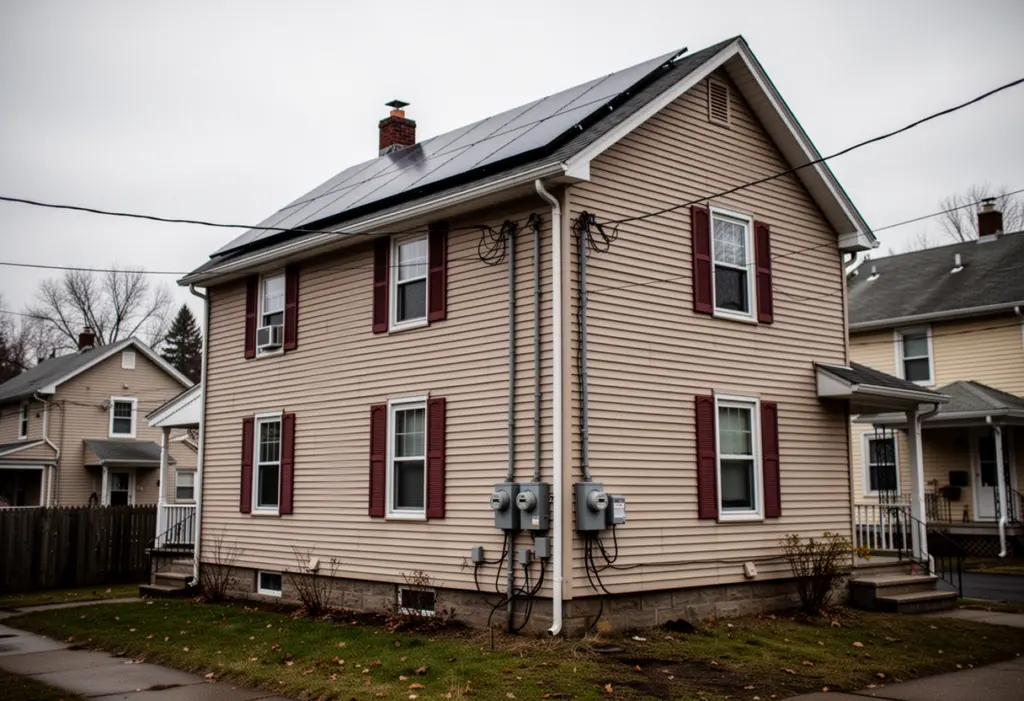
Two entirely different things are called a credit here, and separating them answers most of the question. The income tax credit follows whoever made the expenditure and where that person lives. The net metering credit follows whichever utility account the system is interconnected to. They can easily land on two different people.
The tax credit follows payment and principal residence
New York State’s solar credit is 25% of qualified expenditure, capped at $5,000, claimed on Form IT-255, and it requires the equipment to be installed and used at the taxpayer’s principal residence in New York State. That test does the work in a landlord and tenant situation.
- A landlord who installs on a property they do not live in has no principal residence there, so IT-255 is not the route for that property.
- A tenant who made no expenditure has nothing to claim under a credit that is calculated on expenditure.
- An owner living in one unit of a two family house does have a principal residence at the property, but part of the building is not theirs to occupy. The allocation between the residential portion and the rest is exactly the kind of question a tax preparer should answer on your actual facts rather than a website.
The credit is not refundable and is limited by your actual New York State tax liability, with unused amounts carrying forward. Leases and power purchase agreements can reach it, but only where the agreement runs ten years or more — the ten-year minimum applies to a lease as well as to a PPA — and the $5,000 is a lifetime ceiling for that agreement rather than an annual figure.
The federal question, answered plainly
The 30% federal residential credit is gone. Section 25D was terminated for expenditures made after 31 December 2025, and an expenditure is treated as made when the original installation is completed. A landlord who has been told they will claim 30% on a 2026 installation has been told something materially wrong.
Business and farm projects sit under a different provision entirely and must not be conflated with section 25D. If a property is held as an investment, the treatment is a question for an accountant who can see the ownership structure, and guessing at it from a residential article is how people end up amending returns.
The bill savings follow the meter
Net metering credits appear on the utility account the system is interconnected to. That is a mechanical fact with a large practical consequence: if the tenant’s name is on the meter, the tenant receives the credits, and the landlord who paid for the array receives nothing on the bill. If the landlord holds the account, the reverse.
This is the classic split incentive, and it cannot be left to goodwill. Before anything is installed, put in writing which account the system is tied to, who receives the export credits, whether rent changes as a result, and what happens when the tenancy ends. Ask the utility directly what a change of account holder does to the arrangement, rather than assuming credits move with the property.
Costs also land on that account
The Customer Benefit Contribution is charged monthly on DC capacity regardless of production, on systems interconnected on or after 1 January 2022. On LIPA and PSEG Long Island the 2026 residential rate is $1.13 per kW-month, so a 5 kW array costs 5 x $1.13, about $5.65 a month or roughly $68 a year, and it appears on the same account that receives the credits. Rates are recalculated annually. If your electricity comes from a municipal electric utility, none of this applies in the same way: those utilities are outside Public Service Commission jurisdiction, so there is no state net metering rule, no Customer Benefit Contribution and no state interconnection process, and the terms must be asked for directly.
The agreement to write before the array goes up
- Who owns the equipment, and what happens to it at the end of the tenancy or on a sale of the building.
- Which utility account the system is interconnected to, stated by account number.
- Who receives the export credits, and who pays the monthly capacity charge.
- How rent is affected, if at all, and for how long that arrangement holds.
- Who is responsible for repairs, for monitoring, and for roof access.
- What happens to any lease or PPA on the equipment when the building changes hands.
What is still available in 2026
For an owner occupied property, the state credit above applies, together with the state sales tax exemption on residential solar equipment and the RPTL 487 property tax exemption on added value, which runs 15 years, requires the system to be constructed before 1 January 2030, and applies only where the municipality, the county and the school district have each not opted out. NY-Sun, including its income-based Affordable Solar track, is not available to add to that: as of September 2026 NYSERDA has no open NY-Sun block for homes in any utility territory; check NYSERDA’s NY-Sun dashboard for a new one. For a property that is not the owner’s residence, take the whole question to an accountant before signing, and confirm the current position of each programme with NYSERDA and the New York State Department of Taxation and Finance, since terms change.
Frequently Asked Questions
Can a landlord claim the New York solar tax credit?
Form IT-255 requires the equipment to be installed and used at the taxpayer's principal residence in New York State, so a property the owner does not live in does not meet that test. Investment property sits under different rules an accountant should apply.
Who gets the net metering savings, the landlord or the tenant?
Whoever holds the utility account the system is interconnected to. If the tenant's name is on the meter, the export credits reduce the tenant's bill even though the landlord paid for the array.
Is the 30% federal credit available to a landlord in 2026?
No. Section 25D was terminated for expenditures made after 31 December 2025, with an expenditure treated as made when the original installation is completed. Business and farm projects fall under a separate provision entirely.
What should be agreed in writing before installation?
Which account the system ties to, who receives export credits, who pays the monthly capacity charge, whether rent changes, who handles repairs and roof access, and what happens to the equipment at the end of the tenancy or on a sale.
This article is general information, not tax, legal or financial advice. Incentive amounts, eligibility rules and deadlines change and depend on your utility, your tax situation and your property. Confirm current terms with NYSERDA, your utility and a qualified tax professional before making a decision.
NY Solar Incentives
Independent New York solar research. We summarise NYSERDA, NY-Sun and federal programme rules from published sources and state plainly when a figure is an estimate. We are not a government agency and do not sell equipment.
Run the arithmetic on your own system
Check the dated program table and your arrangement before counting an incentive. Standard residential NY-Sun blocks are closed; Long Island Affordable Solar has a conditional income-verification route. The NY credit depends on qualified costs and tax liability, while the NYC abatement reduces future property-tax bills. The estimator keeps those timings separate.