Solar Optimizers: What They Do and When You Need One
An optimizer is a small device behind each panel that stops one weak module dragging down the rest of its string. Whether your roof needs them is a question with a real answer.
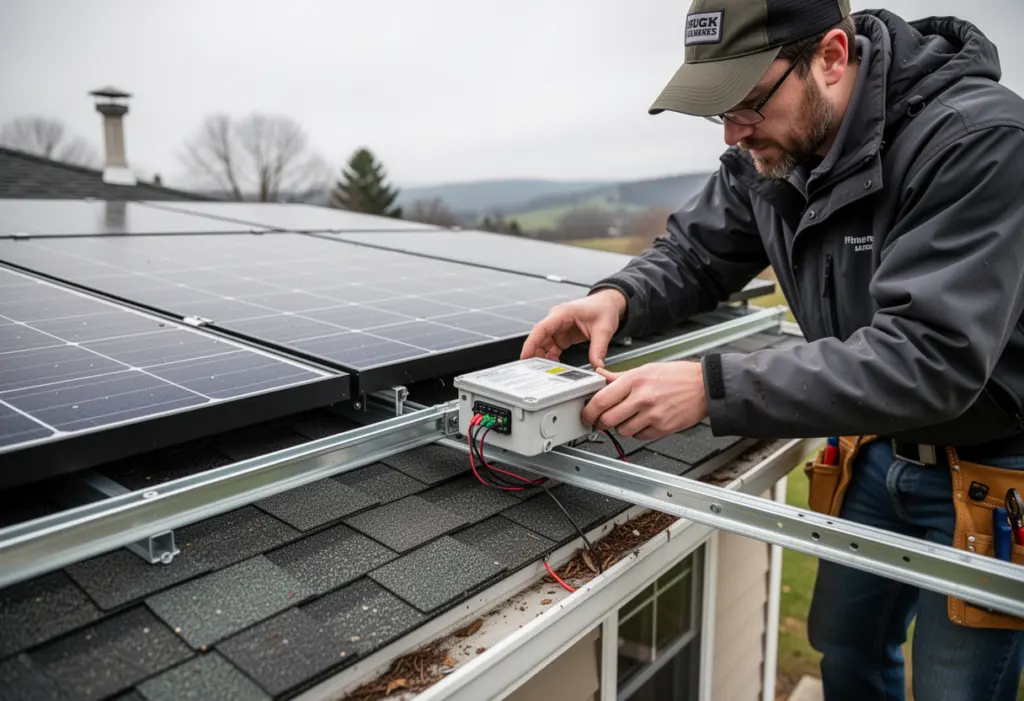
A solar optimizer is a small electronic device fitted behind each panel. Its job is to let every module work at its own best operating point, so that one shaded, soiled or underperforming panel does not drag down the whole string it belongs to. Whether your roof needs them has a real answer, and it depends on the roof rather than on the brochure.
The problem they solve
In a plain string design, panels are wired in series and the string tends to be limited by its weakest member. A chimney shadow crossing two modules in the afternoon therefore costs more than those two modules’ share of the output, because the whole string is pulled toward the shaded condition.
Optimizers break that link. Each module is managed individually, so the shaded pair loses what it loses and the rest of the string carries on. Two useful side effects come with it: per-panel monitoring, which is how you find a single failed module rather than guessing, and module-level shutdown capability, which matters for the electrical code.
When the answer is yes
- Real shading you cannot remove. A neighbour’s mature tree, your own chimney, a dormer, a plumbing stack casting across the array in the afternoon. Anything that reaches part of the array for part of the day while the rest is in full sun.
- Modules on more than one roof plane. East and west faces, or a mix of pitches, produce different amounts at different times, and putting them on one uncontrolled string wastes the difference.
- A complex roof that forced an awkward layout. Small groups of modules on several faces are the classic case.
- Code requirements. Module-level shutdown is required for rooftop arrays under the electrical code as adopted in many jurisdictions. Ask your installer what the authority reviewing your permit requires, because the adopted code edition is a local matter, not a national one.
When the answer is probably no
A single unshaded plane facing broadly south, all modules on the same pitch, no obstructions. On that roof optimizers add cost and add one more device per panel to a place that is expensive to reach. More electronics on a roof means more things that can eventually require somebody to go up there, and roof labour is the expensive part of any future repair.
Say the uncomfortable thing plainly: an optimizer cannot recover energy that shade never let in. It limits the damage, it does not undo it. If a proposal implies that adding optimizers makes a badly shaded roof produce like an unshaded one, that is not what the technology does, and the honest fix is to deal with the shade, move the array, or accept the lower estimate.
Optimizers or microinverters
Microinverters achieve much of the same result differently, by converting to alternating current at each panel instead of managing direct current for a central inverter. Both give you per-panel behaviour and per-panel monitoring. The practical differences are what fails, how many devices are on the roof, and whether there is still a central box to replace at some point in the system’s life.
Ask which architecture is being proposed, why, and what the warranty terms are for the module-level devices specifically, including whether labour is covered. That last point is the one that decides what a future failure costs you, since every module-level repair is roof work.
What optimizers do not change on your bill
They do not alter the DC capacity of your system, so they do not alter the Customer Benefit Contribution, which is charged per kilowatt of DC size every month on systems interconnected on or after 1 January 2022. A 6.5 kW array on Con Edison pays $8.39 a month at the 2026 residential rate of $1.29 per kW-month, about $101 a year, with or without module-level electronics. What optimizers can change is the production side of the ledger on a roof that genuinely has per-panel variation, which is the only place the extra cost is recovered.
And if your electricity comes from a village or city electric department rather than one of the investor-owned utilities, the contribution does not apply to you at all, because municipal electric utilities sit outside Public Service Commission jurisdiction along with state net metering and the state interconnection process. Confirm the utility name from your own bill before applying anything on this page to your situation.
Incentives in 2026, and the one that has run out
The incentive that depended most on when you acted is NY-Sun. It is structured as a megawatt block: each region has capacity blocks, and the per-watt incentive steps down as each block fills, by design, so that the programme phases out as the market matures. For homes it has now run out: as of September 2026 NYSERDA has no open NY-Sun block for homes in any utility territory; check NYSERDA’s NY-Sun dashboard for a new one. The last standard residential blocks closed on 29 May 2025 in Con Edison territory, on 17 December 2025 in NYSERDA’s Upstate region and in April 2016 on Long Island, and the Affordable Solar blocks for lower-income households closed on 15 October 2025 (Con Edison) and 9 March 2026 (Upstate). If a quote for your home still deducts a NY-Sun figure, ask which open block it comes from, and compare bids on the price before it.
What still applies is New York’s 25% credit capped at $5,000 on Form IT-255 for a principal residence, the residential sales tax exemption, and the RPTL 487 property tax exemption, which runs 15 years on the added value the system gives the property, requires that your municipality, your county and your school district have each not opted out, and reaches only systems constructed before 1 January 2030. The 30% federal residential credit is not available: section 25D was terminated for expenditures made after 31 December 2025, with the expenditure treated as made when the original installation is completed. Because block levels and local opt-outs both move, check NYSERDA and your assessor before you sign rather than relying on anything printed.
Frequently Asked Questions
What does a solar optimizer actually do?
It manages each panel individually so one shaded or underperforming module does not pull down the whole series string. It also enables per-panel monitoring and module-level shutdown capability.
Do I need optimizers on an unshaded south facing roof?
Often not on performance grounds. They add cost and one more device per panel in a place that is expensive to reach. Check separately what module-level shutdown the electrical code adopted by your permitting authority requires.
Will optimizers fix a badly shaded roof?
No. They limit what shade costs you, they do not recover energy the panels never received. If a proposal suggests otherwise, the honest options are removing the shade, relocating the array, or accepting a lower production estimate.
Are optimizers better than microinverters?
Neither is better in the abstract. Both give per-panel behaviour and monitoring. Compare what fails, how many devices sit on the roof, whether a central inverter still needs replacing later, and whether module-level warranties cover labour.
This article is general information, not tax, legal or financial advice. Incentive amounts, eligibility rules and deadlines change and depend on your utility, your tax situation and your property. Confirm current terms with NYSERDA, your utility and a qualified tax professional before making a decision.
NY Solar Incentives
Independent New York solar research. We summarise NYSERDA, NY-Sun and federal programme rules from published sources and state plainly when a figure is an estimate. We are not a government agency and do not sell equipment.
Run the arithmetic on your own system
Check the dated program table and your arrangement before counting an incentive. Standard residential NY-Sun blocks are closed; Long Island Affordable Solar has a conditional income-verification route. The NY credit depends on qualified costs and tax liability, while the NYC abatement reduces future property-tax bills. The estimator keeps those timings separate.