Solar Inverter Error Codes and What They Mean
The code on the screen is manufacturer specific, so looking it up rarely helps a homeowner. What helps is knowing the four families a code belongs to, and which one you must never simply keep resetting.
On this page 8 sections
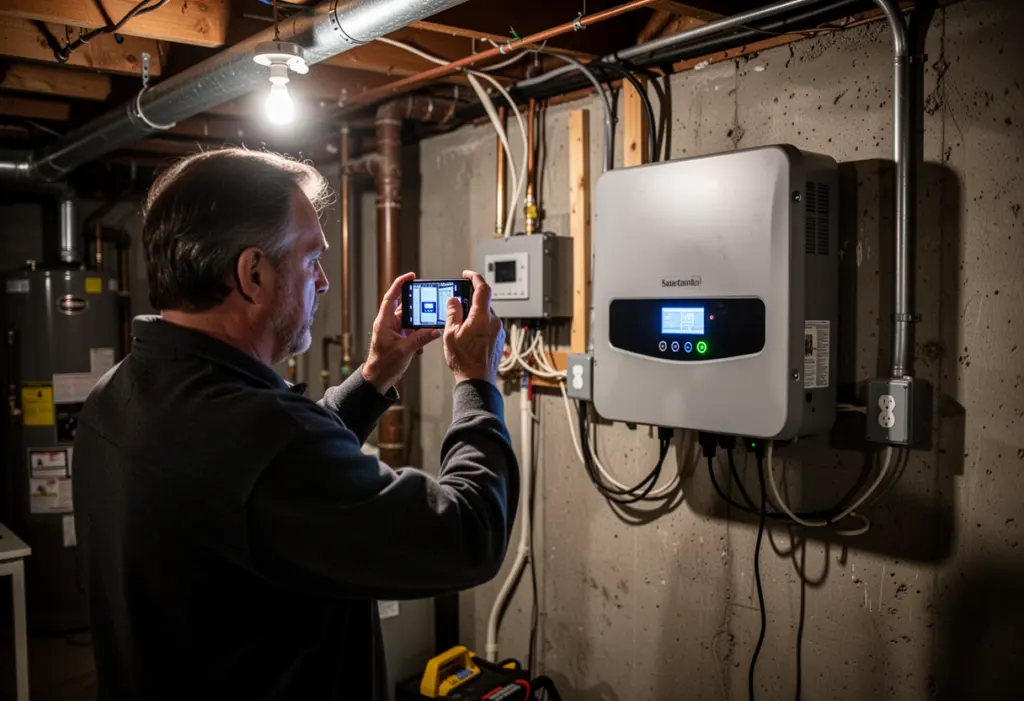
Inverter fault codes are manufacturer specific, so the same number means different things on different equipment and searching for it usually returns somebody else machine. What generalises is the family the code belongs to. There are four, they behave differently, and knowing which one you are looking at tells you whether to wait, to call, or to stop touching it.
Family one: grid side
Codes about voltage or frequency being out of range mean the inverter has disconnected because the grid outside your house is not within the window it is required to operate in. That is the inverter doing its job, not failing at it.
A brief trip during a storm or a utility switching event is normal. A pattern of trips on sunny afternoons is not, and it points at a sustained high voltage condition on the distribution circuit — sometimes the service run, sometimes the wider network. This is the family where the fix may not belong to your installer at all. Record the dates and times, and ask the installer to raise the voltage readings with the utility.
Family two: the array side, and the one rule
Isolation faults, ground faults and arc fault codes describe a problem in the DC wiring or the modules. This is the family that gets the rule: do not keep resetting it. A repeated manual reset of an isolation or arc fault clears the symptom while leaving the condition, and the condition is the one with a safety dimension.
In New York the most common benign explanation is water. Moisture in a connector after heavy rain or a thaw can raise an isolation fault that clears when the array dries, which is exactly why the fault that returns after every rainfall is telling you something real about a connector rather than about the weather. Report it and have it inspected.
Family three: thermal and derating
Codes about temperature usually mean the inverter is protecting itself by reducing output, and the cause is often environmental: direct sun on the enclosure, a poorly ventilated corner of a garage, or something stored against it. These are the codes you can sometimes act on yourself, by clearing the space around the unit and shading it from direct afternoon sun, but ask the installer before you build anything around an inverter, because clearance requirements are specified by the manufacturer.
Family four: communications
Monitoring dropouts, gateway offline, no data since a date. This is the least urgent family and the one that produces the most alarm, because it looks like the system stopped when usually only the reporting did. Check whether the house internet changed, whether a router was replaced, or whether the monitoring device lost power. If your bill has not moved, the system is very likely producing.
It still matters, because monitoring is how you find the other three families. A system that has not reported since March is a system nobody would notice failing.
What to record before you call
- A photograph of the screen with the code visible, and the date and time.
- Whether production stopped completely or continued at a reduced level.
- Whether it is the whole system, one string, or one module, if your monitoring reports at that level.
- What the weather was doing, and whether the fault has recurred at the same time of day.
That set of facts frequently turns two site visits into one, and it is the difference between a diagnostic call and a conversation that starts from scratch.
What downtime costs while you sort it out
Two numbers argue for dealing with a fault in the week it appears. Exports under Phase One net metering are credited at the full retail rate, so a stopped array loses the retail value of everything it would have made, not a wholesale one. And the Customer Benefit Contribution, which applies to systems interconnected on or after 1 January 2022, is charged on the DC size of the system regardless of production: an 11 kW array on PSEG Long Island pays 11 × $1.13, about $12.43 a month or $149 a year, running exactly the same while the inverter sits on an error screen.
Set the monitoring alerts up at commissioning, send them to an address you actually read, and confirm once a month that data is arriving at all.
Before you pay for a repair, check what you already own
Find the inverter warranty document and check the term for your exact model, whether labour is covered or only the part, and who honours it. That is a five minute check that occasionally saves the entire cost of the visit.
Do not plan a replacement around a federal credit, because there is none: section 25D was terminated for expenditures made after 31 December 2025, with an expenditure treated as made when the original installation is completed. New York still offers 25% capped at $5,000 on Form IT-255 for qualified solar energy system equipment at a principal residence, limited by your actual state tax liability and carried forward up to five years, and the state sales tax exemption still applies to residential solar equipment — but whether a repair or a replacement component qualifies is a question for the form instructions and a tax preparer rather than an assumption. Confirm the current position with NYSERDA, because these programmes move.
Frequently Asked Questions
What do solar inverter error codes mean?
Codes are manufacturer specific, but they fall into four families: grid side voltage or frequency trips, array side isolation and arc faults, thermal derating, and communications dropouts. The family tells you how urgent it is.
Can I just reset the inverter?
Not for isolation, ground or arc fault codes. Repeated resets clear the symptom and leave the condition, and that is the family with a safety dimension. Record it and have the DC side inspected.
My monitoring says offline but the bill looks normal. Is the system broken?
Probably not. Communications faults stop the reporting, not the production. Check whether the internet, router or monitoring device changed. It still needs fixing, because monitoring is how you find the faults that matter.
Why does the fault come back every time it rains?
Moisture in a DC connector is a common cause of isolation faults in New York, clearing as the array dries. A fault that tracks rainfall is telling you about a connector, so report it rather than waiting it out.
This article is general information, not tax, legal or financial advice. Incentive amounts, eligibility rules and deadlines change and depend on your utility, your tax situation and your property. Confirm current terms with NYSERDA, your utility and a qualified tax professional before making a decision.
NY Solar Incentives
Independent New York solar research. We summarise NYSERDA, NY-Sun and federal programme rules from published sources and state plainly when a figure is an estimate. We are not a government agency and do not sell equipment.
Run the arithmetic on your own system
Check the dated program table and your arrangement before counting an incentive. Standard residential NY-Sun blocks are closed; Long Island Affordable Solar has a conditional income-verification route. The NY credit depends on qualified costs and tax liability, while the NYC abatement reduces future property-tax bills. The estimator keeps those timings separate.