Do Solar Panels Need Cleaning in New York?
For most pitched roofs in New York the honest answer is no. Rain does the work, and a paid cleaning visit rarely recovers enough production to pay for itself.
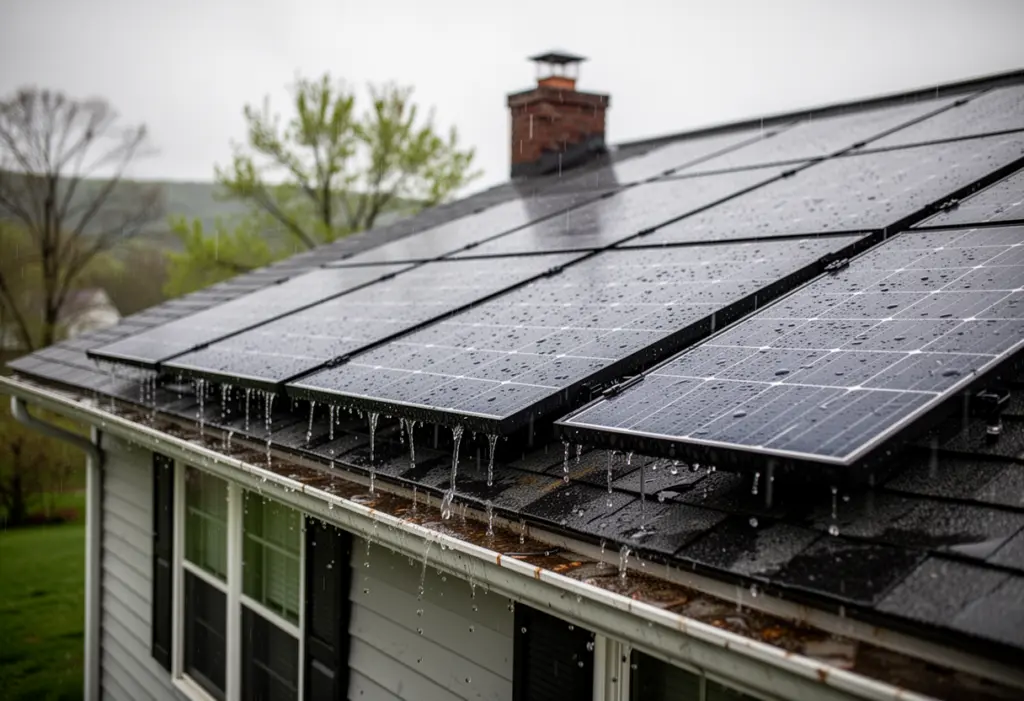
For a pitched array in New York, the honest answer is usually no. Rain washes sloped glass, this state gets rain in every month of the year, and a paid cleaning visit rarely recovers enough production to pay for itself. Annual cleaning contracts sold alongside a system are, for most roofs here, a service being sold rather than a problem being solved.
That is the general case. There are specific situations where it is wrong, and they are worth knowing because they are the ones where dirt genuinely costs you money.
When cleaning does matter
- Low tilt or flat arrays. Water sheets off a steep roof and sits on a shallow one, leaving a residue line at the lower edge that builds up over seasons.
- Concentrated soiling rather than dust. Bird droppings, sap from an overhanging tree, or heavy pollen that arrives as a paste rather than a film. These are opaque and they do not rinse away the way road dust does.
- A nearby source. A gravel drive under a ground mount, agricultural dust in harvest season, or a persistent industrial or construction source next door.
- Ground mounts generally. They are low, they are close to whatever the ground throws up, and unlike a roof array they can be inspected safely at eye level.
Decide with your own data
Before paying anyone, use the monitoring you already have. Compare this month against the same month in a previous year, which controls for the season in a way that comparing June to September never will. If the platform reports at panel level, compare modules against each other across several sunny days.
The distinction that matters: a broad, gradual decline across the whole array can be soiling. A sharp drop confined to one module or one string is a fault, not dirt. Cleaning an array that has an electrical problem buys you a clean array with an electrical problem.
Then do the arithmetic before agreeing to a price. Under Phase One net metering, exported energy is credited at the full retail rate, so recovered production is worth your own retail rate per kWh — take it from your bill rather than from an estimate. If your system produces around 8,000 kWh a year and you believe soiling is costing 2%, that is 160 kWh. Multiply by your rate, and compare the result against the quote. Very often the quote is larger, and that is the answer.
Snow, which is the question people actually mean
Snow slides off a pitched array as the panel surface warms, and it does so faster than it leaves the shingles around it. Meanwhile December and January are the smallest production months of the year, so the energy at stake while you wait is small.
Clearing snow yourself is where New York homeowners get hurt and where panels get scratched. A roof rake, a broom or anything with a hard edge can mark the glass or the frame, ladders on ice are their own hazard, and a slab of snow released from an array comes off in one piece. If snow must be cleared because of what is underneath the eave, that is a job for somebody insured to work on roofs, and the more durable answer is snow guards discussed with your installer.
If you do have the array cleaned
Ask three things of whoever does it. That they are insured for work at height. That they use water and a soft brush or a soft squeegee, with no abrasives, no detergents unless the manufacturer permits them and no pressure washer. And that they will not spray cold water onto hot glass on a summer afternoon, which is a thermal shock risk on any glazed panel.
Check the module warranty document before booking, because some manufacturers specify permitted cleaning methods and a wrong method can be the thing that ends a warranty conversation early.
What the money looks like around this
Cleaning is maintenance, and maintenance is not where New York solar incentives live. The state credit on Form IT-255 is 25% of qualified solar energy system equipment expenditure capped at $5,000, for equipment at your principal residence, and whether any particular service spend qualifies is a question for the form instructions and a preparer rather than an assumption. Federally there is nothing at all for a 2026 residential expenditure, because section 25D was terminated after 31 December 2025, with the test being when the original installation is completed.
What does run continuously, on a system interconnected on or after 1 January 2022, is the Customer Benefit Contribution, charged on the DC size of the array regardless of production. An 8 kW system on National Grid pays 8 × $0.97, about $7.76 a month or $93 a year, and the same 8 kW pays roughly $13.36 a month in Central Hudson territory. If your array was interconnected before 2022 the charge does not apply to you at all, so check the date on your own interconnection paperwork before assuming it does. Notice what that means for this decision: the fixed cost of owning capacity is larger than the plausible value of routine cleaning on most pitched roofs. Spend the attention on faults, shade and snow discharge instead, and confirm your own rate from your own bill, because these figures are recalculated annually.
Frequently Asked Questions
Do I need to clean my solar panels in New York?
On a pitched roof, usually not. Rain washes sloped glass and the state gets rain year round, so a paid cleaning visit rarely recovers its own cost. Low tilt arrays, ground mounts and concentrated soiling are the exceptions.
How do I tell dirt from a fault?
A broad, gradual decline across the whole array can be soiling. A sharp drop confined to one module or one string is a fault. Compare this month against the same month in a previous year rather than against last month.
Should I clear snow off my panels?
Generally no. Snow slides off pitched glass as it warms, and midwinter production is small anyway. Roof rakes and brooms scratch glass, and ladders on ice are a serious hazard. Discuss snow guards with your installer instead.
What is the safe way to clean an array?
Water and a soft brush, no abrasives, no pressure washer, and never cold water on hot glass. Use somebody insured for work at height, and check the module warranty first, since some makers specify permitted methods.
This article is general information, not tax, legal or financial advice. Incentive amounts, eligibility rules and deadlines change and depend on your utility, your tax situation and your property. Confirm current terms with NYSERDA, your utility and a qualified tax professional before making a decision.
NY Solar Incentives
Independent New York solar research. We summarise NYSERDA, NY-Sun and federal programme rules from published sources and state plainly when a figure is an estimate. We are not a government agency and do not sell equipment.
Run the arithmetic on your own system
Check the dated program table and your arrangement before counting an incentive. Standard residential NY-Sun blocks are closed; Long Island Affordable Solar has a conditional income-verification route. The NY credit depends on qualified costs and tax liability, while the NYC abatement reduces future property-tax bills. The estimator keeps those timings separate.