Solar for a Municipality in New York
A municipal solar project is not a large residential one. Three structural facts change it: no tax liability to offset, public procurement rules, and sometimes a municipal electric utility of its own.
On this page 6 sections
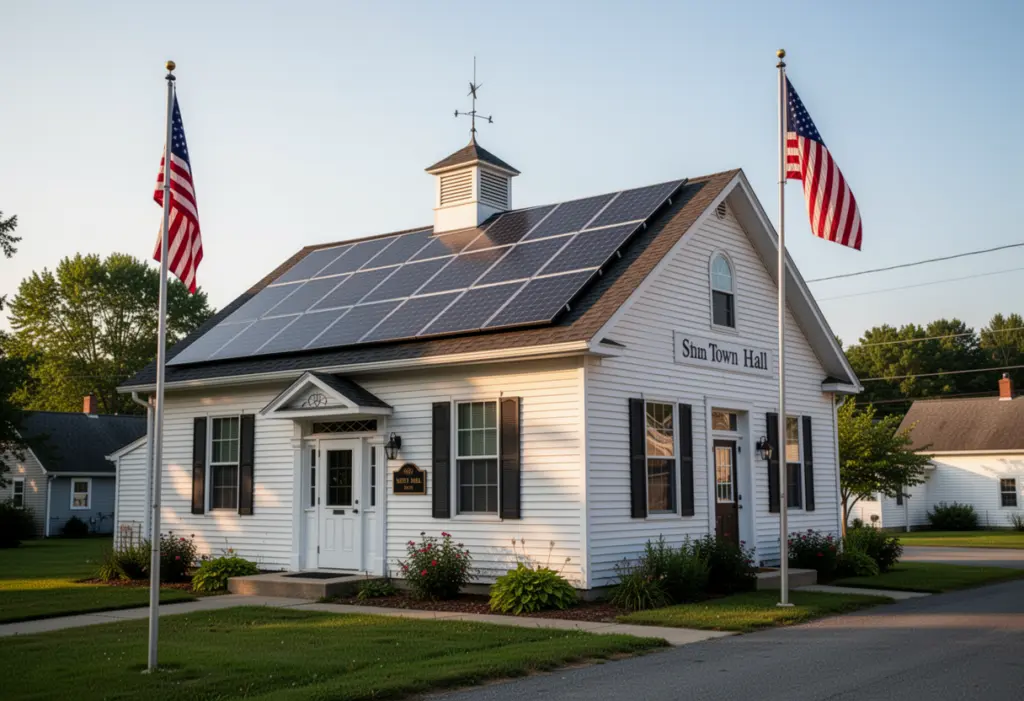
A municipal solar project differs from a private one in three structural ways, and each of them changes the answer rather than the timeline. A municipality has no income tax liability, so tax credits and depreciation have no direct value. It buys under public procurement rules, so how the work is contracted is as consequential as what is bought. And in several dozen New York communities, the municipality runs its own electric utility, which places it outside the state framework that governs everyone else.
No tax liability means the ownership question comes first
Most published solar arithmetic assumes a taxpayer who can use a credit. A town, village or city cannot. That leaves two broad routes. Own the system and value it purely on the electricity and on avoided cost. Or contract with a third party that owns it, which is a taxable business able to use the federal business-side provisions, and negotiate over how much of that value is reflected in the price offered to the municipality.
Federal law also contains mechanisms intended to let entities without tax liability benefit from clean energy provisions. Whether any applies here, what it requires and when, is a question for the municipality’s counsel and financial adviser, not for a vendor’s slide. Get that answer before a procurement is drafted, because it can change which structure you should be soliciting.
Procurement decides the quality of what you get
- Specify the compensation framework in the solicitation. Whether the project is compensated under net metering or under the Value Stack, and under what utility tariff, determines the value of every exported kilowatt-hour. Leaving it to bidders means receiving bids that cannot be compared.
- State the wage regime. Whether prevailing wage applies is a question about the contract and the funding, answered by the New York State Department of Labor and by the award conditions. Two bids written under different assumptions are not comparable.
- Require interval data to be used. The utility can provide it for the municipality’s own accounts, and a design modelled against it is a design you can hold someone to.
- Set performance and service obligations with teeth, including what happens if the contractor ceases trading, and who holds the monitoring credentials.
The municipality may be its own permitting authority
The NYS Unified Solar Permit standardises residential and small commercial permitting for systems of 25 kW DC and under and has been adopted by more than 300 authorities having jurisdiction. It does not apply in the five boroughs, where the Department of Buildings runs its own process. If your municipality is the authority having jurisdiction for its own project, the structural and electrical review is not less important for being internal. Say plainly who is performing it and record it, because the appearance of a self-approved project is a governance problem even when the engineering is sound.
One thing to strike from any budget: the old Clean Energy Communities framing in which adopting the Unified Solar Permit was one of ten High Impact Actions and completing four earned a grant of up to $250,000. That was PON 3298, whose solicitation closed on 30 September 2020. NYSERDA’s current High-Impact Actions list has fifteen point-weighted actions and the Unified Solar Permit is not among them, and both programme pages now carry a closed notice. The figure still circulates in old memos. Do not fund a project against it.
If the municipality runs its own electric utility
New York has roughly fifty municipal electric utilities, among them the Jamestown Board of Public Utilities, the Plattsburgh Municipal Lighting Department, Massena Electric Department, Sherrill Power and Light and the Village of Solvay Electric Department. A municipal electric utility is outside Public Service Commission jurisdiction: there is no PSC net metering, no Customer Benefit Contribution and no state interconnection process, and the terms are set by the utility itself.
Two consequences follow. If the municipality is the utility, it is setting the rules it will then operate under, and those rules also govern every resident who installs solar in the village. And if it is not, do not assume from a neighbouring community: a municipality running its own water or sewer department is not evidence that it runs its own electric utility, and that assumption has produced published errors. Confirm from the electric bill itself.
The charges and the incentives that actually apply
Where the municipality is served by an investor-owned utility, the Customer Benefit Contribution is billed monthly on DC system size regardless of production, for systems interconnected on or after 1 January 2022, and it is recalculated annually. On the 2026 LIPA and PSEG Long Island small commercial rate of $1.19 per kW-month, a 75 kW rooftop pays 75 x $1.19 = $89.25 a month, about $1,071 a year. Accounts carrying a demand charge are not subject to it.
NY-Sun applies through the contractor as a price reduction and steps down as each regional megawatt block fills. RPTL 487’s property tax exemption is largely beside the point where the parcel is municipally owned, but it matters to any third-party owner of equipment on your land, and it turns on whether the municipality, the county and the school district have each opted out, for systems constructed before 1 January 2030. Note that in New York City, Buffalo, Rochester, Syracuse and Yonkers the school districts are fiscally dependent and levy no separate property tax, so there is no separate school check in those five cities. The 30% federal residential credit under section 25D is gone in any case, and never applied to a public entity. Confirm every figure with NYSERDA and with counsel before it reaches a board resolution.
Frequently Asked Questions
Can a town claim a solar tax credit in New York?
No, because a municipality has no income tax liability to offset. Federal law contains mechanisms intended to let entities without tax liability benefit from clean energy provisions, and whether any applies is a question for the municipality's counsel and financial adviser before procurement is drafted.
Can a municipality earn a grant for adopting the Unified Solar Permit?
No. That framing came from PON 3298, whose solicitation closed on 30 September 2020. The current High-Impact Actions list has fifteen point-weighted actions and the permit is not among them, and both programme pages carry a closed notice. Do not budget against the old $250,000 figure.
What changes if the village runs its own electric utility?
Everything about interconnection and compensation. A municipal electric utility is outside Public Service Commission jurisdiction, so there is no PSC net metering, no Customer Benefit Contribution and no state interconnection process, and the terms are set by the utility itself.
What should a municipal solar solicitation specify?
The compensation framework and utility tariff, the applicable wage regime, a requirement that the design be modelled against the municipality's own interval data, and performance and service obligations including what happens if the contractor ceases trading.
This article is general information, not tax, legal or financial advice. Incentive amounts, eligibility rules and deadlines change and depend on your utility, your tax situation and your property. Confirm current terms with NYSERDA, your utility and a qualified tax professional before making a decision.
NY Solar Incentives
Independent New York solar research. We summarise NYSERDA, NY-Sun and federal programme rules from published sources and state plainly when a figure is an estimate. We are not a government agency and do not sell equipment.
Run the arithmetic on your own system
Check the dated program table and your arrangement before counting an incentive. Standard residential NY-Sun blocks are closed; Long Island Affordable Solar has a conditional income-verification route. The NY credit depends on qualified costs and tax liability, while the NYC abatement reduces future property-tax bills. The estimator keeps those timings separate.