Solar Panel Installation in Port Chester, NY
Port Chester is dense, with a great deal of two-family and multi-family housing. The meter question decides most projects here.
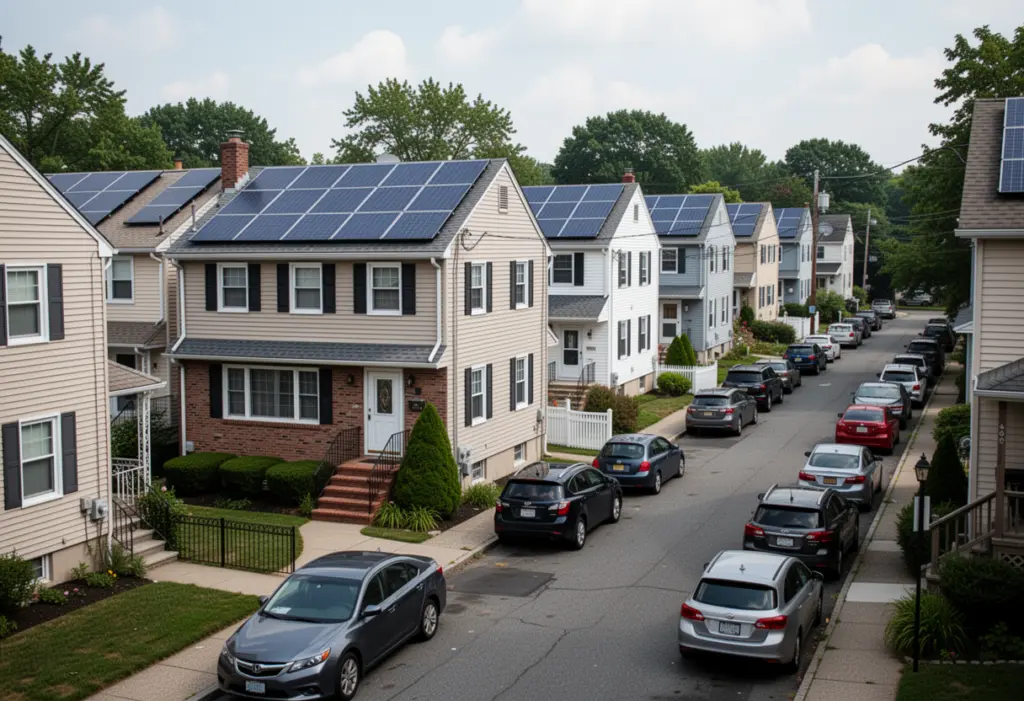
Port Chester is an incorporated village on the Connecticut line in southern Westchester. ZIP code 10573. It is one of the denser communities in the county, with a great deal of two-family and small multi-family housing — and that is what decides most solar projects here.
Which meter does the system offset?
A system offsets the meter it is connected behind. Only that meter. On a two-family or a small apartment building that is the question that has to be settled before any design work.
- Tenants on their own meters: a system behind the owner’s meter offsets the owner’s usage — hallways, boiler, common areas — and not theirs. Whether that is worth doing depends on how large the owner’s own load actually is.
- Electricity included in the rent: the building is effectively one customer, and a system can be sized against the whole load. That is the favourable version.
- Owner-occupied one unit, tenant in the other: the system behind your own meter offsets your household only, and the array is sized to that rather than to the building.
Get the answer from the bills, and get which meter the system will serve in writing before design.
Small roofs, close neighbours
Lots are small and buildings sit close together. Usable roof area frequently caps the array rather than consumption, fire-access clearances take proportionally more of a small roof, and a neighbour’s roofline removes December production at the low winter sun angle.
Ask what is limiting the system and how much capacity went to clearances, and insist on an on-site shading assessment.
Access and staging on a narrow lot with attached or near-attached neighbours also takes longer than on an open suburban plot, and labour reflects that.
Con Edison
Phase One net metering credits exports at the full retail rate and holds for 20 years from interconnection — and Westchester retail rates are high, which is what makes even a modest system pay here.
The Customer Benefit Contribution is $1.29 per kW-month of DC system size for 2026 — about $6.45 a month on a 5 kW system, roughly $77 a year. Billed on capacity regardless of production and recalculated annually.
Permits
The Village of Port Chester issues its own building permits, separately from the Town of Rye and from the City of Rye next door. Establish which authority covers your address — the similar names cause genuine confusion in this corner of the county.
2026 incentives
The 30% federal residential credit is gone — section 25D was terminated for expenditures made after 31 December 2025, with an expenditure treated as made when the original installation is completed.
Still available:
- New York’s 25% credit, capped at $5,000, on Form IT-255 for your principal residence — so on an owner-occupied two-family there is a real apportionment question between the residential and rental parts, and on a property you do not live in the residential credit is not the applicable provision at all. Your accountant, before you sign.
- The state sales tax exemption on residential solar equipment.
- RPTL 487’s 15-year property tax exemption where the village, the town, Westchester County and your school district have not opted out.
No longer available: NY-Sun, which used to come off the price through your contractor, and its Affordable Solar incentive for households at or below 80% of area median income. In Con Edison territory the last standard residential block closed on 29 May 2025 and the Affordable Solar block ran from 30 May to 15 October 2025. As of September 2026 NYSERDA has no open NY-Sun block for homes in any utility territory; check NYSERDA’s NY-Sun dashboard for a new one.
For renters, and for owners whose tenants hold the meters, community solar needs no roof and no up-front cost, and its subscribers pay no Customer Benefit Contribution at all.
Frequently Asked Questions
Can I install solar on a two-family house in Port Chester?
Yes, but the system offsets only the meter it is connected behind. If tenants hold their own meters, an owner-side system offsets hallways, the boiler and common areas rather than their apartments. Settle which meter it serves before design.
Why is my Port Chester array so small?
Small lots and dense building mean usable roof area rather than consumption usually caps the system, and fire-access clearances take proportionally more of a small roof. Ask what is limiting it and how much went to clearances.
Who issues a solar permit in Port Chester?
The Village of Port Chester issues its own, separately from the Town of Rye and the City of Rye next door. The similar names cause genuine confusion, so establish which authority covers your address.
Can I claim the New York credit on an owner-occupied two-family?
There is a real apportionment question between the residential and rental parts, because the credit is for equipment installed and used at your principal residence. On a property you do not live in, the residential credit is not the applicable provision at all.
This article is general information, not tax, legal or financial advice. Incentive amounts, eligibility rules and deadlines change and depend on your utility, your tax situation and your property. Confirm current terms with NYSERDA, your utility and a qualified tax professional before making a decision.
NY Solar Incentives
Independent New York solar research. We summarise NYSERDA, NY-Sun and federal programme rules from published sources and state plainly when a figure is an estimate. We are not a government agency and do not sell equipment.
Run the arithmetic on your own system
Check the dated program table and your arrangement before counting an incentive. Standard residential NY-Sun blocks are closed; Long Island Affordable Solar has a conditional income-verification route. The NY credit depends on qualified costs and tax liability, while the NYC abatement reduces future property-tax bills. The estimator keeps those timings separate.