Solar Panel Installation in Hudson, NY
Hudson has one of the most intact early streetscapes in New York and row houses to match. Both the review board and the roof geometry decide this project before an installer does.
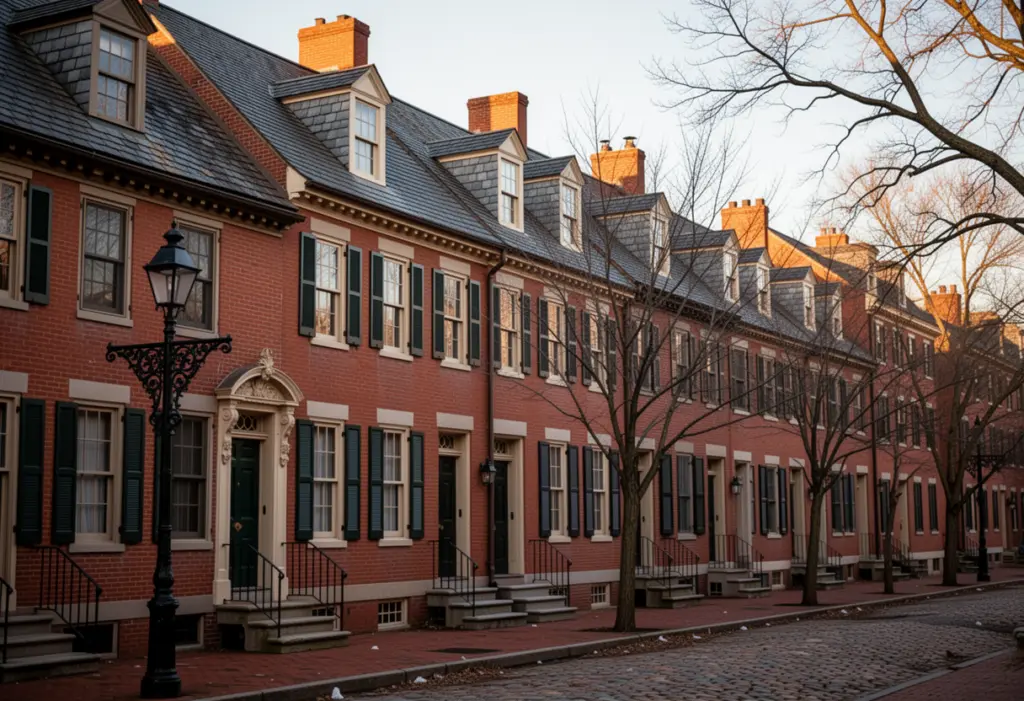
Hudson is a small city in Columbia County, on the east bank of the Hudson River. ZIP code 12534. Its centre is one of the most intact eighteenth and nineteenth century streetscapes in New York State, and that fact governs a solar project here from the first conversation.
Architectural review comes before the building permit
Where a property sits inside a designated historic area, the design is judged before the building department ever sees it, and the review can restrict street-visible placement. This is not an appeal you win afterwards. Establish whether your address is inside a designated district, then design for approval:
- A rear roof plane not visible from the public way. On the Warren Street blocks the rear elevation is where almost every approved array ends up.
- Black modules in black frames. Against brick and slate a silver frame reads as machinery bolted on.
- Mounting flush to the pitch. Nothing is refused more reliably than tilted racking on a historic roof.
- Conduit kept out of sight: internal where the building allows it, painted to the elevation where it does not.
Ask when the board meets and what the submission deadline is. Monthly meetings are common and four weeks is easy to lose, so make sure the installation date on the proposal allows for the board’s calendar.
Row house geometry sets the system size
Much of central Hudson is attached or near-attached housing on narrow lots, and that limits capacity in a way consumption does not:
- Fire-access pathways and setbacks take proportionally more of a narrow roof than they take of a suburban one, so a smaller share of the plane is usable.
- Chimneys, dormers and stair bulkheads remove a meaningful fraction of a small roof rather than being worked around.
- A neighbouring roofline can shade yours at the low December sun angle, because the buildings share walls.
Ask what is limiting your system size and how much capacity went to clearances. If the answer is roof area rather than your consumption, that is the honest position and worth knowing before you judge the price.
Slate, standing seam and 100 amp service
Hudson roofs are old. Slate demands a mounting method many installers simply do not have, so ask what they have done on it and ask to see the finished work photographed. Standing-seam metal is the easiest surface in the city, clamped rather than drilled, and it will normally outlive the modules. Asphalt sets a deadline instead: with under about ten years of shingle left, replace the roof before the array goes up rather than after.
Older framing draws a structural engineer’s letter more often than modern trusses, and 100 amp service is common enough that a panel upgrade or a line-side tap should be priced into the quote rather than arriving as a change order.
Which authority, and the waterfront
The City of Hudson, the Town of Greenport and the Town of Claverack are separate authorities with their own building departments, and a Hudson postal address does not prove which one you are in. Confirm by parcel. On the low ground near the waterfront, ask whether the parcel is in a mapped flood zone, because that decides how high the inverter, disconnects and any battery have to be mounted.
What the utility charge comes to on a small array
The Customer Benefit Contribution is levied monthly on DC capacity, not on generation, for any system interconnected on or after 1 January 2022, and Central Hudson’s 2026 residential rate of $1.67 per kW-month is the highest residential rate of any utility in New York. On the modest arrays this housing supports the absolute numbers stay small: every kilowatt costs $1.67 a month, so a 3 kW rear-plane array runs to $5.01 a month, about $60 a year. The rate is reset annually rather than fixed at interconnection. Columbia County borders National Grid territory at $0.97 and parts of the region are NYSEG at $1.19, where that same array would cost $2.91 or $3.57 a month, so confirm the name printed on your own bill. In the other direction, Phase One net metering values what you export at the full retail rate and holds that for 20 years from the date of interconnection.
Hudson also has a substantial rented and multi-family housing stock, and there the meter question settles everything: a system offsets only the meter it is connected behind. A landlord-side array offsets hallways and common services, not a tenant’s apartment, even directly beneath it. For a tenant, and for an owner whose roof is too small, too shaded or too visible from Warren Street, community solar reaches the person paying the bill with no roof, no up-front cost, and no Customer Benefit Contribution at all.
2026 incentives
The federal 30% credit ended with 2025. Section 25D no longer reaches an expenditure made after 31 December 2025, and the expenditure is dated to completion of the original installation. A proposal that still prints that line is wrong, and so is every figure derived from it.
On a city parcel the exemption worth the most trouble to confirm is the school one. RPTL 487 keeps the added value of the system out of your assessment for 15 years unless the taxing body has opted out, and a school district opts out by its own resolution, entirely independently of the city and the county. Because the school levy is normally the heaviest line on the bill, an exemption granted by the city and refused by the district is worth far less than it sounds — and here it is a live question rather than a formality: fiscally dependent city school districts that levy no separate property tax exist in New York, but only in New York City, Buffalo, Rochester, Syracuse and Yonkers. Hudson is not among them, so there is a separate school levy, and a separate resolution to ask about, alongside the City of Hudson and Columbia County.
The rest of the list, briefly. The state credit: a quarter of qualified expenditure, no more than $5,000, at a principal residence, available on a purchase or on a lease or power purchase agreement of ten years or more, and never larger than the state tax you owe that year. And the state sales tax exemption on residential solar equipment. NY-Sun, once netted off the price by the contractor, and its Affordable Solar incentive at or below 80% of area median income are off the list. As of September 2026 NYSERDA has no open NY-Sun block for homes in any utility territory; check NYSERDA’s NY-Sun dashboard for a new one. Confirm the current terms of each with NYSERDA and the NY Department of Taxation and Finance before signing.
Frequently Asked Questions
Will a Hudson historic district allow rooftop solar?
Frequently, on a rear plane that is not visible from the public way, with all-black flush-mounted modules and concealed conduit. Review sits ahead of the building permit rather than after it, so design for approval rather than planning to argue a refusal.
Why is the proposed system so small?
Usually roof area rather than consumption. Narrow attached houses lose proportionally more plane to fire-access pathways and setbacks, chimneys and bulkheads remove a large fraction of a small roof, and a neighbouring roofline can shade yours in December.
Does the school district matter for the property tax exemption?
It matters most. A school district opts out of RPTL 487 by its own resolution, independently of the city and the county, and the school levy is normally the heaviest line on the bill. Ask the district directly as well as the City of Hudson and Columbia County.
What if I rent, or my roof will not work?
A rooftop system offsets only the meter it is connected behind, so a landlord's array does not reach a tenant's apartment. Community solar does, with no roof and no up-front cost, and subscribers pay no Customer Benefit Contribution at all.
This article is general information, not tax, legal or financial advice. Incentive amounts, eligibility rules and deadlines change and depend on your utility, your tax situation and your property. Confirm current terms with NYSERDA, your utility and a qualified tax professional before making a decision.
NY Solar Incentives
Independent New York solar research. We summarise NYSERDA, NY-Sun and federal programme rules from published sources and state plainly when a figure is an estimate. We are not a government agency and do not sell equipment.
Run the arithmetic on your own system
Check the dated program table and your arrangement before counting an incentive. Standard residential NY-Sun blocks are closed; Long Island Affordable Solar has a conditional income-verification route. The NY credit depends on qualified costs and tax liability, while the NYC abatement reduces future property-tax bills. The estimator keeps those timings separate.