Solar Panel Installation in Ellenville, NY
Ellenville sits on the floor of the Rondout Valley with high ground on both sides. That geometry, not the roof, is usually what decides whether a system here is worth building.
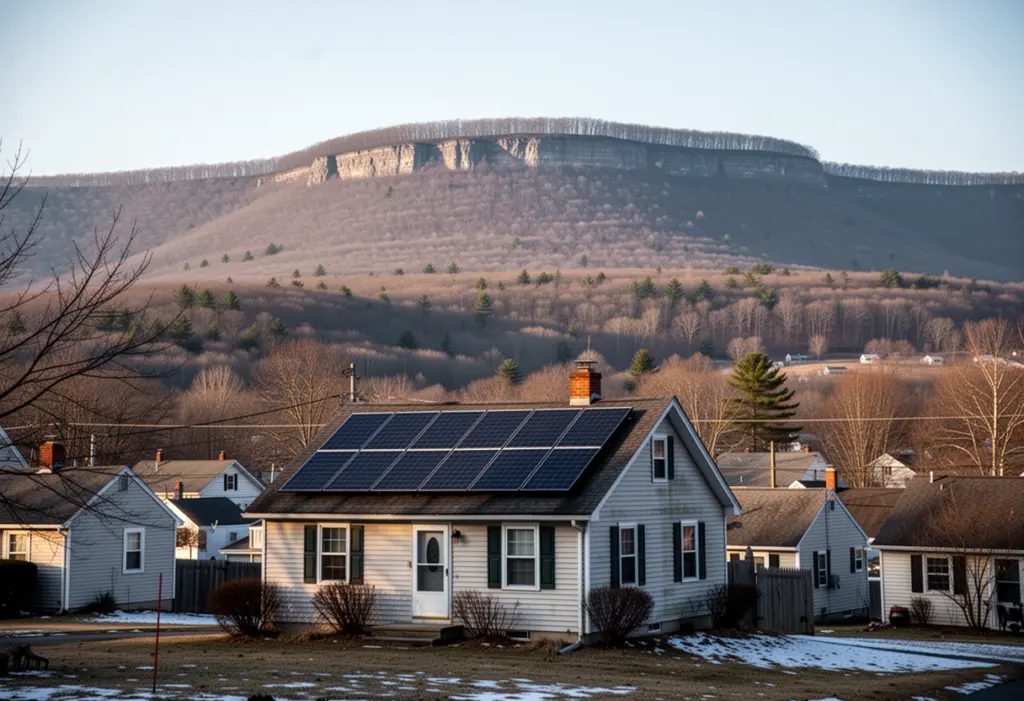
Ellenville is a village in the Town of Wawarsing, in south-western Ulster County. ZIP code 12428. It sits on the floor of the Rondout Valley with the Shawangunk Ridge rising steeply to the east and the Catskill foothills across the valley to the west, and that is the first thing an installer should be talking about.
High ground on both sides shortens the day
A ridge does not shade a roof the way a tree does. It removes the beginning and the end of the solar day, every day, and it does the most damage in December when the sun never climbs far above it.
Three questions that follow, and none of them can be answered from a satellite image:
- What does the production model assume for December and January rather than for the year as a whole? That is the period when the net metering credit bank is being drawn down, and an annual figure hides a valley winter completely.
- Was there an on-site horizon assessment? Insist on one. Where two quotes for the same roof differ sharply on production, the usual explanation is that one installer never visited.
- Does the south-facing horizon clear the ridge line? On some parcels the answer is that the roof is simply the wrong place, and that is worth knowing before a design is drawn rather than after.
Where the roof does not work, a ground mount on an open part of the parcel lets tilt and orientation be chosen instead of inherited, and takes the roof’s age out of the decision entirely. The other route is dealt with at the end of this page.
Village or town
The Village of Ellenville and the Town of Wawarsing are separate authorities with their own building departments, and the village sits inside the town. Establish which covers your address before an installer files anything, because a permit lodged with the wrong department is time lost rather than a small correction. Older village streets can also carry protected character, in which case review comes before the permit and a rear plane with all-black flush-mounted modules is what typically gets approved.
Older village housing: two checks
Roof age. A shingle roof with under about ten years left in it wants replacing before the array goes on rather than after: taking a system down and refitting it is far dearer than mounting it once.
Service capacity. Older village housing here runs to 100 amp service, which frequently will not take a solar breaker without a panel upgrade or a line-side tap. Ask for the rating, ask for a look at the busbar, and have the answer costed inside the contract price.
Both slate and standing-seam metal turn up on older roofs in the village. Seamed metal is the easiest surface in this valley by some distance, since racking clamps on and nothing is drilled. Slate is the opposite, and the only useful test of an installer is photographs of slate work they have actually finished.
Central Hudson, and the charge that follows the system size
The Customer Benefit Contribution is a monthly charge on the DC size of the system for anyone interconnecting on or after 1 January 2022. Central Hudson’s 2026 residential rate is $1.67 per kW-month, the highest residential rate of any utility in the state:
- A 6 kW system: $10.02 a month, about $120 a year.
- An 11 kW system: $18.37 a month, about $220 a year.
Charged on capacity regardless of production, and recalculated annually. Parts of this region are NYSEG at $1.19 instead, where that same 11 kW system pays $13.09 a month, about $157 a year. Confirm the name printed on your own bill. Should it name neither company, check whether you are on a municipal electric system: roughly fifty exist across New York, none of them under Public Service Commission jurisdiction, and their customers fall outside state net metering, outside this charge and outside the standardised interconnection process, with terms set by the utility itself. On the credit side, a system interconnecting now takes Phase One net metering, which values exported kilowatt-hours at the full retail rate and keeps that arrangement for 20 years.
2026 incentives
Nothing federal is left for a buyer. Section 25D closed to expenditures made after 31 December 2025, and what fixes the date of an expenditure is the day the original installation is completed. There is no phase-down and no transitional rule, so strike a 30% federal line off any 2026 proposal that still carries one.
The rest of the list assumes you own a roof the sun can reach, which on this valley floor is exactly what cannot be assumed. So take the one that does not: community solar. You subscribe to a share of an off-site array and the credits land on your own electricity bill, which means no roof, no south-facing horizon, no clearing, no equipment on the house and nothing paid up front. Because community solar is a front-of-the-meter project, subscribers pay no Customer Benefit Contribution at all — the entire charge set out above simply does not arise. For a parcel boxed in by the ridge, for a rented apartment or for anyone who does not want a 20-year commitment attached to the building, it is the honest first option rather than the consolation prize.
If the roof does work, an owner has the state credit on Form IT-255: a quarter of qualified expenditure to a $5,000 ceiling, principal residence only, good on a purchase and equally on a lease or power purchase agreement of ten years or more, and never larger than the state tax you owe that year. Then the state sales tax exemption, and RPTL 487’s 15 years of exemption on the added value, which the village, the town, Ulster County and your school district can each refuse independently. Ask those four separately, and read every programme’s current terms from NYSERDA and the NY Department of Taxation and Finance before signing. What an older proposal may still show, NY-Sun through the contractor and its Affordable Solar incentive at or below 80% of area median income, is not available. As of September 2026 NYSERDA has no open NY-Sun block for homes in any utility territory; check NYSERDA’s NY-Sun dashboard for a new one.
Frequently Asked Questions
Does the Shawangunk Ridge affect solar in Ellenville?
Yes. A ridge removes the beginning and end of the solar day rather than casting a moving shadow, and it does the most damage in December. Ask for an on-site horizon assessment and for what the model assumes about December and January, not only the annual total.
Who issues my permit, the village or the town?
The Village of Ellenville and the Town of Wawarsing are separate authorities with their own building departments, and the village sits inside the town. Establish which covers your address before anything is filed.
What if the roof does not work?
Community solar is the route that needs no roof, no south-facing horizon and nothing paid up front, and because it is a front-of-the-meter project its subscribers pay no Customer Benefit Contribution. On a parcel with open land, a ground mount is the other option.
What does Central Hudson charge here?
The Customer Benefit Contribution at $1.67 per kW-month of DC system size for 2026, the highest residential rate in New York. About $120 a year on 6 kW and $220 on 11 kW. Parts of the area are NYSEG at $1.19, so check your bill.
This article is general information, not tax, legal or financial advice. Incentive amounts, eligibility rules and deadlines change and depend on your utility, your tax situation and your property. Confirm current terms with NYSERDA, your utility and a qualified tax professional before making a decision.
NY Solar Incentives
Independent New York solar research. We summarise NYSERDA, NY-Sun and federal programme rules from published sources and state plainly when a figure is an estimate. We are not a government agency and do not sell equipment.
Run the arithmetic on your own system
Check the dated program table and your arrangement before counting an incentive. Standard residential NY-Sun blocks are closed; Long Island Affordable Solar has a conditional income-verification route. The NY credit depends on qualified costs and tax liability, while the NYC abatement reduces future property-tax bills. The estimator keeps those timings separate.