Solar Incentives in Smithtown, NY
The federal credit has gone, so what is left in Smithtown is a state credit with a residency test and two programmes your contractor applies for you.
On this page 8 sections
- 01The federal credit is gone. Start there.
- 02New York’s credit, and the test that catches people here
- 03NY-Sun and Affordable Solar: no open block for homes
- 04Three villages, three building departments
- 05What PSEG Long Island charges
- 06What no incentive covers
- 07The property tax exemption, and the layer people forget
- 08Frequently Asked Questions
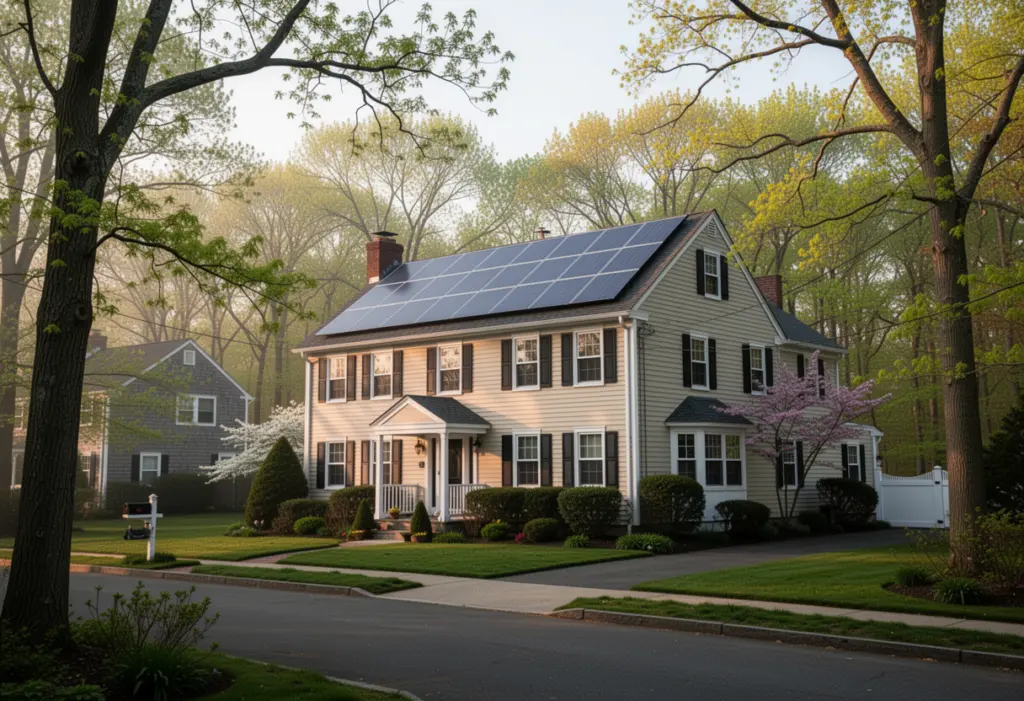
Smithtown is a town in Suffolk County on the north shore, running from Commack and Nesconset up to the Long Island Sound. ZIP codes include 11787, 11780, 11754, 11767 and 11725. The incentive position here changed sharply at the end of 2025, and the practical question now is which of the remaining programmes you actually qualify for.
The federal credit is gone. Start there.
The 30% federal residential credit no longer exists. Section 25D closed to expenditures made after 31 December 2025, and the statute dates an expenditure to the completion of the original installation. A homeowner buying a system in 2026 claims nothing federally.
This matters immediately when you compare quotes. A proposal that still shows a 30% federal line is materially wrong, and a payback figure built on it is wrong by roughly that amount. Ask for the arithmetic again without it.
New York’s credit, and the test that catches people here
New York still offers a 25% credit on Form IT-255, capped at $5,000. Three conditions decide whether it reaches you:
- It must be your principal residence in New York. A seasonal, second or rental property does not qualify. On the shoreline in Nissequogue and Head of the Harbor that is worth establishing before a proposal is designed around the credit.
- It is limited by your actual New York State tax liability. The credit is only worth what you owe the state, though it is not lost if your liability falls short — unused amounts carry forward up to five years.
- It reaches leases and power purchase agreements of ten years or more as well as outright purchases. The ten-year minimum applies to the lease as well as to the PPA, so a five or seven year lease does not qualify.
The $5,000 ceiling is a ceiling, not a rate. On a large Smithtown house with a correspondingly large array, the credit covers a smaller share of the total than the headline 25% suggests.
NY-Sun and Affordable Solar: no open block for homes
NY-Sun was applied by the contractor as a reduction on the price rather than claimed by you on a form. On Long Island there is nothing left to apply: PSEG Long Island’s last residential NY-Sun block closed on 17 April 2016. As of September 2026 NYSERDA has no open NY-Sun block for homes in any utility territory; check NYSERDA’s NY-Sun dashboard for a new one.
Affordable Solar, the NYSERDA incentive for lower-income households, is not available either: NYSERDA’s Long Island block chart lists no Affordable Solar block for homes, and the ones it ran for the Con Edison and Upstate regions closed on 15 October 2025 and 9 March 2026. If a quote shows an NY-Sun or Affordable Solar reduction, ask which open block it comes from.
New York also exempts residential solar equipment from state sales tax, and localities may separately elect to exempt their local share.
Three villages, three building departments
Suffolk towns are large and each issues its own permits. Smithtown contains three incorporated villages that do their own: Head of the Harbor, Nissequogue and the Village of the Branch. Establish which authority covers your address before an installer files anything.
The two shoreline villages are low-density with heavy mature canopy and considerable historic character, and architectural review can apply ahead of the building permit, capable of restricting street-visible placement. Where it does, a rear or secondary roof plane with all-black flush-mounted modules and concealed conduit is what typically gets approved.
What PSEG Long Island charges
Anything interconnected on or after 1 January 2022 picks up the Customer Benefit Contribution — a fixed monthly amount for each kilowatt of installed DC capacity, unrelated to how much the array actually generates. PSEG Long Island’s residential figure for 2026 is $1.13:
- A 7 kW system: $7.91 a month, about $95 a year.
- A 10 kW system: $11.30 a month, about $136 a year.
The rate is reset annually rather than fixed at interconnection. Exports are credited at the full retail rate under Phase One net metering, a structure that holds for 20 years, and community solar subscribers pay none of the contribution at all.
Read the utility name off your own bill. PSEG Long Island serves most of Suffolk, but the two recorded exceptions — the Village of Greenport and Fishers Island — run their own municipal electric utilities, and their customers sit outside Public Service Commission jurisdiction entirely.
What no incentive covers
Three costs are yours regardless. Roof age — under roughly ten years of shingle life left means re-roof first, because removing and reinstalling an array later costs considerably more than mounting on a bare roof. Service capacity — post-war housing in Commack and Nesconset frequently has 100 amp service, and fitting a solar breaker can require an upgrade or a line-side tap. And coastal specification near the Sound, where wind load and salt-rated hardware both matter.
The property tax exemption, and the layer people forget
RPTL 487 gives a 15-year exemption on the value the system adds to your assessment. It is available only where the municipality, the county and the school district have each not opted out — three independent decisions, taken by three bodies that do not coordinate and do not report each other’s answers.
The one that gets skipped is the third, and it is the one that usually matters most, because the school levy is billed as its own line and decided by its own body. The municipality and the county opt out by local law; a school district opts out by its own resolution, which is a different instrument and a different meeting. There is no shortcut here: outside the five fiscally dependent Big Five city districts, which levy no separate property tax at all, you have to ask the district that actually bills your parcel.
In Smithtown that means checking the Town of Smithtown or your village, then Suffolk County, then your school district — Smithtown Central, Kings Park Central and Commack Union Free all serve parts of the town, and they are independent bodies with independent answers. Two houses on opposite sides of a district line can land differently. Ask your assessor rather than your installer, and note that section 487 also requires construction before 1 January 2030.
None of this is fixed. The programmes are amended from time to time and the contribution rate is republished annually, so take the current position from NYSERDA and from the New York State Department of Taxation and Finance rather than from a proposal, before you sign.
Frequently Asked Questions
What solar incentives are still available in Smithtown in 2026?
New York's 25% credit capped at $5,000 on Form IT-255, the state sales tax exemption, and RPTL 487's 15-year property tax exemption. NY-Sun has no open block for homes, and the 30% federal residential credit ended for expenditures made after 31 December 2025.
Does a second home on the harbour qualify for the state credit?
No. Form IT-255 requires the system to be installed and used at your principal residence in New York. A seasonal, second or rental property does not qualify, so establish that before a proposal is designed around the credit.
How do I check the property tax exemption in Smithtown?
Three separate checks: the Town of Smithtown or your village, Suffolk County, and your school district — Smithtown Central, Kings Park Central and Commack Union Free all serve parts of the town. Each can opt out independently, so ask your assessor.
What does PSEG Long Island charge a Smithtown solar customer?
The Customer Benefit Contribution at $1.13 per kW-month of DC system size for 2026 — about $95 a year on a 7 kW system and $136 on 10 kW. Community solar subscribers pay none of it.
This article is general information, not tax, legal or financial advice. Incentive amounts, eligibility rules and deadlines change and depend on your utility, your tax situation and your property. Confirm current terms with NYSERDA, your utility and a qualified tax professional before making a decision.
NY Solar Incentives
Independent New York solar research. We summarise NYSERDA, NY-Sun and federal programme rules from published sources and state plainly when a figure is an estimate. We are not a government agency and do not sell equipment.
Run the arithmetic on your own system
Check the dated program table and your arrangement before counting an incentive. Standard residential NY-Sun blocks are closed; Long Island Affordable Solar has a conditional income-verification route. The NY credit depends on qualified costs and tax liability, while the NYC abatement reduces future property-tax bills. The estimator keeps those timings separate.