Solar Panel Installation in Commack, New York
Commack sits across a town line, so the first question about a solar project here is not about panels at all — it is about which building department your address answers to.
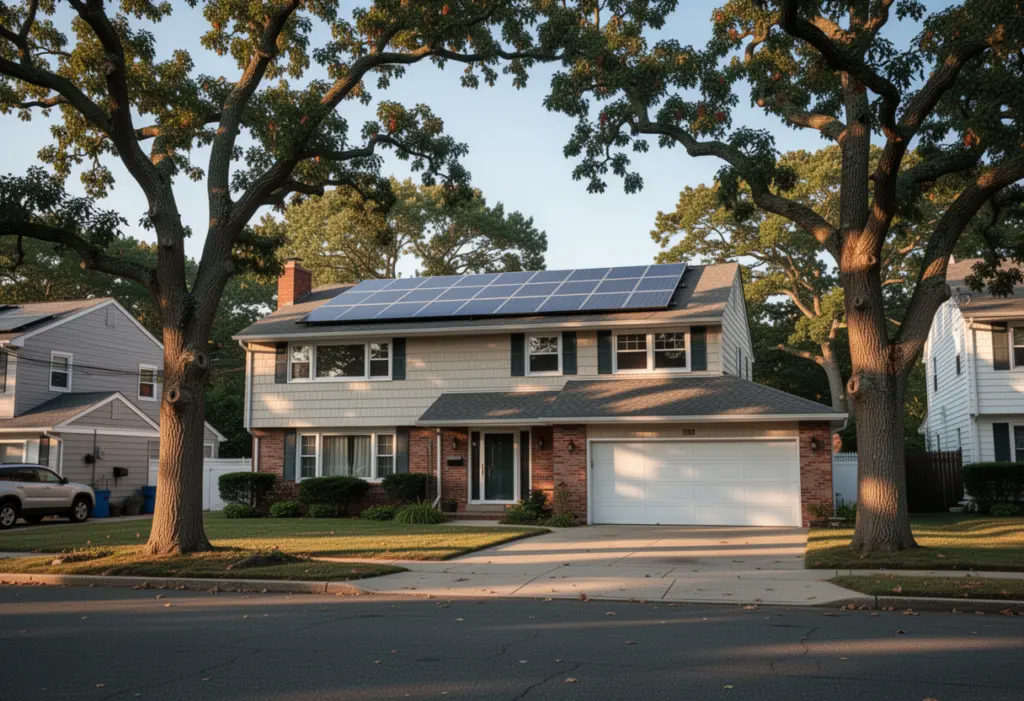
Commack is a hamlet rather than a village, and it lies across the boundary between the Town of Huntington and the Town of Smithtown. There is no village hall to go to, and which of the two towns issues your permit depends on which side of that line the house sits. That is the first thing to settle, because the fee schedule, the review time and the inspection sequence all follow from it — and an installer who has to find out mid-project has already told you something about how carefully the rest was checked.
The utility question is simpler, and the charge is not
Most of Suffolk County, Commack included, is served by PSEG Long Island, which operates the LIPA system — though service territory does not follow town or county lines cleanly, so read the name printed on your own bill rather than assuming it. Two things follow that many Long Island proposals leave out.
First, the Customer Benefit Contribution is charged monthly on the DC size of the array regardless of production, on systems interconnected on or after 1 January 2022. At the 2026 residential rate of $1.13 per kW-month, an 11 kW array pays 11 x $1.13 = $12.43 a month, roughly $149 a year, every year the system stays connected. The rates are recalculated annually and are not fixed at interconnection.
Second, mass-market residential projects here run on Phase One net metering, which credits exports at the full retail rate and holds that structure for 20 years from interconnection. The Value Stack is not the mass-market residential mechanism on Long Island, so a proposal that describes your exports in Value Stack terms is describing something else.
A small number of Long Island communities are served by their own municipal electric utility rather than by PSEG Long Island, and a municipal customer sits outside Public Service Commission jurisdiction: no state net metering rules, no capacity charge, no state interconnection process. The name printed on your own bill settles which world you are in.
Wind load is a real engineering item here
Long Island roofs are designed for coastal wind, and a solar array changes the uplift picture. Ask, in writing, what design wind speed the racking and attachment layout was engineered to, how many attachment points the layout uses, and who stamps the structural calculation. This is not paperwork for its own sake — the attachment pattern is what carries the uplift load, so ask for the stamped drawing and count the attachment points on the finished array against it.
What the housing stock does to the design
Much of Commack was built in the postwar decades, and the typical roof reflects it:
- Split levels and ranches give you several small planes rather than one large one. Fewer modules fit per plane, more racking and flashing is needed per kilowatt, and microinverters or optimisers become more attractive than a single string. Ask for the layout drawing, not just the total.
- Shingle age. A roof approaching the end of its life should be replaced first. Removing and reinstalling an array later is a real cost, and worth getting in writing before you decide.
- Electrical service. Older sections still carry modest service capacity, and a solar breaker alongside an electric vehicle charger may not fit. Establish the service rating and any upgrade cost before the array is sized.
- Oaks and pines. Mature canopy takes the low winter sun. Ask for an on-site shade assessment rather than a satellite estimate, and ask how twenty years of growth was treated.
The 11725 postal area is the one most Commack addresses use, and it does not follow the town line, which is exactly why it cannot answer the permit question at the top of this page.
Property tax, and who has opted out
RPTL 487 exempts the added value of a solar system from property tax for 15 years, where the taxing bodies have not opted out — and the opt-out belongs separately to a county, city, town or village by local law and to a school district by resolution. Here that means your town, Suffolk County, and the school district that appears on your tax bill: three separate enquiries, and the answer can differ between two houses a few streets apart if they sit in different towns. Construction has to take place before 1 January 2030.
What a 2026 quote should look like
It should contain no federal credit line. Section 25D was terminated for expenditures made after 31 December 2025, with an expenditure treated as made when the original installation is completed, so a Commack homeowner buying this year claims nothing federally and any 30% line makes every payback figure in the document wrong.
It should contain no NY-Sun reduction either. NYSERDA’s last residential block on Long Island closed in April 2016, and as of September 2026 NYSERDA has no open NY-Sun block for homes in any utility territory; check NYSERDA’s NY-Sun dashboard for a new one. It should reflect the state sales tax exemption. And it should treat the 25% state credit capped at $5,000 on Form IT-255 accurately: it requires your principal residence in New York, it is not refundable, and it is limited by the state tax you owe, carrying forward up to five years. If the offer is a lease or a PPA, that credit still reaches you where the agreement runs ten years or more. Confirm the NY-Sun position with NYSERDA and the credit rules with the Department of Taxation and Finance before signing anything.
Frequently Asked Questions
Which building department issues a solar permit in Commack?
It depends on the address. Commack is a hamlet with no village government and it straddles the Town of Huntington and the Town of Smithtown, so the permit comes from whichever town the property sits in.
What does the capacity charge cost in Commack?
PSEG Long Island customers pay the 2026 residential rate of $1.13 per kW-month on DC size regardless of production, so an 11 kW array pays 11 x $1.13 = $12.43 a month, roughly $149 a year.
Do I get net metering or the Value Stack here?
Mass-market residential projects run on Phase One net metering, which credits exports at the full retail rate for 20 years from interconnection. A proposal describing your exports in Value Stack terms is describing something else.
What should I ask about wind load?
Ask what design wind speed the racking and attachment layout was engineered to, how many attachment points the layout uses, and who stamps the structural calculation. Then check the finished array against the stamped drawing.
This article is general information, not tax, legal or financial advice. Incentive amounts, eligibility rules and deadlines change and depend on your utility, your tax situation and your property. Confirm current terms with NYSERDA, your utility and a qualified tax professional before making a decision.
NY Solar Incentives
Independent New York solar research. We summarise NYSERDA, NY-Sun and federal programme rules from published sources and state plainly when a figure is an estimate. We are not a government agency and do not sell equipment.
Run the arithmetic on your own system
Check the dated program table and your arrangement before counting an incentive. Standard residential NY-Sun blocks are closed; Long Island Affordable Solar has a conditional income-verification route. The NY credit depends on qualified costs and tax liability, while the NYC abatement reduces future property-tax bills. The estimator keeps those timings separate.