Solar Panel Installation in Pawling, NY
Pawling is a village inside a town in the Harlem Valley, with wetlands on the valley floor and ridges on both sides. All three change a solar design.
On this page 9 sections
- 01Village or town
- 02Wetlands on the valley floor
- 03Ground mounts, and the questions that decide their price
- 04The ridges, and where the winter day starts and ends
- 05Barns, outbuildings and the meter question
- 06Older farmhouse roofs and 100 amp service
- 07What the utility charges
- 082026 incentives: on a large array, the cap is what binds
- 09Frequently Asked Questions
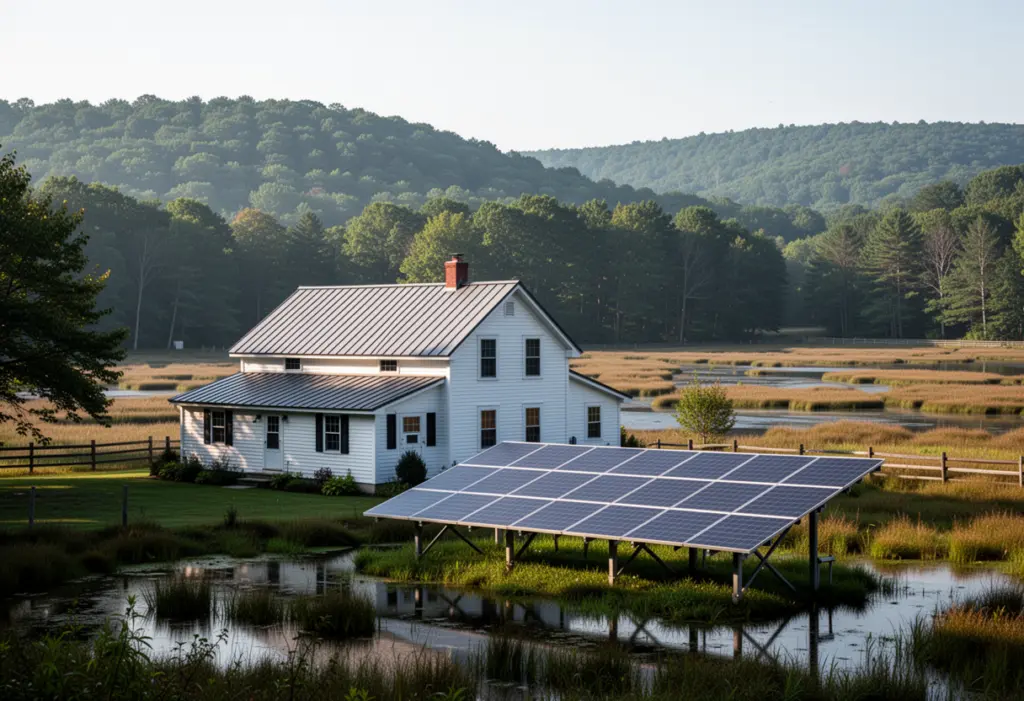
Pawling is a village inside the Town of Pawling, in eastern Dutchess County, in the Harlem Valley between two ridges. ZIP code 12564; the hamlet of Holmes to the north is 12531. Village lots and rural acreage sit within a few miles of one another here, and they are effectively two different solar projects.
Village or town
The Village of Pawling and the Town of Pawling are separate authorities with their own building departments. Work out which covers your address before an installer files anything — the two departments set their own fees, their own inspection slots and their own turnaround, and a file lodged in the wrong one simply starts again in the other.
The older village streets carry historic character, and where architectural review applies it comes before the building permit. Design for approval rather than arguing after a refusal: nothing on a street-facing plane, black frames rather than silver, flat to the pitch rather than tilted, conduit out of sight.
Wetlands on the valley floor
The Great Swamp runs along the valley here, and wetland and buffer areas are a genuine constraint on rural parcels. The right move is not to guess: establish before a design is drawn whether any part of the proposed work touches a mapped wetland or its buffer, and which agencies have a say.
It matters for anything that breaks ground — a ground mount and its foundations, a trench for the conductor run, or an access track for machinery — far more than for a roof array on an existing house.
Ground mounts, and the questions that decide their price
On rural acreage a ground mount is a genuine option rather than a fallback. Orientation and tilt are chosen rather than inherited, the roof-age question disappears entirely, and maintenance and snow clearing happen at ground level. Ask for it to be quoted alongside a roof option, and ask about:
- Setbacks and site plan review, which differ between the village and the town.
- Foundation depth below the frost line, and what the ground conditions on your parcel actually are.
- Clearance beneath the lowest row. An array set too low is buried by drifted snow for weeks.
- Trench length back to the house, which is priced by the foot and can change the wire size. A cheaper array at the end of a long run is not necessarily the cheaper project.
The ridges, and where the winter day starts and ends
A valley with high ground on both sides raises the horizon at both ends of the day, and the effect is worst in December and January — precisely when the net metering credit bank is being drawn down. A model built from imagery will not see either ridge properly, so ask for the survey to be taken on the parcel, and ask for those two months to be reported on their own rather than folded into an annual figure.
Barns, outbuildings and the meter question
This is the rural detail that catches people out. A system offsets only the meter it is connected behind. A barn, a workshop or a second dwelling on the same property may sit on its own meter and its own account, in which case an array on the barn roof does not reduce the house bill.
Before a design is drawn, establish how many meters and accounts the property has and which one the array will be connected behind. Where a barn roof is the better surface but the house holds the load, that is a question to put to the installer and to the utility early rather than after interconnection.
Older farmhouse roofs and 100 amp service
A standing-seam metal roof is the easiest surface on this list. Clamps grip the seams, so nothing is drilled through the covering at all, and the roof itself will usually still be there after the modules have been retired. Slate is the hard case and not every installer is set up for it, so ask which of the two your building has and what work they have done on that specific covering.
On asphalt, under about ten years of remaining life means the roof goes first. Older framing draws a structural engineer’s letter more often than modern engineered trusses, and a 100 amp panel is common in houses of this age, where a solar breaker with no busbar room means an upgrade or a line-side tap. Both are legitimate numbers and both belong in the contract price rather than in a variation.
What the utility charges
Size matters here for a reason that has nothing to do with the panels. The Customer Benefit Contribution, which has applied to everything interconnected from 1 January 2022 onward, is calculated per kilowatt of installed DC capacity — and most of Dutchess County sits in Central Hudson territory, where the 2026 residential figure of $1.67 is the highest in New York:
- A 9.5 kW roof array: $15.87 a month, about $190 a year.
- A 15 kW ground mount, a realistic size on rural acreage: $25.05 a month, about $301 a year.
The boundaries in this part of the valley do not follow municipal lines, and NYSEG serves parts of the Hudson Valley at $1.19, where that 15 kW array would pay $17.85 a month, about $214 a year. Take the utility name from your own bill. Because the charge follows capacity and not output, and is reset annually rather than fixed at interconnection, an oversized ground mount bills you every month for capacity you never use.
Whatever the array sends back is a separate matter. Phase One net metering pays the full retail rate for it, on terms locked for two decades from the day of interconnection.
2026 incentives: on a large array, the cap is what binds
Nothing federal survives for a homeowner buying in 2026. Section 25D was terminated for expenditures made after 31 December 2025, an expenditure counting as made when the original installation is completed, and there is no phase-down and no carryover behind it. Strike that line out of any proposal that still shows it.
The number to hold on to when a ground mount is on the table is $5,000. New York’s credit is 25% of qualified expenditure capped at that figure, and on the larger systems rural acreage makes possible the cap binds long before the percentage does. Once a project passes roughly $20,000 of qualified expenditure, every additional dollar spent attracts no further state credit at all — so a proposal that presents 25% of the whole project as a state benefit is overstating it, and the overstatement grows with the size of the array. Ask for the credit line to be recalculated against the cap before you compare two quotes of different sizes.
Two further limits apply. The credit is available only for your principal residence in New York, and it is limited by your actual state tax liability, though it is not refundable and unused amounts carry forward up to five years. It also reaches leases and power purchase agreements of ten years or more, with that ten-year minimum applying to the lease as much as to the PPA.
Two other things survive alongside it; NY-Sun and its Affordable Solar incentive do not, because NYSERDA’s last standard Upstate residential block for Central Hudson and Orange & Rockland customers (Block 13, $0.15/W) closed on 4 August 2025; the last for NYSEG, RG&E and National Grid customers (Block 14, $0.15/W) closed on 17 December 2025 and the Upstate Affordable Solar block on 9 March 2026. As of September 2026 NYSERDA has no open NY-Sun block for homes in any utility territory; check NYSERDA’s NY-Sun dashboard for a new one. The state sales tax exemption covers the installation as well as the equipment, so on a large ground mount it is worth more simply because the project is larger. And RPTL 487 holds the added assessed value out of your rates for fifteen years, provided the village or town, Dutchess County and your school district have each separately declined to opt out and the system is constructed before 1 January 2030. None of these figures is permanent; check them against NYSERDA before you commit.
Frequently Asked Questions
Village or Town of Pawling — who issues the permit?
They are separate authorities with their own building departments, and setbacks and site plan requirements for a ground mount differ between them. Establish which covers your address before an installer files anything.
Do the Great Swamp wetlands stop a ground mount?
Not necessarily, but they have to be settled first. Establish before a design is drawn whether any part of the work touches a mapped wetland or its buffer and which agencies have a say. It matters far more for foundations and trenching than for a roof array.
Will panels on my barn reduce the house electric bill?
Only if the barn is connected behind the same meter. A system offsets only the meter it sits behind, so establish how many meters and accounts the property has, and which one the array connects to, before a design is drawn.
What does Central Hudson charge on a rural ground mount?
The Customer Benefit Contribution at $1.67 per kW-month of DC size for 2026, the highest residential rate in New York — about $301 a year on a 15 kW array, billed on capacity regardless of what it produces.
This article is general information, not tax, legal or financial advice. Incentive amounts, eligibility rules and deadlines change and depend on your utility, your tax situation and your property. Confirm current terms with NYSERDA, your utility and a qualified tax professional before making a decision.
NY Solar Incentives
Independent New York solar research. We summarise NYSERDA, NY-Sun and federal programme rules from published sources and state plainly when a figure is an estimate. We are not a government agency and do not sell equipment.
Run the arithmetic on your own system
Check the dated program table and your arrangement before counting an incentive. Standard residential NY-Sun blocks are closed; Long Island Affordable Solar has a conditional income-verification route. The NY credit depends on qualified costs and tax liability, while the NYC abatement reduces future property-tax bills. The estimator keeps those timings separate.